
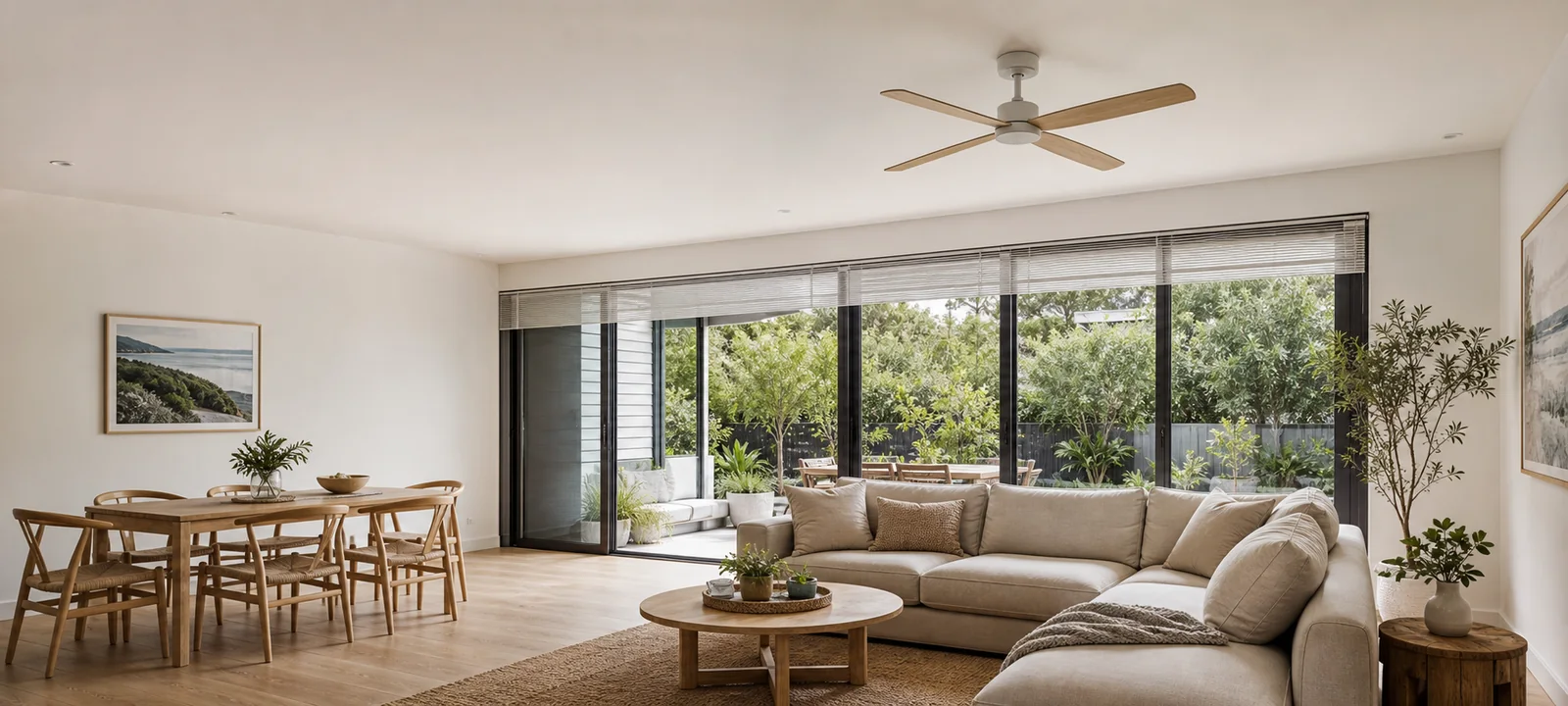
A ceiling fan can fit the ceiling and still be wrong for the room.
The blades may sit too close to a wall, the airflow may miss the bed or seating area, the motor may be distracting at night, or the controls may depend on a remote that is difficult to replace.
Installation can create further surprises. Replacing a light with a fan requires more than attaching a heavier fitting to the same position. The ceiling must provide suitable structural support, blade clearances must be safe and the electrical work must be completed by a licensed electrician.
A ceiling fan also does not cool a room in the same way as an air conditioner. It moves air across people, improving how warm conditions feel while someone is within the airflow.
This guide explains what to measure and compare before choosing a fan.
Our Take
Choose the location before choosing the fan.
Start with where people sit, sleep or work. Then check ceiling height, blade sweep, nearby walls, lights, furniture and the structure above.
The widest fan that fits is not automatically the right one, and the number of blades does not determine performance by itself.
A suitable fan should provide useful air movement where it is needed, operate at an acceptable noise level and be maintainable after installation.
A ceiling fan cools people, not the room
A ceiling fan creates air movement.
That moving air can improve comfort by helping heat leave the body more effectively. The effect is felt while a person is within the airflow.
A fan does not refrigerate the air or remove heat from the room.
This means:
- the fan should be positioned over or near occupied areas
- a fan in an empty room provides little cooling benefit
- airflow that misses the occupants may feel ineffective
- closing the room is not always necessary when outdoor conditions allow natural ventilation
- the fan can complement air conditioning but does not replace it in every climate or condition
Turn the fan off when the room is unoccupied unless it is being used for a specific approved purpose such as air circulation required by another system.
Running a fan in an empty room does not store cooling for later.
Ceiling fan options at a glance
Swipe sideways to compare the full table.
| Feature | Main options | What to check |
|---|---|---|
| Motor type | AC or DC | Controls, speeds, noise, replacement parts and power use |
| Blade span | Compact to extra-large | Room dimensions, occupied zone and wall clearance |
| Mounting | Standard, close-to-ceiling or drop rod | Ceiling height, slope, structure and blade height |
| Controls | Wall switch, pull cord, remote, app or automation | Everyday convenience and replacement availability |
| Direction | Summer only or reversible | Whether winter air circulation is useful |
| Lighting | No light, replaceable globe or integrated LED | Light output, colour, dimming and serviceability |
| Location rating | Indoor, covered outdoor or other specified exposure | Moisture, wind, salt and manufacturer restrictions |
| Blade material | Timber-look, engineered material, metal or composite | Weight, moisture resistance, noise and maintenance |
| Installation | New position or replacement | Structural support, wiring, ceiling access and licensed work |
Start with the occupied area
Measure the room, but also identify where the airflow needs to reach.
In a bedroom, this will usually be the bed.
In a living room, it may be:
- the sofa
- a group of chairs
- a dining table
- an open-plan sitting zone
In a home office, it may be the desk rather than the entire room.
Draw a simple floor plan showing:
- room length and width
- ceiling height
- bed or seating position
- wall cabinets
- wardrobes
- pendant lights
- downlights
- air-conditioning outlets
- smoke alarms
- beams
- sloping ceilings
- door swings
- tall furniture
- the proposed fan centre
A fan positioned at the geometric centre of a large room may not be centred over the people using it.
Blade span is not the only sizing decision
Blade span is the diameter created by the rotating blades.
A larger span can cover a broader area, but airflow also depends on:
- blade shape
- blade pitch
- motor
- rotation speed
- mounting height
- distance from the ceiling
- room shape
- nearby walls and beams
- the fan’s tested airflow performance
- the occupied area beneath it
Do not choose from a generic room-size chart without checking how the room is arranged.
Two rooms with the same floor area may need different solutions.
A square bedroom with one centrally positioned bed differs from a long open-plan room containing kitchen, dining and living zones.
In a long space, two appropriately positioned fans may provide better coverage than one oversized fan in the centre.
Measure the full blade sweep
The fan needs clearance for the complete rotating diameter, not just the motor housing.
Check the blade sweep against:
- walls
- beams
- bulkheads
- wardrobes
- tall cabinets
- open cupboard doors
- pendant lights
- track lighting
- high shelving
- curtains
- folding doors
- raised platforms
- bunk beds
Do not rely on a plan that shows only the mounting point.
Mark the proposed fan centre and calculate where the blade tips will travel.
A fan installed close to a wall or beam may:
- move air unevenly
- create turbulence
- produce additional noise
- look visually cramped
- fail to meet the manufacturer’s clearance instructions
Have the licensed installer confirm all required clearances before the fan is ordered.
Ceiling height and blade height
Ceiling height affects both safety and performance.
The blades must remain safely above people, furniture and activities in the room while also sitting at a height that allows useful air movement.
Low ceilings may require a close-to-ceiling or low-profile fan.
High ceilings may require an approved drop rod so the fan does not remain too far above the occupied area.
Do not select the drop-rod length from appearance alone.
The installer must consider:
- finished ceiling height
- fan body depth
- blade position
- manufacturer instructions
- current applicable electrical and installation requirements
- sloping ceilings
- furniture and room use
- the final safe blade height
Online guides publish different generic clearance figures. Do not use one number as a substitute for the fan instructions and a licensed installer’s site assessment.
Bunk beds and tall furniture
Bunk beds, loft beds and raised furniture can place a person much closer to the blade sweep than the floor measurement suggests.
Product-safety guidance has specifically warned about ceiling fans near bunk beds and other furniture that allows children or adults to reach the blades.
Do not position a fan where a person can contact it while:
- sitting or standing on a bunk
- changing bedding
- climbing on furniture
- lifting a child
- stretching from a raised platform
- carrying a long object
Consider future furniture changes as well as the current layout.
A bedroom that does not contain a bunk today may be rearranged later.
Where safe clearance cannot be maintained, use another fan location or another cooling method.
Structural support matters
A ceiling fan creates weight, rotation and vibration.
It cannot be assumed that a ceiling point originally intended for a light fitting is suitable for a fan.
The mounting must be supported by an appropriate structural element or fan-rated mounting system.
The licensed electrician may need to assess:
- ceiling framing
- joists or trusses
- mounting brackets
- an existing electrical box
- plasterboard thickness
- ceiling access
- vibration
- the fan’s assembled weight
- sloping-ceiling hardware
- whether additional support is required
Do not buy the fan on the assumption that replacing an existing light will be a simple direct swap.
A visually intact ceiling does not confirm that suitable support exists above it.
Fixed electrical installation is not DIY work
A hard-wired ceiling fan must be installed by a licensed electrician in accordance with the requirements that apply in the relevant state or territory.
This includes replacement work where wiring is disconnected and reconnected.
Do not:
- remove an existing fixed light fitting
- connect the fan to fixed wiring
- alter wall switches
- add a receiver in the ceiling
- extend cables
- install a new circuit
- modify a safety switch
- conceal electrical joints
Ask the electrician what electrical certificate or compliance documentation applies in your jurisdiction.
Keep that documentation with the fan invoice and warranty information.
AC and DC motors
Residential ceiling fans commonly use AC or DC motors.
AC motor fans
AC fans often use:
- a stepped wall controller
- a pull cord
- a remote receiver
- relatively simple control arrangements
Possible advantages include straightforward controls and easier compatibility with some conventional wall-switch arrangements.
DC motor fans
DC fans commonly offer:
- more speed settings
- low-speed operation
- remote controls
- electronic reversing
- timers
- lower power use in many models
- compact motor housings
However, motor type alone does not determine:
- airflow
- noise
- build quality
- blade balance
- reliability
- suitability for a large room
- remote-control quality
- replacement-part availability
A DC fan with poor blade design may move less useful air than a well-designed AC model.
Compare the complete fan rather than choosing from the motor label alone.
Power use and airflow
Ceiling fans generally use much less electricity than refrigerated air conditioning, but consumption still varies by model and speed.
Check:
- rated power at maximum speed
- power used at lower speeds
- standby power where electronic controls remain energised
- tested airflow
- airflow per unit of power where published
- whether the figures include an integrated light
- whether reverse mode changes operation
Do not compare power input without considering airflow.
A low-wattage fan that provides inadequate air movement may need to run at maximum speed while a more effective model provides the preferred comfort at a lower setting.
Avoid fixed running-cost figures unless they are calculated from the household’s current electricity tariff and the fan’s documented input.
More blades do not automatically mean more airflow
Blade count affects appearance and may influence sound or airflow characteristics, but it does not provide a reliable performance ranking by itself.
Air movement depends on the complete design, including:
- blade length
- blade width
- pitch
- profile
- material
- rotation speed
- motor
- distance from the ceiling
- room conditions
A three-blade fan is not automatically stronger than a four-blade fan.
A six-blade fan is not automatically quieter or more suitable for a bedroom.
Use tested performance information and practical noise characteristics rather than blade count as the deciding measure.
Fan speed and low-speed usefulness
Maximum airflow receives attention in product descriptions, but the lowest settings can be just as important.
For a bedroom, nursery, home office or dining area, check whether the fan provides gentle, stable airflow at low speed.
A useful low speed can:
- reduce draught discomfort
- operate more quietly
- suit sleeping
- circulate warm air in winter
- support air conditioning without excessive movement
- provide comfort during mild weather
Some fans have several nominal speed settings but very little difference between adjacent levels.
Ask whether airflow or rotation-speed figures are available for each setting.
Noise
Ceiling-fan noise may come from:
- the motor
- airflow
- blade shape
- vibration
- a remote-control receiver
- electrical control components
- loose light fittings
- ceiling resonance
- unbalanced blades
- a long drop rod
- interaction with beams or nearby walls
A quiet showroom can help reveal sound, but it may not reproduce a bedroom at night.
For bedrooms and home offices, consider:
- motor sound at low speed
- clicking or humming
- changes between speed settings
- noise from the receiver
- whether reversing requires a mechanical switch
- beep sounds from the remote
- whether beep sounds can be disabled
- light-dimming buzz
- warranty treatment for noise complaints
“Quiet” is subjective unless supported by published measurements and clear test conditions.
Wobble is not normal performance
A small amount of visible movement may occur in some installations, particularly with long drop rods, but persistent or severe wobble should be investigated.
Possible causes include:
- blades fitted in the wrong position
- loose fixings
- warped blades
- damaged blade holders
- unequal blade height
- unsuitable mounting
- ceiling movement
- installation errors
- accumulated dirt
- unbalanced accessories
Do not attempt to adjust a hard-wired or operating fan while it is energised.
If a newly installed fan wobbles, contact the installer before attaching improvised weights or changing structural components.
Stop using the fan if there is:
- sudden severe wobble
- scraping
- cracking
- loose parts
- visible blade damage
- electrical smell
- intermittent operation
- movement at the ceiling canopy
- a shock or tingle
Arrange licensed inspection or authorised service as appropriate.
Wall controls, remotes and apps
The control method affects everyday use and future maintenance.
Wall control
A fixed wall controller is difficult to misplace and may be easier for guests or tenants to understand.
Check:
- number of speeds
- whether reversing is available
- whether a separate light switch is included
- whether new wiring is required
- compatibility with the motor
- whether the controller creates audible hum
Remote control
A remote can provide:
- more speeds
- timer functions
- reverse mode
- light control
- dimming
- sleep modes
Check:
- whether the remote uses replaceable batteries
- whether a wall holder is included
- whether replacement remotes remain available
- whether pairing instructions are clear
- whether several nearby fans interfere with each other
- what happens after a power interruption
- whether the fan can operate if the remote is lost
App or smart control
App control may add scheduling or automation.
Before relying on it, check:
- whether ordinary controls still work
- Wi-Fi requirements
- account requirements
- cloud dependence
- privacy terms
- software support
- compatibility with the household platform
- what happens if the internet service is unavailable
- whether the app will remain supported through the expected life of the fan
A fixed household appliance should remain practical even when a phone is unavailable.
Summer and winter direction
Many ceiling fans include a reversing function.
In summer mode, the fan is generally configured to direct noticeable airflow towards occupants.
In winter mode, it is generally configured to circulate warmer air that has collected near the ceiling while reducing direct draughts.
The exact blade direction cannot be assumed from “clockwise” or “anticlockwise” alone because it depends on the fan design and the viewing position.
Use the labelled summer and winter setting in the manufacturer’s instructions.
Winter mode can complement heating, particularly in rooms with warm air collecting above the occupied zone.
It does not create heat and will not correct inadequate insulation, draughts or an undersized heating system.
Ceiling fans and air conditioning
A ceiling fan can complement air conditioning by distributing conditioned air through the occupied area.
This may allow the household to remain comfortable with:
- less aggressive cooling
- a higher thermostat setting
- shorter air-conditioner use
- better circulation through a large seating zone
The result depends on:
- fan position
- air-conditioner position
- room layout
- fan speed
- insulation
- shading
- doors and openings
- local humidity
Avoid positioning the fan so its airflow works against the air conditioner’s intended distribution.
The fan should help mix and move conditioned air rather than leave one part of the room draughty and another stagnant.
Fans and natural ventilation
Ceiling fans can supplement natural breezes during still periods.
They do not bring fresh air into the home unless windows, doors or a ventilation system provide it.
In suitable outdoor conditions, fans can work with:
- cross-ventilation
- openable windows
- shaded doors
- night cooling
- high and low openings
- secure insect screens
Do not open the home automatically during:
- smoke
- extreme outdoor heat
- severe humidity
- storms
- poor air quality
- security risks
A fan moves existing indoor air. It is not a substitute for ventilation where fresh-air exchange is required.
High, raked and sloping ceilings
A high ceiling can leave a standard-mounted fan too far above the occupied area to provide useful airflow.
An approved drop rod may improve performance.
For sloping ceilings, check:
- maximum allowable ceiling angle
- whether a slope adaptor is required
- drop-rod compatibility
- blade clearance on the higher and lower sides
- canopy fit
- structural mounting
- final blade height
- movement on the drop rod
- access for future servicing
Do not assume every fan can be mounted on every rake.
The fan instructions should state the allowed slope and compatible mounting accessories.
A long drop rod may make installation, balancing and maintenance more demanding.
Low ceilings
A close-to-ceiling fan may suit a lower room, but low profile does not remove the need for safe blade height and wall clearance.
Check:
- the distance from ceiling to blade
- total depth of any light kit
- blade height above the floor
- furniture beneath
- airflow with the blades close to the ceiling
- access to reverse switches
- the manufacturer’s minimum ceiling clearance
A fan mounted too close to the ceiling may have restricted airflow, depending on its design.
Do not remove a supplied mounting component or shorten a downrod in a way not permitted by the manufacturer.
Downlights, pendants and shadow flicker
A rotating fan can pass through the light path from a downlight or pendant and create a repeated flicker or moving shadow.
Before installing, map:
- existing downlights
- pendant lights
- track lights
- skylights
- fan blade sweep
- beam direction
- the main seating or work area
Avoid placing point-source lights directly above the rotating blades.
Consider whether the fan or lighting position should change before either product is ordered.
This is particularly important in:
- home offices
- dining areas
- bedrooms
- rooms used for video calls
- spaces where visual flicker causes discomfort
Changing the lighting layout after the fan is installed may require additional electrical and ceiling work.
Fans with integrated lights
A fan light can replace a central light point, but it creates another set of buying decisions.
Check:
- light output
- beam spread
- colour temperature
- colour quality
- dimming
- compatibility with wall or remote controls
- whether the light can operate independently
- replaceable globe versus integrated LED
- replacement LED-module availability
- expected service procedure
- warranty
- whether the diffuser can be removed safely
- whether the light introduces additional depth below the fan
An integrated LED may provide a clean appearance but could require a specific replacement module or service if it fails.
Do not assume the entire fan needs replacement, or that the light is user-replaceable, without checking the design.
A single central fan light may not provide sufficient task lighting for a large room.
Bedrooms
Bedroom fans need useful low-speed airflow and acceptable night-time controls.
Check:
- position above the bed
- blade clearance from wardrobes and doors
- possible future bunk-bed placement
- motor noise
- receiver noise
- remote beep sounds
- the lowest speed
- timer options
- indicator-light brightness
- reverse control
- light colour and dimming
- whether the fan restarts after a power interruption
Directly centring the fan over the bed can improve airflow, but only where safe clearances and structure permit it.
Consider whether strong airflow over the face or body will be uncomfortable.
A wider range of low speeds can be more useful than maximum airflow in a sleeping space.
Living rooms and open-plan areas
Open-plan rooms may need more than one fan.
Identify separate occupied zones such as:
- sofa area
- dining table
- kitchen seating
- reading chair
- connected study
One very large fan may not provide even airflow to every zone, especially where the room is long, irregular or divided by beams.
Multiple fans require planning for:
- spacing between blade sweeps
- control grouping
- remote pairing
- speed synchronisation
- lighting
- visual alignment
- electrical routes
- ceiling structure
Do not place a fan over a cooking surface or where the airflow would interfere with a rangehood’s intended operation.
Home offices
A home-office fan should cool the person without disturbing work.
Check:
- airflow over the desk
- paper movement
- microphone noise
- video-call background movement
- shadow flicker
- low-speed sound
- control access
- lighting
- computer ventilation
- whether the fan conflicts with an air-conditioning outlet
Strong airflow may be unnecessary when one person occupies a small office.
A lower stable speed positioned correctly can be more useful than a high-capacity fan centred elsewhere in the room.
Covered outdoor areas
An indoor ceiling fan should not be assumed suitable for a patio, verandah or alfresco area.
Outdoor locations may expose the fan to:
- humidity
- wind
- rain blown from the side
- condensation
- dust
- insects
- salt
- temperature changes
- corrosion
- movement in the supporting structure
Check the manufacturer’s exact location rating.
Terms such as:
- indoor
- covered outdoor
- damp location
- weather-resistant
- coastal
- tropical
are not automatically interchangeable.
A covered patio can still receive wind-driven rain.
Installation must also consider the structural and wind conditions of the outdoor area.
Do not install an indoor-rated fan outside because the roof appears to provide shelter.
Coastal and tropical conditions
Salt, humidity and persistent moisture can affect:
- blade finishes
- fixings
- motor housings
- electrical components
- remote receivers
- light fittings
- mounting hardware
A “coastal-look” finish does not confirm coastal suitability.
Check whether:
- the complete fan is rated for the location
- exclusions apply near the shoreline
- corrosion is covered by warranty
- routine cleaning is required
- stainless-looking parts are actually suitable materials
- replacement fixings are available
- the installer recommends additional maintenance
In tropical homes, fan airflow may be a primary comfort strategy, making low- and medium-speed performance especially important.
Blade materials and finishes
Common blade materials include:
- timber
- plywood
- engineered wood
- metal
- moulded composite
- plastic-based materials
Material affects:
- weight
- moisture response
- maintenance
- appearance
- stiffness
- corrosion
- suitability for outdoor use
Do not assume metal blades always move more air or that timber blades are always quieter.
The blade profile, motor and complete design matter more than a broad material category.
Dark blades can show dust more readily. Light blades can show marks or insect residue.
Choose a finish that can be cleaned according to the manufacturer’s instructions.
Cleaning and maintenance
Dust accumulation can affect appearance and may contribute to imbalance.
Before cleaning:
- switch the fan off
- isolate it according to the manufacturer’s instructions
- wait until the blades stop completely
- use safe floor-based access where possible
- do not stand on furniture
- do not apply excessive pressure to blades
- do not spray liquid into the motor or controls
Check periodically for:
- loose blade screws
- cracked or warped blades
- movement at the canopy
- unusual noise
- damaged light diffusers
- corrosion
- remote-control problems
- wobble
- recall notices
Do not perform electrical repairs or dismantle the motor housing yourself.
If high access cannot be reached safely, arrange appropriate assistance.
Replacement parts and after-sales support
A ceiling fan may remain installed for many years.
Before choosing, check the availability of:
- remote controls
- receiver modules
- wall controllers
- light diffusers
- LED modules
- blades
- blade holders
- mounting components
- drop rods
- authorised service
- warranty support
A missing remote should not make the entire fan unusable.
Ask:
- whether replacement remotes can be paired
- whether the receiver is model-specific
- how long parts are expected to remain available
- whether the fan can use a wall control
- who handles installation-related faults
- who handles product faults
- whether removing the fan for service creates additional labour costs
Keep the model number, serial number, invoice, electrician details and electrical documentation.
Recalls
Ceiling fans and remote-control components have been recalled in Australia for hazards including blade failure and electrical faults.
Before installation, check the Product Safety recalls database using:
- brand
- model
- batch
- date of purchase
- remote or receiver model where relevant
If an installed fan is subject to a recall, follow the recall instructions.
Do not remove covers, disconnect wiring or dismantle the fan unless instructed and authorised to do so.
Renters, apartments and strata properties
Permanent installation may require:
- landlord approval
- body corporate or owners corporation approval
- electrical work
- access to common roof or ceiling spaces
- compliance with fire-rated construction
- restrictions on external or balcony fans
- responsibility for making good
- agreement about ownership when the tenancy ends
Renters should not replace a fixed light fitting with a fan without written approval and licensed installation.
Apartment owners should confirm whether the ceiling, roof space or supporting structure is common property.
Penetrating a fire-rated ceiling or altering common electrical systems can have consequences beyond the individual room.
What to ask the electrician
Before ordering the fan, ask the licensed electrician to confirm:
- whether the proposed location is suitable
- whether structural support exists
- whether additional framing or a fan-rated mount is required
- finished blade height
- blade clearance from walls and fittings
- whether the ceiling slope is compatible
- required drop-rod length
- whether existing wiring can support the chosen controls
- whether a new wall control needs additional cabling
- whether a remote receiver will fit safely
- whether the light circuit is separate
- whether safety-switch protection is adequate
- whether roof or ceiling access is required
- whether asbestos-containing materials may be disturbed
- whether patching or painting may be needed
- which compliance certificate will be supplied
- what work is excluded from the quote
Do not assume the electrician can resolve an unsuitable fan after it has been purchased.
What should the installation quote include?
A written quote should identify:
- number of fans
- exact locations
- new installation or replacement
- removal of existing fittings
- structural mounting work
- electrical cabling
- wall controls
- remote receivers
- switch changes
- drop rods
- slope adaptors
- ceiling access
- difficult access
- patching or making good
- testing
- balancing
- compliance documentation
- disposal of removed fittings and packaging
- workmanship warranty
Clarify whether assembly and blade balancing are included.
A low headline installation price may exclude structural work, switch changes or difficult ceiling access.
Before You Buy Checklist
Before choosing a ceiling fan, check:
- Which occupied area needs airflow?
- Is the proposed fan centre above the bed, seating or work zone?
- What are the room’s length and width?
- What is the finished ceiling height?
- Is the ceiling flat, raked or sloped?
- What is the fan’s full blade span?
- Has the complete blade sweep been marked or calculated?
- Is there safe clearance from walls and beams?
- Is there safe clearance from wardrobes and cabinets?
- Could doors open into the blade sweep?
- Are pendant lights clear of the fan?
- Will downlights create moving shadows or flicker?
- Are bunk beds, loft beds or raised furniture present?
- Could future furniture changes create a blade-contact risk?
- Does the room need one fan or several?
- Is the mounting height suitable for useful airflow?
- Is a close-to-ceiling mount required?
- Is an approved drop rod required?
- Does the fan support the ceiling angle?
- Has structural support been assessed?
- Is the existing light point fan-rated?
- Has a licensed electrician assessed the installation?
- Is an AC or DC motor more suitable for the controls required?
- Is tested airflow information available?
- Has power consumption been compared with airflow?
- Is the lowest speed gentle enough?
- Is maximum airflow adequate without being excessive?
- Is night-time noise important?
- Are remote beeps or indicator lights likely to be disruptive?
- Is wall, remote or app control preferred?
- Can the fan operate if the remote is lost?
- Are replacement remotes and receivers available?
- Does the fan include a clearly labelled reverse mode?
- Is reverse mode controlled at the wall, remote or motor?
- Is a light kit needed?
- Is the light bright enough for the room?
- Is the light dimmable?
- Is the globe or LED module replaceable?
- Does the fan suit the air-conditioner position?
- Does the fan suit the room’s natural-ventilation strategy?
- Is the fan rated for indoor or outdoor use as required?
- Can wind-driven rain reach the proposed outdoor position?
- Is coastal or tropical suitability required?
- Are corrosion exclusions understood?
- Can the blades be cleaned safely?
- Is authorised service available locally?
- Have the fan and remote been checked for recalls?
- Are landlord or strata approvals required?
- Does the quote include structural, electrical and control work?
- Will the required electrical documentation be provided?
Choose for the airflow you will actually use
A ceiling fan should not be chosen as a decorative object with a motor attached.
It must fit the room, clear the surroundings, reach the occupied zone and operate at useful speeds without creating unacceptable noise.
Measure the room and full blade sweep. Check ceiling height, structure, lights, furniture, controls, outdoor exposure and replacement-part availability.
Then have a licensed electrician confirm that the fan and proposed location can be installed safely.
A well-positioned fan can provide useful summer comfort, complement air conditioning and circulate warm air in winter. A poorly positioned fan may run above an empty part of the room while the people beneath it remain uncomfortable.
Official guidance
NSW and Queensland sources below are jurisdictional examples supporting the broader requirement to use appropriately licensed electrical workers. Check current licensing, installation and certification requirements in your own state or territory.
- Australian Government guidance on summer energy savings
- Australian Government guidance on heating and cooling
- Australian Government quick energy-saving actions
- Australian Government Your Home guidance on passive cooling
- Australian Government Your Home guidance on heating and cooling
- Australian Government Your Home guidance on passive heating
- Australian Government Your Home guidance on safety and security
- NSW Climate and Energy Action guidance on ceiling fans
- NSW Government electrical safety guidance for the home
- Queensland Electrical Safety Office guidance against do-it-yourself electrical work
- Product Safety Australia guidance on ceiling-fan injury hazards
- Product Safety Australia consumer product recalls search