
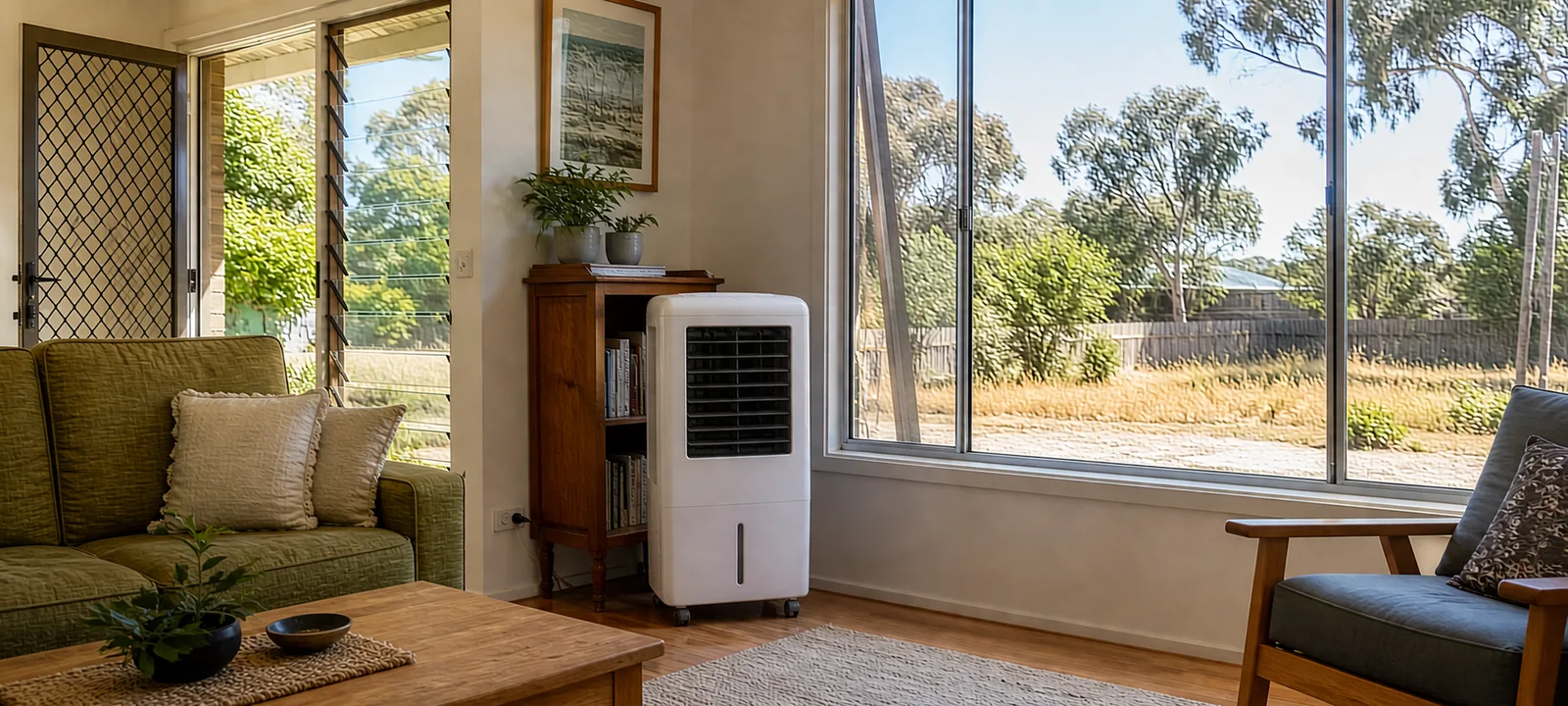
Evaporative coolers and refrigerated air conditioners can both make a room feel cooler, but they work in very different ways.
That difference matters because the weather outside can determine how well an evaporative cooler works.
Evaporative cooling is generally best suited to hot, dry conditions. Refrigerated air conditioning is much less dependent on low outdoor humidity and can both cool and remove moisture from indoor air.
If you live in a humid coastal, tropical or subtropical part of Australia, that distinction is particularly important before buying.
For the broader system, sizing and installation questions, start with the Air Conditioning Buying Guide.
How evaporative cooling works
An evaporative cooler passes warm air through or across water.
As some of the water evaporates, it absorbs heat from the air, lowering the air temperature.
The process also adds moisture to the air.
That works well when the incoming air is hot and dry because dry air has more capacity to accept additional water vapour.
Why humidity matters
Evaporation becomes less effective as the air becomes more humid.
When the incoming air already contains a lot of moisture, less additional water can evaporate, so less heat can be removed through the process.
There is no universal humidity percentage at which every evaporative cooler suddenly stops working.
Instead, performance generally declines progressively as humidity rises.
This is why evaporative cooling can make excellent sense in hot, dry inland areas while being much less effective during muggy coastal or tropical weather.
How refrigerated air conditioning is different
Refrigerated air conditioning uses a refrigeration cycle rather than water evaporation to remove heat.
Warm indoor air passes across a cold evaporator coil, and heat is transferred through the refrigeration system and released outside.
Moisture can also condense on the cold indoor coil and drain away.
That means refrigerated air conditioning can reduce both indoor temperature and humidity.
This makes it better suited to conditions where the problem is not only heat but also muggy, moisture-laden air.
For more on moisture removal, see our guide to air-conditioner dry mode and humidity.
Dry inland climates
In hot, relatively dry summers, evaporative cooling can provide useful cooling while generally using less electrical energy than a conventional refrigerated air conditioner.
Whole-home evaporative systems are therefore more common and practical in some inland Australian climates than in humid coastal regions.
However, water consumption is part of the operating equation. An evaporative system needs a continuing water supply because evaporation creates the cooling effect.
Humid coastal, tropical and subtropical climates
In humid regions, evaporative cooling faces two problems.
Higher humidity reduces how much additional water can evaporate and therefore how much cooling the system can achieve. The system then adds more moisture to the indoor air.
If the weather is already hot and muggy, that may make the result less comfortable than expected.
For coastal Queensland and other humid tropical or subtropical regions, refrigerated air conditioning is generally more practical when reliable temperature and humidity control are required.
A fan can still help with air movement and perceived comfort, but that differs from reducing the moisture content of the air. See our ceiling-fan guide if a fixed fan is part of the plan.
Evaporative systems need ventilation
Evaporative cooling continually introduces air into the building, and that air needs somewhere to leave.
Windows or doors are therefore generally left partly open so warm indoor air can escape and fresh cooled air can continue moving through the home.
Closing the home tightly can reduce the effectiveness of an evaporative system and allow humidity to build.
Refrigerated air conditioning works differently. For normal cooling, doors and windows are generally kept closed so the system is not continually trying to condition new hot outdoor air.
What about portable evaporative air coolers?
Small portable evaporative coolers are often marketed alongside portable air conditioners, but they are different appliances.
A portable refrigerated air conditioner:
- uses a refrigeration system
- removes heat from the room
- exhausts heat outdoors
- usually requires a window hose
- can remove moisture from indoor air.
A portable evaporative cooler:
- uses water evaporation
- does not use a refrigeration cycle
- usually has no hot-air exhaust hose
- adds moisture to the air
- depends heavily on low humidity for useful cooling.
This matters when shopping online, where terms such as air cooler, personal cooler and portable air conditioner can appear beside very different products.
For the window, hose, noise and condensate checks that apply to refrigerated units, see our Portable Air Conditioners Australia guide.
Which uses less electricity?
Evaporative cooling generally uses less electrical energy because it does not operate a conventional refrigeration compressor.
Evaporative systems also use water, and lower energy consumption is of little benefit if the climate prevents them from providing the cooling you need.
Refrigerated systems use more electrical energy, but modern efficient systems can provide greater control over both temperature and humidity.
Compare the system type against your climate and actual cooling needs rather than looking only at electricity use.
Which should you choose?
Consider evaporative cooling when:
- your climate is consistently hot and dry
- you are comfortable leaving some windows or doors open
- adding moisture to the indoor air is not a problem
- water use is acceptable
- the system is appropriate for your local conditions.
Consider refrigerated air conditioning when:
- summers are humid or muggy
- reliable temperature control is important
- indoor moisture removal matters
- you need cooling during tropical or subtropical wet-season conditions
- you want the room closed while cooling.
Before you buy
Start with your climate rather than the appliance price.
Evaporative cooling can be an efficient and effective solution in the right dry environment.
In the wrong environment, particularly humid coastal or tropical conditions, it may deliver much less cooling than expected while adding moisture to already humid air.
The question is not simply which technology is cheaper. It is which cooling method actually suits the air you are trying to cool.
If refrigerated cooling is the better climate match, our guide comparing portable, window/wall and split-system air conditioners explains the main format choices.
Sources and guidance
- Australian Government guidance on evaporative and refrigerated cooling
- Australian Government climate-specific cooling guidance for northern Australia
- YourHome guidance on evaporative coolers, ventilation, water and climate
- CHOICE comparison of portable evaporative coolers and refrigerated air conditioners