
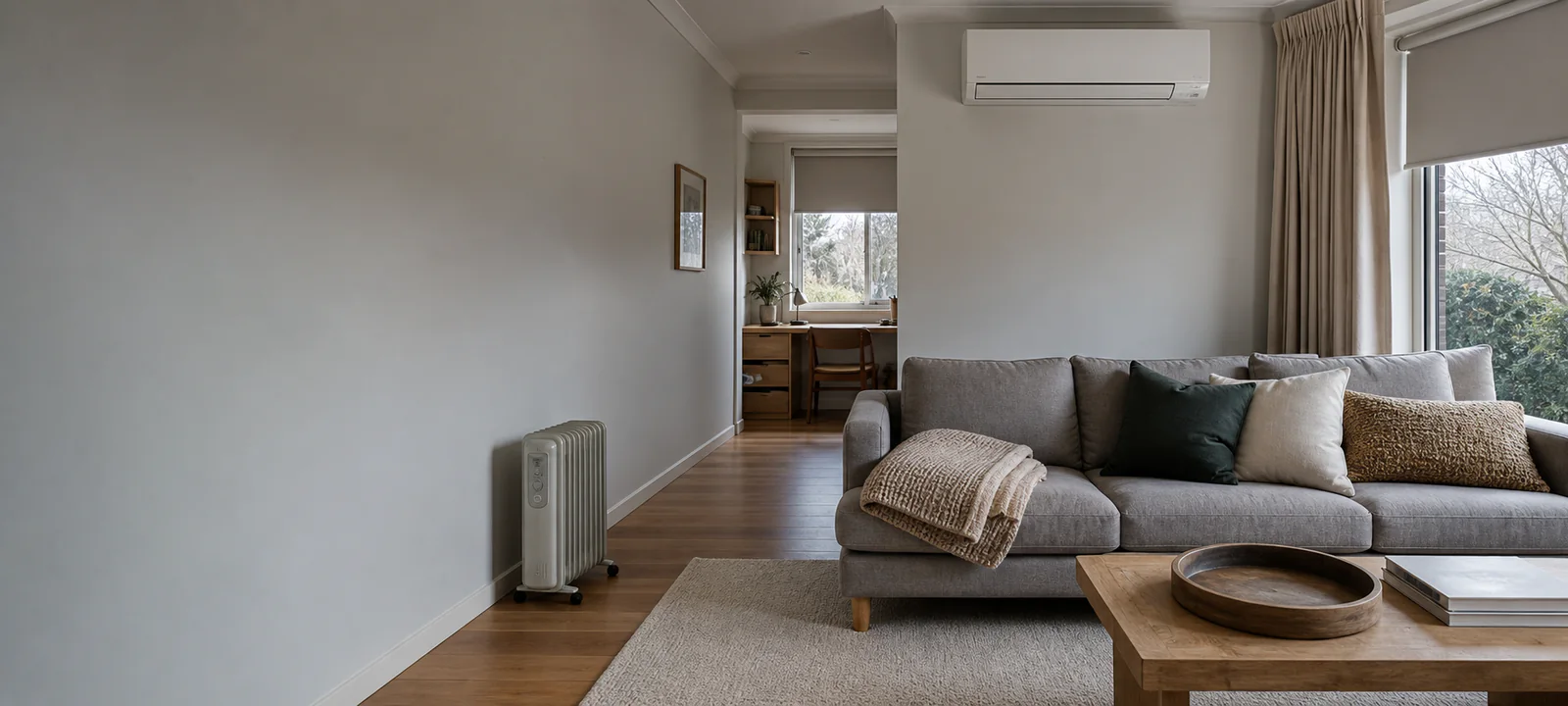
A heater can be an easy purchase to get wrong.
A small portable heater may warm a home office quickly but achieve very little in an open-plan living area. An oil column heater can provide quiet background warmth but take time to affect a cold room. A reverse-cycle air conditioner can heat efficiently and also cool in summer, although it requires suitable sizing and licensed installation.
The right starting point is not the heater type. It is the room, the local climate and the way the space is used.
This guide provides a practical overview of the main home heating options available in Australia. More detailed comparisons are linked throughout where a particular option deserves closer consideration.
Our Take
There is no single best heating option for every Australian home.
Choose according to:
- the size and ceiling height of the space
- whether it can be closed off
- how long it remains occupied
- how quickly warmth is needed
- acceptable noise and airflow
- local winter conditions
- existing insulation and draughts
- whether summer cooling is also required
Before buying a larger heater, check whether warmth is escaping through doors, windows, open hallways or an inadequately insulated ceiling. Improving the room can sometimes make more difference than increasing heater output.
Start with the heating task
Different heating choices solve different problems.
Ask what the household actually needs:
Quick warmth for a short period
A fan or ceramic heater can suit a small enclosed room used briefly, such as a home office or bedroom while getting dressed.
Quiet background warmth
Oil column and panel heaters provide gradual electric resistance heating without a strong fan. They suit smaller enclosed rooms better than large connected spaces.
Warmth for one person or one bed
An electric blanket or heated throw targets the occupant rather than heating the whole room.
Regular room heating and summer cooling
A correctly sized reverse-cycle air conditioner can provide efficient fixed heating and refrigerated cooling from the same system.
Heating several rooms
A ducted or multi-room system may be appropriate, but zoning, installation access and the building’s thermal performance become part of the decision.
Home heating options at a glance
| Heating option | Usually suited to | Main advantage | Main limitation |
|---|---|---|---|
| Fan or ceramic heater | Brief use in a small enclosed room | Fast warm air | Fan noise and limited reach |
| Oil column heater | Quiet bedroom, office or small living space | Gradual, steady warmth | Slow initial response and bulky floor footprint |
| Panel heater | Enclosed room where a slim profile is useful | Quiet background heating | Wall and furniture placement can restrict performance |
| Radiant heater | A person or defined spot | Heat is felt quickly | Limited coverage |
| Electric fireplace | Ambience with supplementary heat | Flame effect and integrated heater | Appearance does not increase heating capacity |
| Electric blanket | Pre-warming a bed | Targets the bed instead of the room | Must fit and be used correctly |
| Heated throw | An awake person on a chair or sofa | Localised personal warmth | Not intended to replace an electric underblanket |
| Reverse-cycle air conditioner | Regular room heating and cooling | Efficient heating plus summer cooling | Requires correct sizing and installation |
| Ducted system | Multiple rooms or whole-home use | Central distribution and zoning | Greater design and installation complexity |
| Wood, gas, hydronic or underfloor heating | Particular homes, climates or renovations | Can provide substantial fixed heating | Installation, servicing and local requirements vary |
Fan and ceramic heaters
Fan-assisted heaters provide warm air quickly and are most useful in small enclosed spaces.
A conventional fan heater and a ceramic heater are both generally electric resistance heaters. A ceramic model may include oscillation, digital controls or a more refined thermostat, but the word “ceramic” does not make it inherently cheaper to run.
Electricity use depends mainly on rated power, operating time and thermostat cycling.
Read the detailed Fan Heater vs Ceramic Heater guide before deciding whether the additional controls or airflow pattern are useful for the room.
Oil column and panel heaters
Oil column and panel heaters are generally quieter than fan-assisted models.
An oil column heater warms sealed internal oil and its metal columns, producing a combination of radiant and convective warmth. It is portable but relatively heavy and slow to respond.
A panel heater uses natural convection and may be wall-mounted or used with compatible feet. Its slim profile can preserve floor space, although furniture and curtains must not obstruct it.
Both are electric resistance heaters. Neither design is automatically inexpensive to operate.
The Oil Column Heater vs Panel Heater guide compares warm-up time, retained warmth, controls, placement and portability in more detail.
Radiant heaters
Radiant heaters direct warmth towards people and objects.
They can suit short-term spot heating in a defined position, but they do not evenly warm every part of a room. Move outside the radiant zone and the surrounding space may still feel cold.
Open or hot heating surfaces also require careful placement. Keep bedding, curtains, furniture and clothing outside the manufacturer’s required clearances.
Never bring an outdoor gas heater, barbecue or other outdoor combustion appliance inside.
Electric fireplaces
An electric fireplace combines a flame-effect display with an electric heater.
Its heating section commonly operates in a similar way to another fan or convection heater. The size of the fireplace surround or flame display does not indicate stronger heating performance.
Check:
- rated heating output
- fan noise
- electrical supply
- wall or recess dimensions
- clearances from televisions and cabinetry
- ventilation and servicing access
- whether the flame effect can operate without heat
Treat it as supplementary heating unless its documented output and installation suit the complete room.
Electric blankets and heated throws
Electric bedding warms the bed or person rather than the room.
An electric blanket is generally fitted to a mattress in the configuration specified by its manufacturer. A heated throw is designed to sit over an awake person on a chair or sofa. They are not interchangeable unless the instructions explicitly allow the intended use.
Current Product Safety Australia guidance advises inspecting electric blankets each winter, warming the bed and switching the blanket off before sleeping.
The Electric Blankets vs Heated Throws guide covers fit, controls, cleaning, storage and intended use.
For a broader room decision, see Heating a Bedroom for Overnight Comfort.
Reverse-cycle air conditioning
A reverse-cycle air conditioner is a heat pump.
Rather than creating all its heat through electrical resistance, it transfers heat from the outdoor air into the room. This allows it to provide substantially more room heat for the electricity used than ordinary resistance heaters.
It can also provide refrigerated cooling in summer.
Before buying, check:
- heating capacity
- the heating side of the Zoned Energy Rating Label
- performance for the relevant climate zone
- room size and connected spaces
- indoor airflow
- indoor and outdoor noise
- drainage
- electrical requirements
- licensed refrigerant installation
- filter and servicing access
A cooling star rating does not automatically describe winter heating performance.
Read Reverse-Cycle Heating Explained for climate performance, defrost cycles and winter operation. The broader Air Conditioning Buying Guide covers system types and installation planning.
Ducted and multi-room heating
Ducted heating can distribute conditioned air through several rooms from one central system.
Options include ducted reverse-cycle air conditioning and existing ducted gas systems. Multi-split air conditioning can instead connect several indoor units to one outdoor system.
The design needs to account for:
- room and zone loads
- supply and return air
- duct routes and insulation
- minimum airflow
- ceiling or underfloor access
- controls
- electrical capacity
- servicing
Zoning can reduce heating of unused areas, but zones cannot always be closed without limit.
For large connected areas, see Heating an Open-Plan Living Area.
Other fixed heating systems
Wood heaters, fixed gas heaters, hydronic systems and underfloor heating may suit particular climates, properties or renovation projects.
They introduce site-specific considerations such as:
- flues and ventilation
- fuel storage
- clearances
- local emissions or planning requirements
- floor and wall construction
- maintenance
- installation access
Major fixed systems should be assessed with appropriately qualified professionals before equipment is ordered.
Do not assume that an existing fuel type remains the most suitable choice for a replacement system.
Match the option to the room
Small room used briefly
A fan or ceramic heater may provide fast supervised warmth without the cost and installation of a fixed system.
Quiet bedroom or office
An oil column or panel heater may provide gradual pre-bedtime or background warmth. Electric bedding may be more direct where the main problem is a cold bed.
Regularly occupied living room
A correctly sized reverse-cycle system may provide more efficient ongoing heating and summer cooling.
Large or open-plan space
Measure the complete connected area and ceiling volume. One portable heater is unlikely to condition a kitchen, dining room, lounge, hallway and stairwell effectively.
Several rooms
Compare ducted, multi-split or separate room systems. The right choice depends on which rooms are occupied at the same time and whether they can operate independently.
Australia does not have one heating climate
Heating requirements vary substantially across the country.
In cooler southern, inland and elevated regions, heating performance, insulation and heat retention may be major household priorities.
In temperate coastal areas, room-by-room heating may be sufficient.
In tropical and subtropical regions, heating may be required only during occasional cool mornings or evenings. The heating mode of an existing reverse-cycle air conditioner or a small portable option may be enough.
Use the climate-zone information relevant to the property rather than assuming advice written for another region applies unchanged.
Improve the room before increasing the heater
A heater cannot work efficiently against unlimited heat loss.
Before increasing capacity, check:
- gaps around doors and windows
- open hallways and unused rooms
- poorly fitted curtains or blinds
- large areas of cold glazing
- inadequate ceiling insulation
- blocked heater airflow
- furniture beside cold external walls
- warm air collecting near a high ceiling
The draught-reduction guide explains how to reduce uncontrolled air leakage without blocking required ventilation.
The Home Insulation Basics guide covers ceilings, walls, floors, R-values and installation quality.
Where windows are the main issue, review the existing bedroom lighting and window-coverings guide.
Essential portable-heater safety
Before operating a portable heater:
- inspect the plug, cord, body and controls
- place it on a stable, level surface
- connect it directly to a suitable wall power point
- use one appliance per power point
- keep clothing, curtains, bedding and furniture at least one metre away
- keep it outside walkways
- supervise children and pets
- switch it off before leaving the room or going to sleep
- maintain working smoke alarms
Safety features such as thermostats, timers, tip-over switches and overheat protection do not replace correct placement and supervision.
Never use an outdoor gas heater, barbecue or charcoal appliance inside.
Before You Buy Checklist
Before choosing a heating option, check:
- Which room or connected area needs heating?
- What are its dimensions and ceiling height?
- Can the space be closed off?
- How long will it be occupied?
- Is fast heat or steady background warmth required?
- Is the aim to warm the room, one person or the bed?
- Is fan noise or direct airflow acceptable?
- What insulation is present?
- Are there significant draughts?
- How much window glass is present?
- Does the option suit the local climate?
- What is the appliance’s rated power or heating capacity?
- Is summer cooling also required?
- Is there a safe appliance position?
- Can required clearances be maintained?
- Is there a suitable power supply?
- Does fixed installation require electrical, refrigerant, gas or building work?
- Are landlord or strata approvals required?
- What cleaning, servicing or fuel storage will be required?
- Has the product been checked against current recalls?
Choose for the home you actually have
The largest heater is rarely the most useful starting point.
A fan heater can suit brief use in a small room. An oil column or panel heater may suit quiet background heating. Electric bedding can warm a bed or person without conditioning the whole home. Reverse-cycle air conditioning can efficiently heat and cool a regularly occupied space.
Start with the room, local climate and duration of use.
Then consider heat loss, noise, controls, safety and installation.
A suitable heater in a prepared room will generally provide a better result than a larger appliance fighting open spaces, cold windows and uncontrolled draughts.