
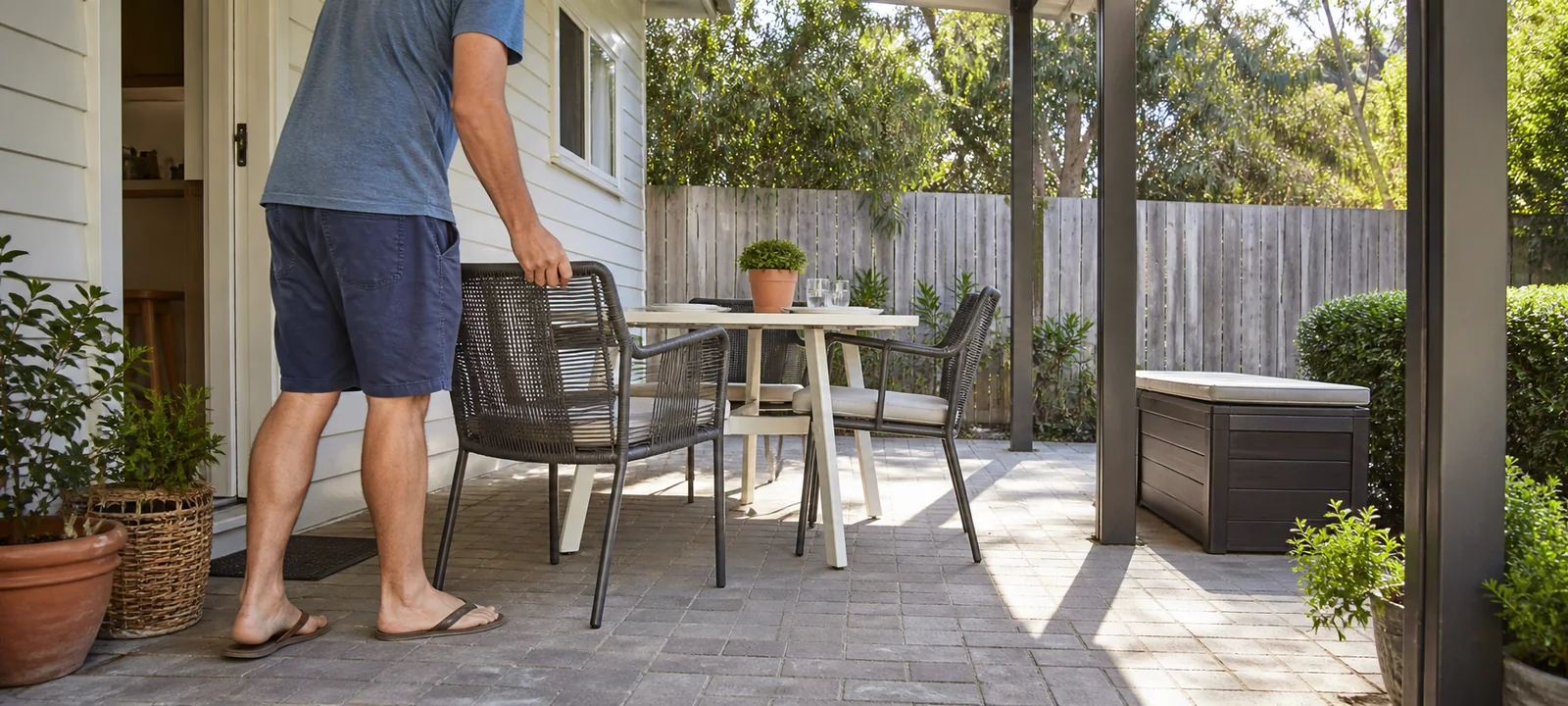
An outdoor area does not need a makeover to become easier to use. It needs a clear route, enough shade, clean furniture, somewhere for loose items to go and a simple way to pack everything down when the weather changes.
Start with the patio, balcony, courtyard or deck you already use. In one hour, you can identify what needs cleaning, what no longer fits and what is preventing the area from working properly.
Set up one complete seating area before buying cushions, lights or another storage box. Let the remaining problems reveal themselves.
The one-hour outdoor reset
| Time | Job | What you are trying to learn |
|---|---|---|
| First 10 minutes | Clear the normal walking and serving routes | What does not belong in the area? |
| Next 10 minutes | Inspect and sweep the surface | Is cleaning enough, or is repair needed? |
| Next 10 minutes | Set out the furniture as it is actually used | Can everyone sit, move and reach the door? |
| Next 10 minutes | Check sun and shade | Is the area comfortable at the time it will be used? |
| Next 10 minutes | Reset storage and remove trapped water | Where will cushions, toys and loose items go? |
| Final 10 minutes | Check lighting and the weather pack-down | Can the area be used after dark and secured quickly? |
Photograph anything requiring repair or a product measurement. That keeps the first hour focused on identifying problems rather than shopping for them.
Clear the route from the kitchen to the table
Open the back door fully, carry an empty tray outside and walk to the table. Pull every chair into its occupied position and repeat the trip.
Check whether:
- a chair blocks the door when someone is seated
- the screen door can close without hitting furniture
- people must squeeze behind occupied chairs
- a step or level change is hidden
- the barbecue crosses the serving route
- pets, children, prams or mobility aids can pass
- the route to the indoor or outdoor bin is practical
Test the furniture in use, not tucked neatly under the table. A layout can look spacious until every chair is pulled out.
If the furniture is the wrong size, use the outdoor dining-area guide or outdoor lounge-seating guide before replacing it.
Inspect before cleaning
Sweep loose leaves, dirt and grit before adding water or cleaning products. This reveals the surface and prevents debris being pushed into drains, gaps or garden beds.
Look for:
- raised pavers or tiles
- loose or splintered deck boards
- slippery growth
- cracked edges
- unstable steps
- movement in a railing or balustrade
- soft or badly weathered timber
- loose or corroded visible fixings
- mats that curl, slide or hold water
Cleaning is reasonable when the surface is sound but dirty. Stop using an affected section and arrange appropriate assessment when a deck feels unusually springy, a railing moves or deterioration appears structural.
Match the cleaning method to the material
One cleaning method will not suit every outdoor surface.
| Surface or item | Start with | Avoid assuming |
|---|---|---|
| Timber deck | Sweep and follow its coating or timber-care guidance | That high pressure or bleach is safe |
| Composite decking | Use the manufacturer’s cleaning instructions | That timber treatments suit composite material |
| Pavers | Sweep joints and test the least aggressive suitable method | That pressure cleaning will not disturb sand or damage the finish |
| Outdoor tiles | Check the tile, grout and slip conditions | That a glossy indoor-tile cleaner suits outdoor use |
| Powder-coated furniture | Use a soft cloth and care guidance for the finish | That abrasive pads will not scratch the coating |
| Outdoor cushions | Check the cover and filling care labels | That every cover can be machine washed |
| Umbrella or awning fabric | Remove loose debris and follow its care instructions | That it can be scrubbed, pressure washed or stored wet |
Test unfamiliar cleaners in an inconspicuous area. Let cushions and covers dry completely before storage.
Queensland Government guidance recommends avoiding unnecessary frequent wetting of decks and balconies and allowing them to dry properly when they become wet.
Check shade when the area will be used
Morning shade does not prove that the table will be comfortable at 3 pm.
Visit at the normal time of use and check:
- direct sun across occupied chairs
- reflected heat from paving, walls and fences
- gaps in umbrella or awning coverage
- shade moving away from the table
- glare affecting one side
- an umbrella blocking the doorway
- wind exposure around portable shade
Repeat the check later in spring as the sun path and shadow length change.
Inspect existing umbrellas, awnings and shade sails for fabric damage, difficult operation or loose visible fittings. Do not improvise structural anchor points.
Shade reduces UV exposure but does not provide complete sun protection. Cancer Council Australia recommends using shade with the other SunSmart measures when protection is required.
The outdoor shade guide covers coverage, wind exposure and fit in more detail.
Give every loose item a home
Sort cushions, toys, covers, gardening items and barbecue accessories into four groups:
- stays outside and is used regularly
- stored outside between uses
- returned indoors after use
- no longer belongs in the area
Use existing storage first. Check whether it keeps items dry, opens without moving furniture and can be reached without blocking the path.
Do not store damp cushions or wet folded covers. Check covers for pockets that collect rain and storage lids for hollows that hold water.
The small outdoor-storage guide covers footprint, lid clearance and access where space is limited.
Remove meal residue and trapped water
Clean food and drink spills, barbecue residue, bin rims and pet-feeding surfaces after use.
After rain, empty avoidable water from pot saucers, covers, toys, buckets, umbrella bases, storage lids and containers left upright. Store loose containers so they cannot refill.
The flies-and-mosquitoes guide covers insect entry points, standing water and product limitations in detail.
Test the lighting by walking the route
After dark, walk from the door to the table, gate, steps and barbecue area.
Make sure you can see:
- steps and changes in level
- door handles and locks
- path edges
- gates and latches
- cooking and serving surfaces
Position portable lighting securely so it does not become another obstacle.
Outdoor lights, equipment and connections must be suitable for their exposure and kept away from water. Remove damaged equipment from use. Fixed electrical work belongs with a licensed electrician.
Keep the barbecue out of the traffic flow
Place the barbecue on a firm, level surface outdoors, away from flammable surroundings and the main walking route.
Check that:
- children and pets do not need to pass close to it
- the cook is not standing in the doorway
- smoke is not directed into the house
- chairs, cushions and vegetation remain clear
Follow the appliance instructions rather than borrowing a clearance measurement from another barbecue. Fire and Rescue NSW advises keeping a lit barbecue under responsible adult supervision.
Use the barbecue-area guide if the cooking position or serving layout needs a full review.
Create a five-minute weather pack-down
Choose secure locations for:
- umbrellas
- lightweight chairs
- cushions
- furniture covers
- toys
- portable lights
- loose barbecue accessories
Practise the pack-down once. If it takes much longer than five minutes, reduce what stays outside or make the storage point easier to reach.
Keep accessible ground-level drainage clear. Use the gutter-maintenance guide if roof drainage is involved.
Before guests arrive
- Pull out every chair and clear the serving route.
- Confirm the shade at the expected time.
- Clean the table, barbecue area and nearby spills.
- Make sure steps, doors and paths are visible.
- Prepare drinking water and suitable airflow.
- Check the forecast and know where loose items will go.
A successful outdoor reset does not make the area look like a showroom. It makes the space easy to reach, comfortable to sit in and quick to clear when the meal—or the weather—is over.