
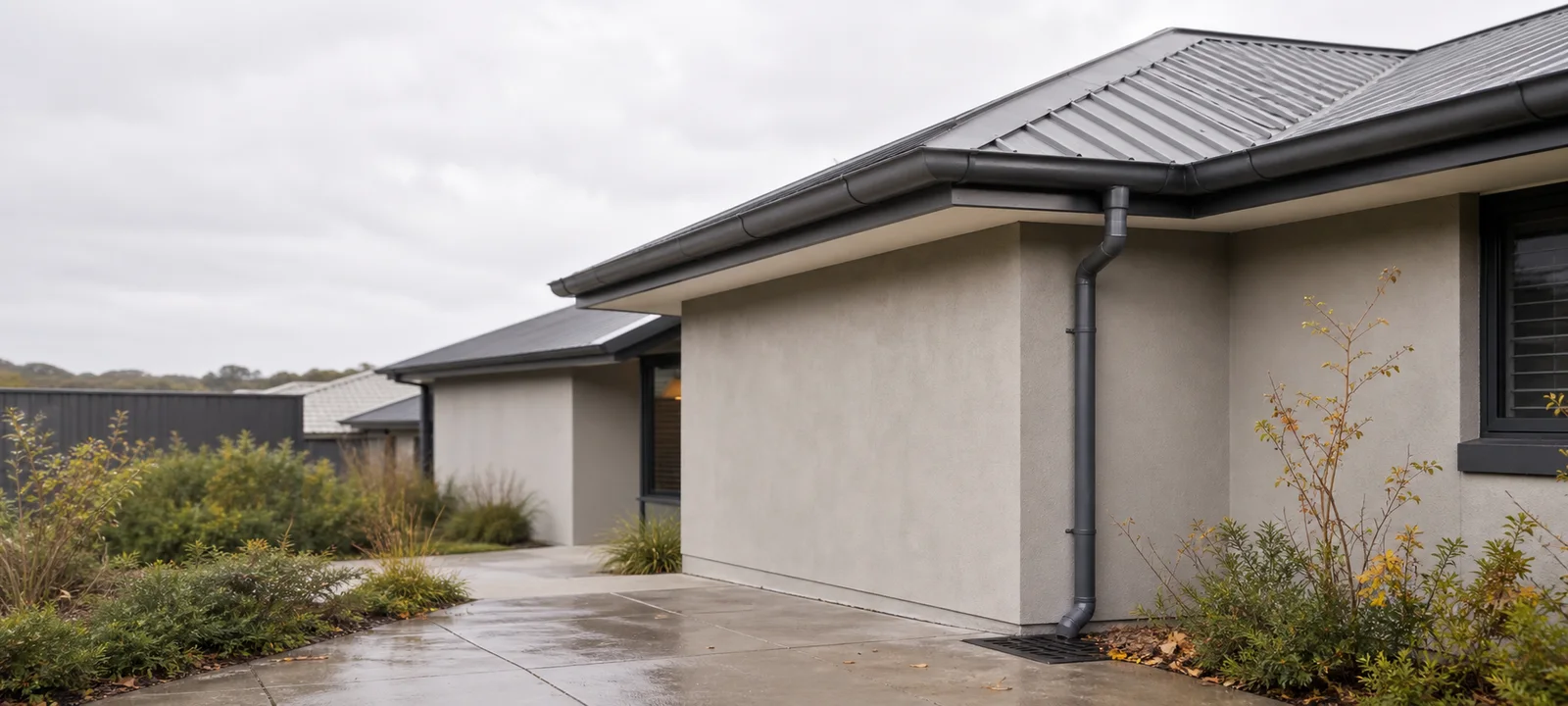
Gutters are easy to ignore while water appears to be reaching the downpipe.
A system can still be partly blocked, holding water behind debris, leaking at joints or overflowing into a place that is difficult to see from the ground. The first obvious sign may be staining beneath the eaves, water entering the roof space or soil washing away beside the house.
Cleaning is only part of gutter maintenance.
The roof, gutter, downpipe, overflow provisions, stormwater connection and ground drainage need to work as one system. Rainwater tanks, gutter guards, nearby trees, solar equipment, powerlines and safe access can all change what maintenance is appropriate.
This guide explains what can be checked from ground level, when professional help is the safer option and what to understand before paying for cleaning, repairs or gutter guards.
Our Take
Do not begin with a ladder or a gutter-guard quote.
First observe what the system does during ordinary rain from a safe position at ground level. Look for overflow, leaks, staining, slow drainage and water collecting near the building.
Then consider why it is happening.
Leaves may be the cause, but so may a crushed downpipe, poor gutter fall, undersized drainage, damaged roof materials, incorrect overflow detailing or a stormwater problem below ground.
The safest and most useful maintenance plan addresses the entire drainage path rather than repeatedly removing visible debris.
What a roof-drainage system does
A typical roof-drainage system may include:
- roof sheets or tiles
- valleys
- flashings
- eaves gutters
- box gutters
- sumps
- overflow provisions
- downpipes
- rainheads
- leaf screens
- first-flush devices
- rainwater tanks
- charged or gravity-fed pipes
- stormwater drains
- surface outlets
- lawful discharge points
Not every home has every component.
The purpose is to collect roof runoff and move it away without allowing water to enter the building or concentrate beside the foundations.
A problem in one component can affect the others.
For example:
- a clear gutter can still overflow when the downpipe is blocked
- a clear downpipe can still back up when the underground drain is obstructed
- a gutter guard can remain clear on top while fine debris accumulates beneath it
- a rainwater-tank inlet can block even when the main gutter appears clean
- a gutter can overflow because its fall or capacity is inadequate rather than because it contains leaves
Maintenance should therefore follow the water from the roof to its final discharge point.
Gutter problems at a glance
Swipe sideways to compare the full table.
| What you notice | Possible causes to investigate | Do not assume |
|---|---|---|
| Water spilling over the front edge | Leaves, downpipe blockage, excessive rain intensity, inadequate capacity or poor fall | Cleaning alone will solve it |
| Water spilling behind the gutter | Blockage, failed flashing, incorrect gutter position, roof damage or overflow design | The water is harmless because it is hidden |
| Staining on fascia or eaves | Repeated overflow, leaking joints, roof leaks or condensation | It is only cosmetic |
| Gutter holding water after rain | Insufficient fall, sagging, blocked outlet or deformation | More downpipes are automatically required |
| Dripping at joins | Failed seals, corrosion, movement or loose fittings | Sealant is always a permanent repair |
| Downpipe overflowing at the top | Blockage below, restricted rainhead, tank inlet problem or excessive flow | The gutter is the only blocked component |
| Water pooling beside the house | Disconnected outlet, blocked stormwater, poor surface drainage or incorrect discharge | A longer downpipe extension is always lawful or sufficient |
| Plants growing in the gutter | Long-term organic build-up and trapped moisture | A gutter guard removes the need for future inspection |
| Rust or holes | Corrosion, incompatible metals, standing water or age | Painting over the surface will stop the cause |
| Pests or mosquitoes | Standing water, debris, damaged screens or accessible tank openings | Chemical treatment is the first solution |
| Tank not filling during rain | Blocked screens, diverter, downpipe or inlet; closed valve; leak or overflow | The property received insufficient rain |
| Ceiling or wall water marks | Roof, flashing, gutter, plumbing or condensation issue | The nearest gutter is definitely responsible |
These signs are starting points rather than remote diagnoses.
Water can travel along roof framing or internal surfaces before becoming visible.
Australia does not have one gutter season
The most useful inspection timing depends on local conditions.
A home may need attention:
- after deciduous leaf fall
- before a local storm or cyclone season
- before the bushfire season
- after strong wind
- after hail
- after nearby tree work
- after roof or solar installation
- after birds or pests have been active
- before relying on rainwater for household use
- whenever overflow or staining appears
In cooler areas, autumn leaf fall may create the main annual build-up.
In tropical regions, intense rain, wind, foliage and wet-season debris may be more significant.
In dry or bushfire-prone areas, combustible leaf litter can accumulate even when rain is infrequent.
Coastal exposure can accelerate corrosion of metal components.
Do not copy a fixed national cleaning interval without considering:
- tree cover
- roof pitch
- gutter profile
- local rainfall
- wind
- bushfire exposure
- tank use
- gutter guards
- previous blockage history
- safe access
A trigger-based inspection plan is generally more useful than waiting for one calendar date.
Begin with ground-level observation
Many useful signs can be identified without climbing.
From the ground, look for:
- visible plants or debris above the gutter line
- sagging sections
- loose brackets
- rust streaks
- peeling paint on fascia
- water marks beneath joints
- displaced downpipes
- cracked or crushed downpipes
- missing rainheads
- leaking tank connections
- soil erosion near outlets
- water staining on walls
- mould or discolouration beneath eaves
- gaps where roof edges or flashing appear damaged
- branches touching the roof
- pest nesting activity
- overflow from an accessible ground-level drain
Binoculars or a suitable camera zoom can assist observation from a safe position.
Do not lean from an upper-storey window, balcony or unstable surface to gain a closer view.
Do not fly a drone near powerlines, neighbouring properties or restricted areas without understanding the applicable rules and operating risks.
Observe the system during rain — from a safe location
Ordinary rainfall can reveal how the system behaves.
From a sheltered, ground-level position, look for:
- water spilling over the gutter
- leaks at joins or corners
- downpipes that remain dry while nearby gutters overflow
- water escaping around rainheads
- slow or noisy drainage
- water backing out of ground-level stormwater fittings
- water collecting near walls
- discharge creating erosion
- tank overflow flowing to an unsuitable location
- water running behind fascia or beneath eaves
Do not perform inspections outdoors during:
- lightning
- severe storms
- destructive wind
- hail
- flooding
- emergency warnings
Wait until conditions are safe.
A brief video recorded from the ground during ordinary rain can help a contractor understand an intermittent problem.
Eaves gutters, valleys and box gutters are different
Eaves gutters
Eaves gutters sit along the lower roof edge and are usually visible from outside.
Overflow may be visible at the front, behind the gutter or at designated outlets depending on the design.
Roof valleys
Valleys collect water from adjoining roof slopes.
Debris can accumulate where valleys meet gutters, particularly beneath tree cover.
Do not walk on a tiled or metal roof to inspect a valley.
Box gutters
Box gutters are built into or between roof sections and may be partly concealed.
They can depend on:
- correctly sized sumps
- overflow provisions
- clear outlets
- appropriate falls
- waterproof detailing
A blocked or defective box gutter can direct water into the building without obvious overflow at the external eaves.
Box-gutter inspection and repair are not suitable starting points for casual DIY work.
Use an appropriately qualified roofing or plumbing professional as required in the relevant jurisdiction.
Leaves are not the only debris
Gutters may collect:
- leaves
- twigs
- bark
- seed pods
- flowers
- roof grit
- moss
- bird nesting material
- animal droppings
- windblown soil
- ash
- fragments from deteriorating roofing
- construction offcuts
- screws
- tennis balls and toys
- dead insects
- organic sludge
Fine material can pass through some guards and settle at the bottom.
Organic debris can retain moisture and contribute to:
- corrosion
- plant growth
- blocked outlets
- staining
- odour
- standing water
- mosquito habitat
- contamination of rainwater collection
The appearance of the top surface does not confirm that the gutter channel below is clear.
Downpipes need separate attention
A downpipe can block at:
- the gutter outlet
- an upper bend
- a rainhead
- a junction
- a leaf screen
- a first-flush device
- a charged section
- the tank inlet
- the ground connection
- an underground drain
Signs may include:
- gutter overflow near the outlet
- water escaping around a rainhead
- gurgling
- slow tank filling
- water backing up at ground level
- movement or separation at pipe joints
- one downpipe carrying much less water than another
Do not insert rigid rods, pressure hoses or powered equipment into a concealed pipe without understanding the route and possible damage.
A pipe may contain:
- sharp bends
- old joints
- roots
- collapsed sections
- connections to a tank
- concealed overflow arrangements
Repeated blockage may justify inspection of the complete line rather than another surface clean.
Ground drains and stormwater connections
The roof system does not finish at the bottom of the downpipe.
Check accessible ground-level areas for:
- broken grates
- sediment
- leaves
- roots
- water backing up
- collapsed pits
- disconnected pipes
- erosion
- outlets covered by landscaping
- surface water moving towards the house
Do not connect, divert or extend stormwater onto:
- neighbouring property
- the footpath
- the street
- a sewer connection
- an unapproved soakage area
without checking the requirements that apply to the property.
Stormwater rules vary by council, state, development approval and site conditions.
Below-ground defects may require an appropriately licensed plumber, drainer or other suitable professional.
Water near the foundations
Overflowing gutters and disconnected downpipes can concentrate water beside the home.
Possible signs include:
- eroded soil
- persistent dampness
- subsidence
- water beneath a raised floor
- staining at the wall base
- wet garden beds against the building
- movement in paving
- mould or damp odours indoors
- water entering garages or lower rooms
Do not assume a gutter repair alone will resolve established ground-drainage or building problems.
The site may also have:
- poor grading
- blocked surface drains
- leaking plumbing
- groundwater
- irrigation leaks
- retaining-wall drainage issues
Water-entry problems should be investigated before damaged paint, plaster or timber is simply covered.
Gutter fall and standing water
A gutter is generally intended to direct water towards its outlets.
Small residual droplets may remain, but substantial standing water can indicate:
- inadequate fall
- sagging
- loose brackets
- settlement
- deformation
- blocked outlets
- an unsuitable installation
Standing water can contribute to:
- corrosion
- staining
- organic build-up
- mosquito breeding
- additional weight
- leaks at joints
Do not try to alter gutter fall by bending brackets from a ladder or adding improvised supports.
The gutter line, roof edge, outlets and overflow design need to remain compatible.
Rust, corrosion and incompatible metals
Metal gutters can deteriorate through:
- age
- trapped moisture
- salt exposure
- damaged coatings
- accumulated debris
- contact with incompatible metals
- acidic leaf litter
- roof runoff
- incorrect fasteners
- previous repairs
Look for:
- pinholes
- flaking surfaces
- orange or white corrosion
- rust streaks
- thinning around outlets
- leaks at fasteners
- failed end caps
- corrosion beneath debris
Surface coating may slow deterioration only where the underlying material remains sound and the repair system is compatible.
A sealant or paint layer should not be used to hide widespread perforation or an incompatible-metal problem.
Ask whether repair or replacement is more appropriate for the complete affected section.
Gutters can sag or pull away
Sagging may result from:
- accumulated debris
- standing water
- loose brackets
- damaged fascia
- bracket spacing
- impact
- age
- movement in the roof edge
- installation defects
A gutter full of wet debris can be heavy.
Do not stand beneath a visibly loose or collapsing section.
Do not pull, push or attempt to refasten it while positioned on a ladder.
The fascia and supporting structure may also require assessment.
Gutter guards do not remove maintenance
Gutter guards may reduce the amount or size of debris entering the gutter.
They do not guarantee:
- no leaves
- no fine sediment
- no plant growth
- no pests
- no blocked downpipes
- no roof-valley build-up
- no corrosion
- no storm damage
- no inspection
- no cleaning
Common systems include:
- mesh fixed over the roof edge and gutter
- perforated metal covers
- screens fitted to the gutter
- brush inserts
- foam inserts
- leaf-shedding rainheads
- downpipe strainers
Each changes access and maintenance differently.
Before buying, ask:
- what debris the system is intended to manage
- whether fine material can pass through
- how the gutter beneath will be inspected
- how accumulated material will be removed
- whether roof valleys remain accessible
- whether the system affects roof drainage
- whether it is compatible with the roof and gutter materials
- whether it can trap wet debris
- whether birds or pests can enter beneath it
- whether it affects warranties
- how it behaves in hail or strong wind
- whether it suits bushfire-prone construction requirements
- whether removing it for maintenance creates extra labour
A guard that makes the gutter difficult to inspect can shift the maintenance problem out of sight.
Bushfire-prone areas
Leaf litter in gutters can provide fuel for burning embers.
NSW Rural Fire Service property-preparation guidance recommends removing leaves and twigs from gutters and discusses metal gutter guards as one possible measure.
That does not mean one guard product or emergency action suits every property.
Bushfire preparation depends on:
- local risk
- Bushfire Attack Level where applicable
- roof and gutter construction
- ember entry points
- water supply
- vegetation
- emergency planning
- state and local requirements
Do not rely on gutter cleaning alone as a bushfire plan.
Do not permanently block downpipes or fill gutters with water unless that action forms part of current local fire-agency guidance and the household’s specific emergency plan at the relevant time.
Follow the fire authority for the state or territory and leave early when instructed.
Storm and cyclone preparation
SES guidance commonly includes keeping gutters, downpipes and drains clear so water can move away quickly.
Preparation should occur before severe weather is imminent.
Do not climb onto a roof or ladder when:
- strong wind is forecast or present
- surfaces are wet
- lightning is possible
- emergency warnings have been issued
- time pressure encourages shortcuts
Before the local storm or cyclone season, consider arranging:
- gutter and downpipe cleaning
- roof-condition inspection
- repair of loose roof materials
- trimming of suitable vegetation by qualified people
- stormwater inspection
- removal or securing of loose outdoor items
- review of insurance and emergency plans
Tree work near powerlines requires appropriate authority and professional handling.
Rainwater tanks
Where roof water feeds a tank, gutter condition affects the collected water and system performance.
Check the complete collection path:
- roof catchment
- gutters
- leaf screens
- rainheads
- first-flush diverter
- inlet strainer
- mosquito-proof screens
- tank overflow
- tank lid
- pipework
- pump and treatment equipment where fitted
Leaves, dust, animal droppings and other roof contaminants can enter the system during rain.
First-flush devices and screens require maintenance; they are not permanent fit-and-forget components.
Do not apply gutter-cleaning chemicals, roof treatments or pest products where runoff enters a rainwater supply unless the product and water-system guidance explicitly permit it.
Where tank water is used for drinking, food preparation or bathing, follow current health-authority guidance for the location and system.
Mosquitoes and standing water
Blocked gutters, open tanks and damaged screens can hold water.
In suitable conditions, standing water can support mosquito breeding.
The first response should be to:
- restore drainage
- remove debris safely
- repair screens
- close openings
- correct sagging or blockages
- maintain first-flush and inlet components
Do not apply insecticide to gutters or rainwater systems unless the product is registered for that exact use and all label and health requirements are understood.
A recurring standing-water problem is a drainage defect, not merely a pest-treatment problem.
Trees near the roof
Nearby trees can contribute:
- leaves
- twigs
- flowers
- seed pods
- bark
- animal access
- shade that slows drying
- impact during storms
They can also provide valuable shade, habitat and cooling.
Do not remove or heavily prune a tree solely to reduce gutter cleaning without considering:
- tree health
- council controls
- protected vegetation
- powerlines
- nesting wildlife
- shade value
- property boundaries
- professional arboricultural advice
Branches near powerlines must not be handled as ordinary garden pruning.
A better maintenance plan may combine appropriate tree care with gutter inspection rather than treating all vegetation as a problem.
Solar panels and roof-mounted equipment
Solar panels can change where debris collects and can make roof access more complicated.
Leaves may accumulate:
- beneath panel edges
- near rails
- around cable routes
- upslope of the array
- in valleys beside panels
Solar photovoltaic equipment can continue producing direct-current electricity when exposed to light.
Do not:
- work beneath panels
- move solar cables
- open isolators
- spray electrical components
- place metal tools near wiring
- assume switching off the main power removes every solar hazard
- walk on panels
- use a pressure washer on the array or roof
Arrange qualified inspection where solar equipment affects safe access or appears damaged.
Overhead powerlines
Ladders, long tools, gutter-cleaning poles and branches can create fatal electrical risks near overhead powerlines.
Do not estimate a safe distance by eye or rely on the apparent height of a line.
Exclusion zones and requirements vary according to:
- jurisdiction
- line voltage
- equipment
- task
- person performing the work
Where powerlines are near the work area:
- stop
- do not position a ladder
- do not use long conductive tools
- do not prune nearby branches
- contact the electricity network or an appropriately qualified contractor for guidance
Powerlines can move or sag in wind and heat.
No gutter-maintenance task justifies entering an electrical exclusion zone.
Ladder use is a serious risk
Gutter work commonly places a person near the top of a ladder, where overreaching and unstable setup can lead to severe injury.
Product Safety Australia advises considering whether a ladder should be used at all.
Professional help is the safer choice where:
- the gutter cannot be reached without an extension ladder
- the home has multiple storeys
- ground is sloped or unstable
- powerlines are nearby
- roof edges are high
- the gutter is above an awning, carport or pool
- access requires leaning or reaching sideways
- the person has reduced balance, mobility or confidence
- the ladder is damaged or unsuitable
- weather is wet or windy
- the work involves heavy debris or long tools
- roof access would be required
If a household ladder is used for any permitted low-risk task, follow the ladder manufacturer’s instructions and current Product Safety guidance.
That includes selecting the correct ladder, using firm and level ground, inspecting it before use and avoiding overreaching.
This article must not be treated as ladder-use training.
Do not climb onto the roof
Roof surfaces can be:
- wet
- brittle
- steep
- corroded
- slippery
- affected by moss
- weakened by age
- difficult to access
- close to powerlines
- fitted with live solar equipment
- constructed from fragile materials
Tiles can crack, metal sheets can be slippery and translucent roof panels may not support a person.
A person can also fall through an opening or ceiling where the roof structure is unfamiliar.
Do not climb onto the roof to complete a seasonal checklist.
Use a contractor with suitable access equipment, safety systems, insurance and relevant qualifications.
Pressure cleaning is not routine gutter maintenance
High-pressure water can:
- force water beneath roofing
- damage seals
- loosen coatings
- disturb asbestos-containing materials
- damage solar equipment
- spread contaminated debris
- flood eaves or wall cavities
- create slippery surfaces
- damage old gutters
- direct debris into downpipes
Do not assume pressure washing is appropriate because the roof or gutter looks stained.
Any cleaning method should suit:
- roof material
- gutter condition
- coatings
- rainwater collection
- nearby electrical equipment
- environmental controls
- safe access
Older roofs or unknown materials may require specialist assessment before cleaning.
Older homes and unknown materials
Older roofs and eaves may contain:
- asbestos cement
- lead-based coatings
- corroded metal
- brittle tiles
- old sealants
- deteriorated flashings
- non-compliant previous repairs
Do not scrape, drill, pressure-clean or disturb unknown materials.
If the home was built or renovated before 1990 and work may disturb suspect material, obtain appropriate asbestos guidance or assessment first.
Gutter cleaning should not become unplanned roof renovation.
What can be handled from ground level?
Low-risk household actions may include:
- observing the system during safe ordinary rainfall
- photographing visible faults from the ground
- clearing leaves from accessible ground drains
- moving garden items away from downpipe outlets
- checking tank overflow from ground level
- checking accessible rainwater screens where designed for ground-level maintenance
- recording when and where overflow occurs
- arranging quotes
- checking local storm and bushfire guidance
- keeping paths clear for contractor access
Stop when the task requires:
- climbing
- leaning over an edge
- roof access
- electrical proximity
- dismantling drainage
- moving solar equipment
- cutting trees near powerlines
- handling unknown roof materials
- entering a confined or contaminated space
When professional help is appropriate
Arrange suitable professional assessment where there is:
- a multi-storey roof
- difficult or steep access
- recurring overflow
- a box gutter
- damaged fascia
- loose guttering
- widespread corrosion
- roof leaks
- ceiling water damage
- a blocked underground stormwater line
- a crushed or concealed downpipe
- solar equipment affecting access
- nearby powerlines
- suspected asbestos
- storm or hail damage
- large tree branches above the roof
- rainwater-quality concerns
- water entering the building
- substantial erosion beside the foundations
The appropriate trade may vary by the problem and jurisdiction.
It may involve:
- roofing professionals
- roof plumbers
- licensed plumbers or drainers
- electricians
- solar technicians
- arborists
- builders
- asbestos professionals
- drainage or waterproofing specialists
Ask the contractor to explain which part of the system they are qualified and licensed to inspect or repair.
What to ask a gutter-cleaning contractor
Before accepting a quote, ask:
- What areas are included?
- Are valleys included?
- Are gutter guards removed or lifted where required?
- Are downpipe entries checked?
- Are rainheads checked?
- Are first-flush devices included?
- Are box gutters included?
- Is downpipe flow tested?
- Are ground drains included?
- How will debris be removed from the property?
- How will rainwater tanks be protected?
- What access equipment will be used?
- How are nearby powerlines managed?
- How is solar equipment handled?
- Is the contractor insured?
- Are workers covered for height work?
- Will before-and-after photographs be provided?
- Will defects be reported separately?
- Does the quote include minor repairs?
- Which repairs require another trade?
- What happens if asbestos or damaged roofing is discovered?
- Are roof tiles or sheets walked on?
- How is accidental damage handled?
A low cleaning price may exclude downpipes, valleys, guards, tanks or safe access.
Compare the complete scope rather than the headline fee.
What to ask before installing gutter guards
Before committing to a guard system, check:
- the dominant debris type
- roof material
- gutter material
- gutter profile
- roof pitch
- valley locations
- downpipe positions
- bushfire requirements
- coastal exposure
- hail exposure
- bird and pest activity
- solar panels
- roof warranty
- gutter warranty
- access for future inspection
- access for future roof repairs
- maintenance procedure
- removal cost
- expected fine-debris build-up
- compatibility with rainwater collection
- whether the installer alters roof fixings or tiles
- whether installation requires licensed work
- whether the proposed product has relevant evidence and documentation
Ask to see how the gutter beneath the guard will be inspected and cleaned.
A system that cannot be accessed may make future maintenance slower and more expensive.
Repairs versus replacement
A local repair may suit:
- one failed joint
- an isolated loose bracket
- a damaged end cap
- a small compatible section
- minor seal failure
- one damaged downpipe fitting
Replacement may be more appropriate where there is:
- widespread corrosion
- repeated leaks
- extensive sagging
- incompatible previous repairs
- insufficient or unsuitable outlets
- failing fascia
- poorly designed overflow
- recurring box-gutter problems
- damage across several connected sections
Do not decide from appearance alone.
Ask whether the proposed repair addresses:
- the cause
- drainage capacity
- gutter fall
- overflow
- materials compatibility
- supporting structure
- downstream drainage
A new gutter connected to a blocked underground line will not resolve the full problem.
Renters, apartments and strata properties
Renters should report:
- overflow
- leaks
- water entry
- loose gutters
- damaged downpipes
- mould or staining
- storm damage
- unsafe branches
- pest activity linked to standing water
Do not arrange structural repairs or install gutter guards without permission.
Keep written records and photographs taken from safe ground-level positions.
Apartment and townhouse guttering may form part of:
- common property
- shared roofing
- common stormwater
- exclusive-use areas
- body corporate or owners corporation maintenance
Confirm responsibility before arranging work.
One lot owner should not alter a shared drainage system without the required approval.
A practical seasonal approach
First: inspect from the ground
- review visible gutter lines
- photograph sagging or corrosion
- check downpipe connections
- check ground outlets
- observe ordinary rain safely
- note overflow locations
- inspect accessible tank screens
- identify nearby powerlines
- identify solar equipment
- note trees over the roof
- record interior water marks
Second: separate cleaning from repair
Cleaning tasks may include:
- removing loose debris
- clearing guards
- checking downpipe entries
- servicing accessible tank screens
Repair or investigation may include:
- correcting gutter fall
- replacing corroded sections
- fixing fascia
- repairing roofing
- clearing underground drains
- correcting overflow
- addressing powerline or solar access
- repairing storm damage
Do not accept repeated cleaning as the only response to a recurring design or drainage fault.
Third: plan for local hazards
Before the relevant season:
- check local SES advice
- check local fire-authority guidance
- confirm rainwater maintenance
- arrange safe professional access
- remove ground-level debris
- manage suitable vegetation
- review emergency plans
- avoid last-minute roof work before severe weather
Before You Buy Gutter Products Checklist
Before buying gutter guards, cleaning tools, sealants or replacement components, check:
- What exact problem is being addressed?
- Is the gutter blocked, leaking, sagging or incorrectly draining?
- Has the complete water path been observed?
- Are downpipes clear?
- Are underground drains functioning?
- Is overflow occurring during ordinary rain or only extreme rainfall?
- Is a box gutter involved?
- Is safe professional access required?
- Are overhead powerlines nearby?
- Is solar equipment present?
- Could asbestos-containing material be disturbed?
- What roof and gutter materials are present?
- Are proposed metals and fasteners compatible?
- Is a sealant suitable for the exact material and repair?
- Is the underlying gutter structurally sound?
- Will a guard suit the dominant leaf and debris type?
- Can fine debris pass through the guard?
- Can the gutter beneath still be inspected?
- Can roof valleys still be cleaned?
- Does the guard suit bushfire requirements where applicable?
- Does it suit coastal or hail exposure?
- Does it affect roof or gutter warranties?
- Does it remain compatible with rainwater collection?
- Will installation interfere with tiles, roof sheets or flashings?
- Is installation documentation available?
- Are landlord or strata approvals required?
- Has the ongoing maintenance cost been considered?
- Would repair or redesign solve the problem more effectively?
Gutter Maintenance Checklist
Use this checklist from safe ground level and through appropriate professional inspection:
- Visible gutters appear straight and securely supported.
- No plants or major debris are visible above the gutter edge.
- Fascia and eaves show no obvious repeated overflow staining.
- Gutter joints and corners show no visible leaks.
- Downpipes remain connected and undamaged.
- Rainheads and accessible screens are clear.
- Ground-level stormwater grates are unobstructed.
- Water does not collect beside the house.
- Downpipe discharge is not causing erosion.
- Ordinary rain flows through each visible part of the system.
- Water is not spilling behind gutters or beneath eaves.
- Substantial water does not remain trapped after rain.
- Gutter guards can still be inspected and maintained.
- Roof valleys are included in professional maintenance where required.
- Rainwater-tank inlets and first-flush devices are maintained.
- Tank screens and overflow components remain intact.
- No chemical has been used where it could contaminate tank water.
- Standing water and mosquito access have been addressed.
- Nearby branches have been assessed without unsafe pruning.
- Powerlines have been identified before access is planned.
- Solar panels and cables are left to suitably qualified people.
- No work is planned during wet, windy or storm conditions.
- No householder roof access is required.
- A suitable contractor has been arranged where ladders or height work are involved.
- Bushfire preparation follows the current local fire authority.
- Storm preparation follows the current local SES guidance.
- Interior ceiling or wall stains have been investigated.
- Recurring overflow has been treated as a drainage problem, not only a cleaning task.
- Rental or strata responsibilities have been confirmed.
- Before-and-after records are retained for professional work.
Maintain the whole drainage path
A clear-looking gutter is not proof that the roof-drainage system is working correctly.
Water must move from the roof, through the gutter and downpipes, into a lawful and functioning drainage or rainwater system without entering the building or collecting beside it.
Begin with safe observations from the ground.
Where cleaning requires a ladder, roof access or work near powerlines or solar equipment, arrange appropriate professional help. Where overflow keeps returning, investigate gutter fall, downpipes, underground drains and overflow design rather than repeating the same surface clean.
The useful result is not a spotless gutter on inspection day. It is a drainage system that can be inspected, maintained and relied upon when the next season brings leaves, storms, heavy rain or fire risk.
Official guidance
State-based SES, electrical-safety, fire and health sources below are jurisdictional or regional examples. Check the requirements in your own state or territory, local council stormwater rules, current local fire-authority guidance, electricity-network requirements and rainwater-health advice applicable to your system.
- NSW State Emergency Service guidance on preparing homes and property for storms and floods
- NSW State Emergency Service storm-preparation guidance
- Queensland State Emergency Service storm-preparation guidance
- NSW Rural Fire Service guidance on preparing property
- Product Safety Australia ladders guide
- WorkSafe Queensland guidance on exclusion zones near powerlines
- Energy Safe Victoria guidance on working around powerlines
- Energy Safe Victoria guidance on working safely around solar photovoltaic systems
- Australian Government Your Home guidance on rainwater
- Queensland Health rainwater-tank safety and maintenance guidance
- SA Health guidance on maintaining rainwater tanks and preventing mosquito access
- Australian Government winter energy and household-preparation guidance