
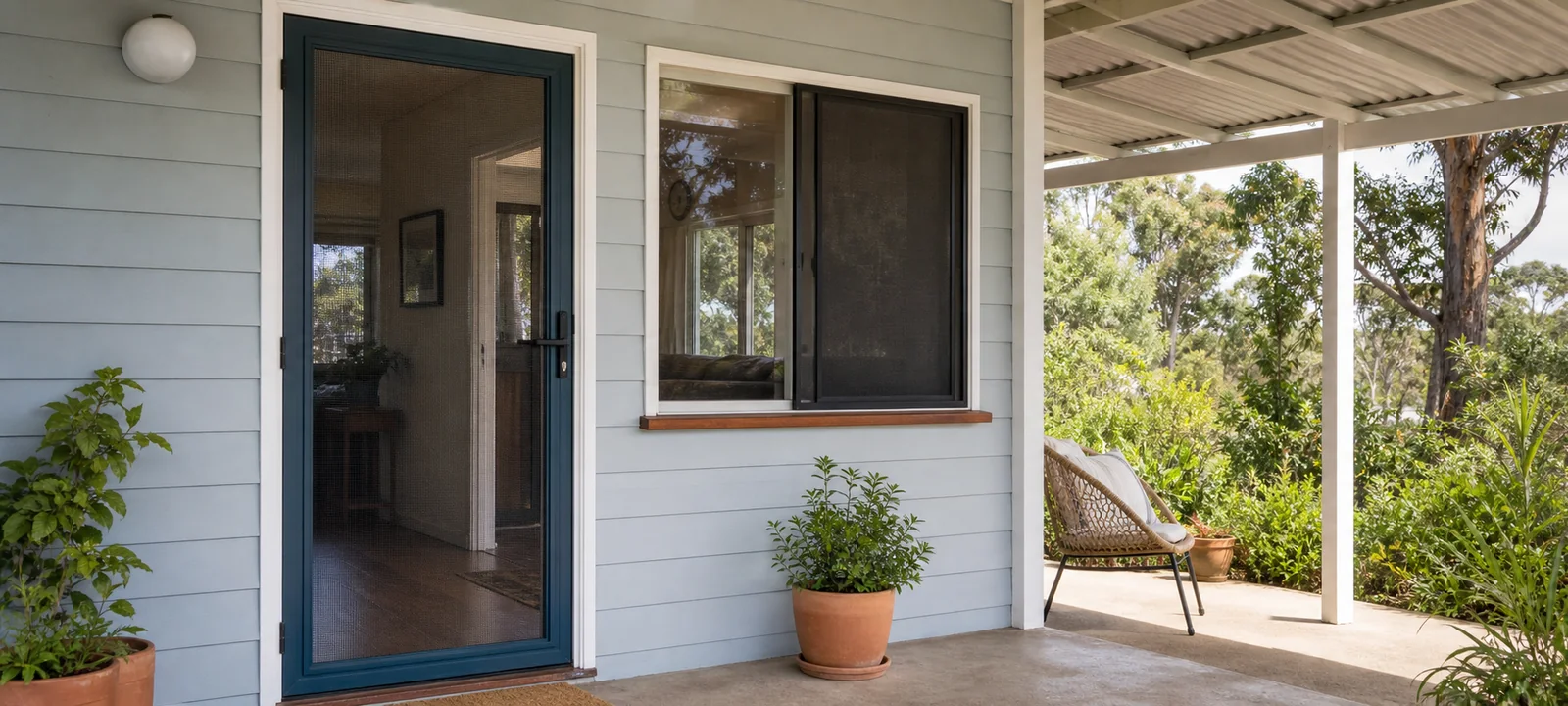
Flies and mosquitoes may arrive at the same time of year, but they rarely need the same solution.
Flies around a kitchen, bin or outdoor table are usually following food or waste. Mosquitoes appearing around dusk are more likely to be sheltering nearby or breeding in standing water. If either insect keeps appearing beside one door or window, the screen or opening may be the real problem.
Start with where and when they appear. That usually tells you more than the number caught by a trap.
Match the problem to the first place you check
| What you notice | Check here first |
|---|---|
| Flies gather around the kitchen during the day | Bins, recycling, fruit, food scraps, pet food and nearby screens |
| Flies appear beside one closed window | Torn mesh, loose screen edges or gaps around the frame |
| Flies arrive whenever the back door opens | A missing screen, a door left ajar or a screen that closes poorly |
| Small flies remain around a sink or drain | Damp organic residue or another source requiring correct identification |
| Mosquitoes appear around dusk | Standing water, shaded vegetation and sheltered outdoor areas |
| Mosquitoes enter bedrooms overnight | Window screens, doors and openings used during the evening |
| Insects persist despite intact screens | Pet doors, exhaust openings, repeated door use or an outside source |
Correct identification becomes more important when insects appear to be coming from a drain, building cavity or inaccessible water.
Check screens, doors and daily use
Close the opening nearest the problem and inspect it in daylight.
Look for:
- holes or tears in the mesh
- mesh pulling away from the frame
- loose rubber spline around the edge
- lifted corners on removable screens
- a bent frame
- worn rollers preventing a sliding screen sitting squarely
- gaps where the screen meets the jamb
- space beneath an external door
- a magnetic screen that does not close completely
From inside, points or lines of daylight can reveal gaps. Check outside as well because loose edges are not always visible from the room.
A patch or flyscreen tape can cover one small tear in otherwise sound mesh. Brittle or sagging mesh with several patches is more likely to need remeshing. A bent frame or door that does not close squarely needs attention beyond replacing the mesh.
Also watch how the entrance is used. Repeated trips for washing, meals, gardening, pets or bins may leave the door open longer than anyone notices.
It may help to:
- repair or adjust a screen-door closer
- clean a sliding-door track
- move furniture blocking the door
- keep outdoor items on the correct side of the entrance
- check that a pet door closes properly
Renters should photograph damaged screens and report them through the normal maintenance process before making permanent alterations.
Do not seal intentional drainage points, weep holes or required ventilation openings.
Know what each product can—and cannot—fix
| Product | Potentially useful when | Will not fix |
|---|---|---|
| Flyscreen patch | There is one small tear in sound mesh | Brittle mesh, loose edges or a bent frame |
| Replacement mesh | The frame is sound but the mesh has deteriorated | A door that does not close squarely |
| Magnetic screen | A frequently used doorway can take a well-fitted removable screen | Uneven openings, security needs or unreliable closure |
| Door seal | There is a genuine gap around a closed door | Insects entering while the door is open |
| Outdoor fan | Mosquitoes bother people in one seating area | Breeding water elsewhere |
| Personal repellent | Additional bite protection is needed | Removing mosquitoes from the property |
| Insect trap | Its target insect and placement match the problem | Damaged screens, food residue or standing water |
| Electric zapper | Limited situations involving insects attracted to light | Reliable mosquito control across a yard |
| Ultrasonic device | No established practical role | Mosquito prevention |
Choose Australian-registered personal repellents and household insecticides and follow the complete label.
Two repair-led options for specific entry points
Compare these only after identifying the exact opening: the patches suit a small isolated tear in otherwise sound mesh, while the removable screen suits a measured window without a serviceable screen. Neither fixes a bent frame, poor door closure, standing water or food attractants.
Some links below are affiliate links. If you buy through one, we may earn a commission at no extra cost to you. Learn more.
Self-adhesive flyscreen repair patches
Cowdroy Flyscreen Repair Patches 150 × 200 mm (Pack of 3)
Three charcoal self-adhesive 150 × 200 mm patches for covering a small isolated tear after confirming that the remaining mesh and frame are sound.
Research-supported option
View at Amazon AustraliaMay suit: one small tear in otherwise sound, clean and dry insect-screen mesh.
May not suit: brittle mesh, several tears, damaged frames, loose edges or any opening needing a security-rated screen.
Drawbacks to consider:
- A patch is only a local repair; brittle, sagging or multiply damaged mesh is more likely to need replacement.
- It cannot correct loose spline, a bent frame, poor door closure or a gap around the opening.
- The Amazon Australia listing showed limited stock at review, so availability may change quickly.
Evidence confidence: moderate. Last reviewed 24 August 2026. Research-based assessment; we have not tested this product firsthand.
Cut-to-size removable window flyscreen
Cowdroy Removable Insect Flyscreen Window 1.3 × 1.5 m
Charcoal mesh for a measured window up to 1.3 × 1.5 m, supplied with 5.6 m of adhesive hook tape so the screen can be cut to size and removed.
Research-supported option
View at Amazon AustraliaMay suit: a measured window without a serviceable insect screen where a removable, cut-to-size solution is appropriate.
May not suit: doors, security openings, uneven frames, unsuitable finishes or windows larger than 1.3 × 1.5 m.
Drawbacks to consider:
- The opening must be measured and the mounting surface must be suitable for adhesive hook tape before the mesh is cut.
- It does not repair a damaged frame, guarantee closure on an uneven opening or provide a security barrier.
- Renters and households with delicate finishes should confirm permission and test the surface before applying adhesive.
Evidence confidence: moderate. Last reviewed 24 August 2026. Research-based assessment; we have not tested this product firsthand.
Remove what is attracting flies
Once damaged screens and door gaps have been repaired or ruled out, check non-entry causes. If flies remain around one location, clean the attractant rather than spraying the surrounding air.
Bins and recycling
Check under the liner, around the rim and inside the lid. Clean leaked residue, let the bin dry and make sure its lid closes.
Rinse food and drink residue from recycling where accepted by your local service.
Food and outdoor meals
Cover food until it is served and clear plates, scraps and spills after eating. Pay particular attention to sugary drinks, meat packaging and barbecue residue.
The outdoor dining-area guide can help create a serving route that does not leave doors open or dirty dishes outside.
Pet areas
Remove uneaten wet food after the normal feeding period and clean around the bowl. Keep opened pet food in its original packaging inside a suitable closed container.
The guides to pet-feeding stations and pet-food storage cover these areas in more detail.
Collect animal waste regularly, particularly near doors and outdoor seating.
Walk the yard after rain or watering
Mosquitoes can breed in small collections of water. Check:
- pot saucers
- buckets and watering cans
- children’s toys
- wheelbarrows
- folded tarps and furniture covers
- containers stored upright
- blocked ground-level drains
- gutters visible safely from the ground
- hollows in outdoor equipment
Empty avoidable water and store movable containers so they cannot refill.
Pets still need clean drinking water. Clean and refill outdoor bowls regularly instead of removing them.
Pools, rainwater tanks, ponds and permanent water features require maintenance suited to their design. Persistent drainage problems need a more specific solution than tipping out loose containers.
Use the gutter-maintenance guide if roof drainage appears to be involved.
Make the seating area harder for mosquitoes to use
Mosquitoes often become noticeable around outdoor seating at dusk. Check the immediate area for wet pot saucers, trapped water, damp storage spaces and dense vegetation.
A suitable fan can create airflow across a table or chairs, making it harder for mosquitoes to land. Aim the breeze through the occupied space while keeping suitable equipment and connections away from water and walking paths.
A fan will not remove breeding water, but it may make one defined area more comfortable.
A ten-minute warmer-weather check
Before the next warm evening:
- Close the nearest screens and look for light around their edges.
- Confirm screen doors close completely.
- Wipe bin rims and remove leaked residue.
- Clear food, drink and pet-food spills.
- Walk the yard and empty avoidable standing water.
- Check covers, pots and storage around the seating area.
- Use targeted airflow if mosquitoes commonly bother that space.
- Keep an appropriate registered repellent available when needed.
When the source may be beyond the property
Contact your council, local public-health unit or a licensed pest professional when mosquito activity remains unusually heavy, water is collecting in inaccessible infrastructure or the insects cannot be confidently identified.
A professional should explain the likely source and why a proposed treatment suits it. Broad spraying without identifying the problem may leave the original entry point, attractant or breeding water untouched.