
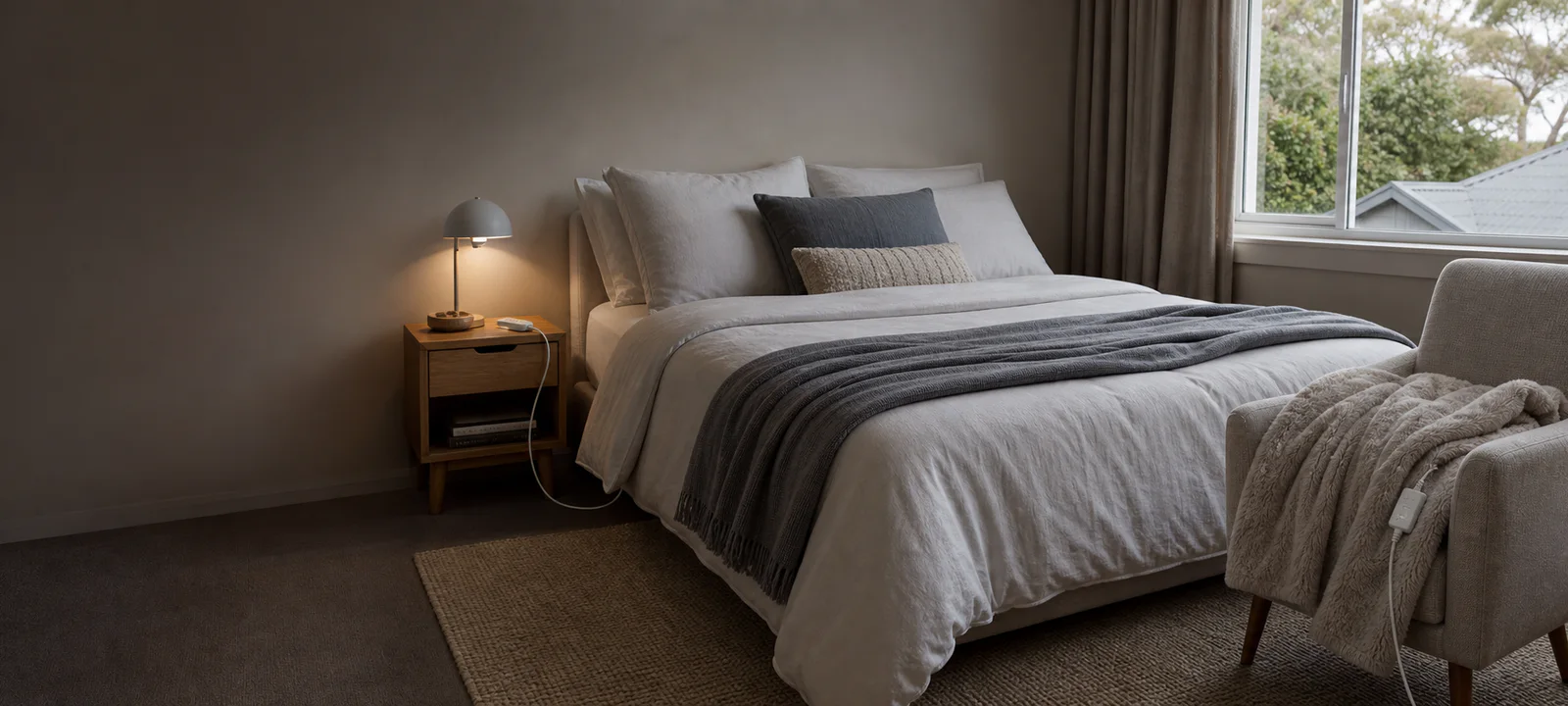
Electric blankets and heated throws both provide close, direct warmth, but they are designed for different situations.
An electric blanket warms a bed. A heated throw warms an awake person sitting or reclining on a sofa, chair or at a desk. That difference determines the correct position, fit, controls, cable path and care routine.
Choose by intended use rather than fabric, appearance or the number of heat settings. Products must only be used in the configuration specified by their manufacturer.
Our Take
An electric blanket can pre-warm a cold bed without heating the whole bedroom. A heated throw can warm one awake person without raising the temperature of an entire living room.
Neither product is interchangeable. An underblanket is not used as an overblanket, and a heated throw is not used as an underblanket or pet mat.
Fit, controller access, cord placement, cleaning instructions and the user’s ability to recognise excessive heat matter more than decorative finish.
Electric blankets warm a bed
In Australia, “electric blanket” commonly refers to a fitted or tie-down underblanket placed on the mattress beneath the sheet. Internal electrical elements warm the sleeping surface, and a controller selects the heat level.
Some products are specifically designed to sit over a sleeper. Use each product only in its stated position. Do not put an underblanket over a person or fit an overblanket beneath the sheet.
Install an underblanket flat and smooth so its heated area sits where the instructions show. Check whether a mattress protector goes above or below it, and keep the connector clear of the sleeper and bed frame. Deep bedding layers should not conceal a poor fit or force the blanket into creases.
Current Australian product-safety advice recommends pre-warming the bed and switching the electric blanket off before sleeping. A timer or automatic shut-off is a backup control, not a reason to ignore that advice or the product instructions.
Heated throws warm an awake person
A heated throw is intended to drape loosely over an awake person who is sitting or reclining. It can suit a sofa, reading chair or desk where individual warmth is useful.
A throw is usually smaller than bed bedding and has one controller. It should not be tucked tightly around a mattress, placed beneath a person or used while heavily folded or bunched.
Allow the throw to rest naturally rather than wrapping it tightly around the body or pinning it beneath furniture. The user should be able to move it, reach the controller and notice if part of the fabric becomes unusually warm. Check that the lead does not pull when the person changes position.
Do not use a heated throw as an underblanket or pet heating mat. A product designed and approved specifically for another configuration may have different instructions, but those instructions remain the deciding source.
Electric blanket and heated throw comparison
Swipe sideways to compare the full table.
| Feature | Electric blanket | Heated throw |
|---|---|---|
| Main purpose | Pre-warming a bed | Warming an awake person |
| Normal position | Fitted beneath the sheet or used exactly as specified | Draped loosely over the user |
| Common size | Matched to a mattress size | One-person throw coverage |
| Controls | One or two controllers depending on size | Usually one controller |
| Dual zones | Available on some larger sizes | Uncommon |
| Typical timing | Bed pre-warm before sleep | Supervised use while awake |
| Portability | Usually remains fitted to the bed | Easier to move between suitable seats |
| Main buying risk | Wrong bed fit or trapped controller connection | Using it as bedding or a mat |
A fitted blanket and an awake-use throw to compare
Before buying, choose the product by where warmth is needed, then verify the exact size, controller and care instructions. The fitted queen blanket is for a correctly matched bed; the throw is for loose use over an awake person. Neither format should be substituted for the other.
Some links below are affiliate links. If you buy through one, we may earn a commission at no extra cost to you. Learn more.
Fully fitted queen electric underblanket
Sunbeam Sleep Perfect Antibacterial Electric Blanket Queen BLA6351
A 153 × 200 cm queen underblanket with dual detachable controllers, six heat settings and 1, 3 or 9-hour auto-off options for a correctly matched mattress.
Research-supported option
View the Sunbeam queen electric blanket at Amazon AustraliaMay suit: a queen mattress that matches the published dimensions and has safe access to two controller leads.
May not suit: another mattress size, an incompatible adjustable bed or a user unable to sense excessive heat or operate the controls safely.
Drawbacks to consider:
- This is the queen-size BLA6351 listing; a different mattress size requires the exact matching model and dimensions rather than stretching or bunching this blanket.
- Dual controllers, auto-off and overheat protection do not replace the current Australian advice to pre-warm the bed and switch the blanket off before sleep.
- The controller connections and two leads need accessible, uncrushed routes, and the product must be inspected, washed, dried and stored exactly as instructed.
Evidence confidence: moderate. Last reviewed 24 August 2026. Research-based assessment; we have not tested this product firsthand.
One-person heated throw for awake use
Sunbeam Feel Perfect Sherpa Fleece Heated Throw TRF4200
A 120 × 160 cm sherpa and microfleece heated throw with one digital controller, six heat settings and selectable 1, 3 or 9-hour auto-off.
Research-supported option
View the Sunbeam heated throw at Amazon AustraliaMay suit: an awake person wanting localised warmth on a suitable chair, sofa or desk seat.
May not suit: someone seeking an underblanket, overnight bed heating or a product that can be tightly wrapped or pinned in place.
Drawbacks to consider:
- The 120 × 160 cm dimensions provide one-person coverage rather than complete bed coverage, and the throw has one controller.
- It is for loose use over an awake person, not beneath a sleeper, tucked around a mattress, folded while operating or used as a pet mat.
- The controller must remain uncovered and reachable, and the detachable parts, washing, complete drying and storage instructions still need to be followed.
Evidence confidence: moderate. Last reviewed 24 August 2026. Research-based assessment; we have not tested this product firsthand.
Intended position and use
Electric bedding is designed around how its elements sit during operation. Folding, tight tucking, heavy bunching or pressure from an unsuitable position can concentrate stress and heat.
Do not use electric bedding folded, heavily bunched, wet or damaged. Do not place heavy objects on an operating electric blanket, and do not use a product in a position that its instructions do not permit.
Keep controllers uncovered and accessible. Do not place a controller beneath a pillow, mattress, person or other bedding. The user should be able to adjust or switch off the product without reaching into a trapped space.
Bed size, mattress compatibility and throw coverage
Match an electric blanket to the exact mattress size and check the actual product dimensions. A fitted skirt should sit securely without pulling or bunching; a tie-down design should attach as instructed.
Mattress depth, pillow-top construction and the position of the controller connection can affect fit. Check the instructions before use with adjustable or profiling beds, sofa beds, air or water mattresses, memory foam, medical or pressure-relieving mattresses and unusual protectors. Moving bed sections must not trap the cord or connection.
On a shared bed, confirm where each controller lead exits and whether both sleepers can reach their own control without crossing cables. Check that the blanket’s heated area aligns with the sleeping area rather than relying only on the size name printed on the box.
A heated throw should be assessed by dimensions rather than a styled photograph. A smaller throw may cover the lap and torso but leave the feet exposed. A larger throw offers more coverage but can be heavier and more awkward to handle or store.
Controls, timers and dual zones
Useful controls are clear, easy to reach and appropriate for the user. Compare the number of heat settings, timer duration, automatic shut-off, button layout, display brightness and whether controllers detach for cleaning.
Dual controls can help two sleepers choose different settings on a larger electric blanket. Check whether each side operates independently and where each heated zone begins and ends; unheated areas near the pillow or edges may be intentional.
Try to assess whether the controller can be understood by touch and in low light, especially if it will be used by someone with limited dexterity or vision. Confirm how to reduce the setting and switch the product off, rather than assuming every button sequence is intuitive.
More settings do not automatically make a product safer or better. A simple controller may be preferable where a complex display would be difficult to operate. Automatic shut-off does not make damaged or incorrectly positioned bedding acceptable.
Cords and controller placement
Before buying, map the wall outlet, controller connection and normal position of the bed, sofa or chair. Cords must not be crushed, stretched, trapped, sharply bent, run through a doorway or placed beneath rugs.
Keep cords out of walkways and away from adjustable-bed mechanisms, reclining furniture and bed frames. Do not assume an unsuitable outlet arrangement can be fixed later with an overloaded power board or improvised cable route.
Inspect plugs, connectors and controllers for looseness, cracks, discolouration or unusual heat. If the available outlet or connection is damaged or unclear, stop and seek appropriately qualified electrical advice.
Cleaning, drying, storage and inspection
Follow the care label exactly. “Machine washable” commonly requires the controller and lead to be disconnected first, and the instructions may specify a water temperature, cycle, spin restriction or hand-washing method.
Keep detached electrical parts away from water and protect the connector as directed during washing. Do not wring, iron or dry-clean the product unless its care instructions expressly allow that treatment. After washing, reshape it gently and check that the fabric and internal elements still lie evenly.
Electric bedding must be completely dry before reconnection. Do not speed drying with the product’s own heat, reconnect it while any moisture remains or use it wet.
Store the product as directed. Current Australian product-safety guidance advises rolling electric blankets rather than folding them. Avoid tight creases, sharp bends and heavy objects that can stress internal elements.
Inspect electric bedding before the first winter use and periodically during the season. Look for frayed fabric, scorch marks, displaced elements, unusual hot spots, cracked controllers, damaged plugs, crushed cords, loose connections, intermittent operation or a burning smell.
Stop using a damaged product. Do not repair internal wiring, controllers or heating elements. Check the Product Safety recalls database, particularly for an older, second-hand or unfamiliar product.
Children, pets and reduced heat sensitivity
Check the manufacturer’s age limits and supervision requirements. Children may not recognise excessive heat or may change controls unexpectedly. People with reduced mobility, sensation, cognitive capacity or ability to respond to discomfort may also need a different approach.
Consider whether the person can move away from the heat, communicate discomfort and operate the controller independently. If they cannot, the product may require closer supervision or may not be appropriate. Do not infer suitability from a low setting alone.
People with reduced heat sensitivity should seek appropriate professional advice before using heated bedding. Product Safety Australia specifically advises seeking advice about electric-blanket use during pregnancy or for people with diabetes. This is general safety guidance, not a diagnosis or individual medical recommendation.
Pets can scratch, chew or knead fabric and damage internal wiring. Keep them away from electric bedding during use and storage, and stop using any product showing pet damage. A heated throw is not a pet mat.
Personal heating does not always replace room heating
Electric blankets and heated throws provide localised warmth. They do not significantly warm the surrounding room, remove a cold draught, prevent condensation or address persistent dampness.
Personal heating can make sense when the room is otherwise safe and one bed or person needs warmth. It may not provide adequate comfort for someone moving around the room, using their hands for tasks or spending long periods in very cold conditions.
For a persistently cold bedroom, large living space or household-wide need, compare an appropriate room-heating system. Personal heating and room heating can serve different purposes.
Before You Buy Checklist
Before choosing an electric blanket or heated throw, check:
- Do you need to warm a bed or an awake person?
- Is the product approved for the intended position and use?
- Does the electric blanket match the mattress size and depth?
- Is it compatible with the mattress and bed mechanism?
- Does the heated throw provide the required coverage?
- Are one or two controllers needed?
- Can dual zones operate independently where required?
- Are the heat settings, timer and shut-off controls clear?
- Can every controller remain uncovered and accessible?
- Can cords avoid crushing, stretching, trapping and rugs?
- Can plugs and connections remain clear of moving furniture?
- Are the washing instructions practical for the household?
- Can the product dry completely before reconnection?
- Can it be stored without tight folds or heavy objects?
- Has it been inspected for damage before winter use?
- Has the model been checked against current recalls?
- Does any user need qualified advice about heat sensitivity?
- Can children and pets remain appropriately supervised?
- Will the bed be pre-warmed and the blanket switched off before sleep?
Choose according to where warmth is needed
Choose an electric blanket to pre-warm a correctly matched bed. Choose a heated throw for an awake person wanting localised warmth on a sofa, chair or at a desk.
The safe choice fits its intended location, keeps controllers accessible, provides a sound cable path and can be cleaned, dried, inspected and stored exactly as instructed.