
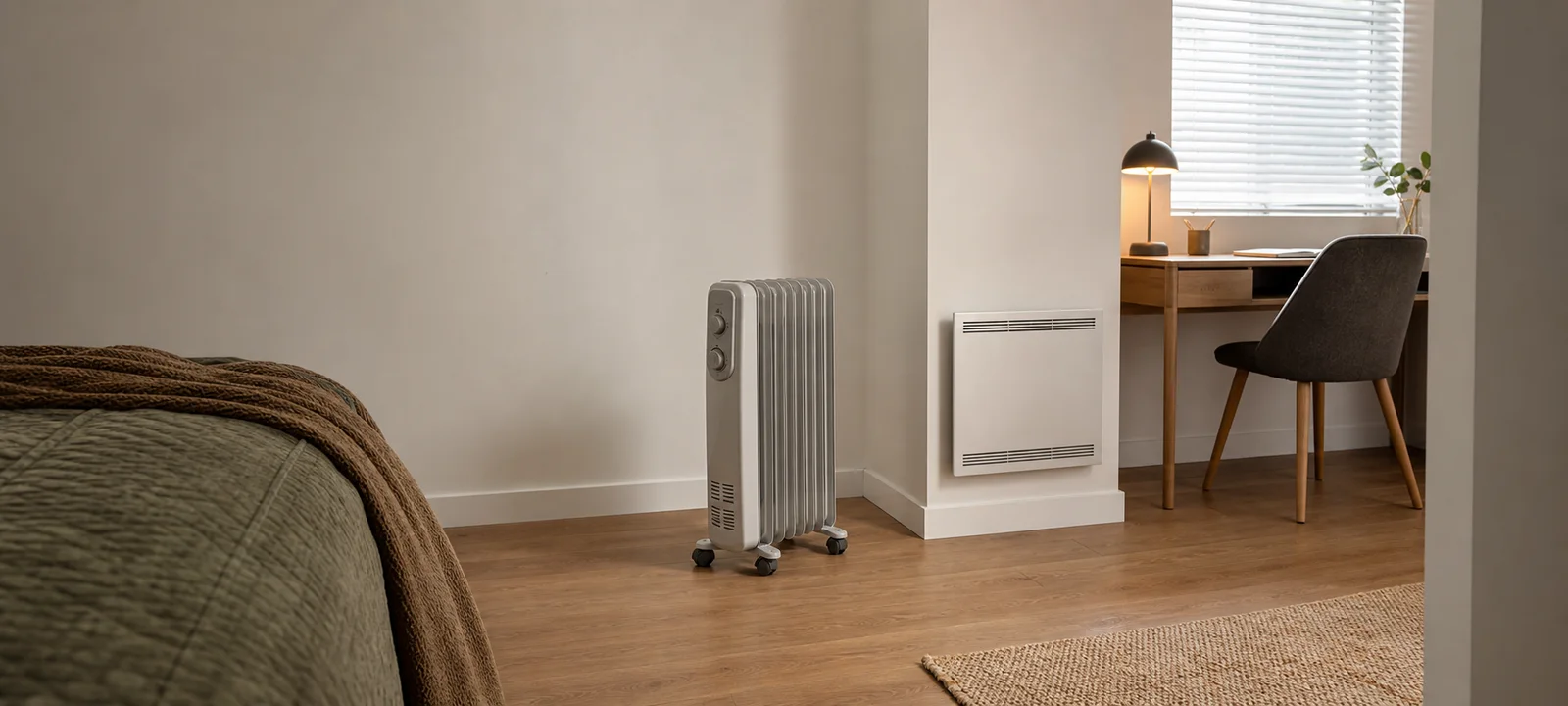
Oil column and panel heaters are often considered for the same rooms.
Both are quiet electric resistance heaters commonly used in bedrooms, home offices and smaller enclosed living areas. Neither normally relies on a strong fan, so both provide gradual background warmth rather than an immediate blast of hot air.
The practical differences are the way the heat feels, how quickly it is noticed, how much warmth the heater retains, and whether portability or a shallow wall position matters more.
Slimness, oil or “eco” wording does not prove lower electricity use. Compare rated wattage, thermostat behaviour, controls and a safe position before choosing either type.
Our Take
An oil column heater can suit a small enclosed room where quiet, gradual warmth is wanted and there is safe floor space. A panel heater can suit a bedroom or compact office where a slim profile or approved wall mounting is useful.
Neither is an efficient answer for heating several connected rooms or a large open-plan area. Both convert electricity into resistance heat, so a model that runs at a high wattage for a long time can use substantial electricity regardless of its shape.
Choose for the room, placement and operating pattern. Quiet operation does not make either heater suitable for unattended overnight use.
How oil column heaters work
An oil column heater contains an electrical element and sealed heat-transfer oil. The element warms the oil, which transfers heat to the metal columns. The heater then warms the room through natural convection and radiant warmth from its surface.
The oil is not burned or normally consumed, and it does not require routine topping up. It acts as thermal mass: it takes time to heat, then continues releasing some warmth as the element cycles off and the body cools.
Most models are portable and have castors, several heat settings and a thermostat. Some add a timer, digital controls, cord storage, overheat protection or a tip-over switch. The body is relatively bulky and can be heavy to move.
How panel heaters work
A panel heater is a slim electric resistance heater that mainly warms air by natural convection. Cooler air enters around the lower part of the heater, warms inside or behind the panel and rises into the room.
Many models mount on a wall; others can stand on manufacturer-supplied feet. Controls may be mechanical or digital. Most operate without a fan, although a model with a boost fan will feel and sound different.
A wall-mounted panel can preserve floor space, but it still needs clear airflow and the manufacturer’s specified clearances. Panel heaters must not be blocked by furniture or curtains.
Oil column and panel heater comparison
Swipe sideways to compare the full table.
| Feature | Oil column heater | Panel heater |
|---|---|---|
| Main heat delivery | Radiant warmth and natural convection | Mainly natural convection |
| Warm-up feel | Usually gradual because the oil and metal heat first | Gradual to moderate as warmed air rises |
| Retained warmth | Oil and metal release stored warmth while cooling | Usually less warmth after the element switches off |
| Noise | Generally quiet, with possible clicks or expansion sounds | Generally quiet, with possible clicks, beeps or bracket noise |
| Space | Needs a stable, clear floor position | Wall mounting can preserve floor space |
| Portability | Movable on castors but often heavy | Fixed when mounted; some models have compatible feet |
| Electricity use | Depends mainly on wattage, operating time and thermostat cycling | Depends mainly on wattage, operating time and thermostat cycling |
| Typical fit | Quiet background warmth where floor space is available | Quiet background warmth where a shallow profile is useful |
An oil column and a slim convector to compare
Only compare these portable 2400W models after measuring an enclosed room, finding a stable position with the required clearances and confirming a suitable wall power point. The oil column favours gradual retained warmth; the slim convector favours a lighter body and faster fan-assisted warm-up.
Some links below are affiliate links. If you buy through one, we may earn a commission at no extra cost to you. Learn more.
2400W oil column heater with mechanical timer
De'Longhi Dragon 4 Oil Column Heater TRD42400MT
An 11-fin 2400W oil column heater with three power settings, adjustable thermostat, 24-hour timer, safety thermostat, tilt switch and pre-assembled castors.
Research-supported option
View the De'Longhi Dragon 4 at Amazon AustraliaMay suit: a measured enclosed room where gradual, quiet warmth, a stable floor position and sufficient clearance are available.
May not suit: a large open-plan area, an obstructed room, a household needing immediate directional heat or a location without a suitable dedicated wall outlet.
Drawbacks to consider:
- The 2400W rating is a high electrical load, so it needs direct connection to a suitable wall power point rather than a power board, double adaptor or extension lead.
- At about 60.5 × 18 × 70 cm and 18.6 kg, it occupies more floor and storage space than a slim convector and remains a hot physical object around children and pets.
- Oil column heating is gradual; the timer and thermostat do not make it suitable for unattended operation, leaving the home or sleeping use.
Evidence confidence: moderate. Last reviewed 24 August 2026. Research-based assessment; we have not tested this product firsthand.
2400W slim convector heater with lateral fan
De'Longhi SlimStyle Convector Heater HSX3324FTS
A 2400W portable convector with three power settings, room thermostat, 24-hour mechanical timer, lateral fan, carry handles, safety thermostat and tilt switch.
Research-supported option
View the De'Longhi SlimStyle convector at Amazon AustraliaMay suit: a measured small or medium enclosed room needing a lighter, slimmer portable heater and faster fan-assisted warm-up.
May not suit: a bedroom during sleep, a crowded furniture layout, a large open area or anyone expecting silent operation.
Drawbacks to consider:
- The 2400W rating is a high electrical load and requires direct use at a suitable wall power point without a power board, double adaptor or extension lead.
- Its lateral fan can accelerate warm-up but adds airflow and a stated 45 dB noise condition, so it is not equivalent to a silent passive panel.
- The slim profile still needs a stable floor position and manufacturer clearances; wall mounting or fixed electrical work must follow the instructions and any required qualified advice.
Evidence confidence: moderate. Last reviewed 24 August 2026. Research-based assessment; we have not tested this product firsthand.
Heat feel, warm-up time and retained warmth
An oil column heater provides both convection and some direct radiant warmth. A person sitting within a suitable distance may notice warmth from the body before the whole room reaches a stable temperature. The internal oil and metal must warm first, so the initial response can feel slow.
A panel heater relies more on rising warm air. It may begin warming that air sooner, but the room still heats gradually through circulation. A thin panel is not automatically a fast heater.
Neither type normally matches the immediate effect of a fan-assisted heater. They make more sense when the room can warm before comfort is urgently needed.
An oil column heater stays warm for a period after its element switches off because the oil and metal have stored heat. That retained warmth is not free heat: it came from electricity already used. Thermal mass changes when heat enters the room, not the total heat produced from the electrical input.
Electricity use and rated wattage
Oil column and panel heaters are both electric resistance heaters. If a 2000-watt oil column heater and a 2000-watt panel heater operate continuously at full input for the same time, their electricity consumption will be broadly similar.
Actual use over a session depends on:
- rated input and selected heat setting
- how long the element operates
- thermostat cycling and target temperature
- room size, starting temperature and heat loss
- how the household uses the controls
A lower heat setting usually reduces electrical input and heat output while selected. It does not change resistance heating into a more efficient process. A heater that is too small for the room may run continuously without delivering comfortable warmth.
Do not infer low electricity use from slimness, the presence of oil, wall mounting, the number of columns or words such as “eco”. Check the rated watts for each setting and any boost mode.
Thermostats and controls
The thermostat switches the element on and off in response to its temperature sensor. A basic mechanical dial may not correspond to a precise room temperature. A digital display may offer a target temperature, but its accuracy still depends on sensor position, nearby warm air, cold walls and room airflow.
Useful controls can include stepped heat settings, a clear thermostat, a timer, scheduling and a simple manual override. In a bedroom or office, also consider display brightness, control beeps and whether settings remain after a power interruption.
Check whether the heater automatically restarts when power returns. Timers, thermostats, child locks, overheat protection and tip-over switches are backup or control features; they do not justify unattended operation, blocked airflow or reduced clearances.
Noise
Both types are generally quieter than fan heaters. An oil column model may click as the thermostat cycles or tick as metal expands and cools. A panel heater may produce relay clicks, control beeps, expansion sounds or vibration against its brackets. A boost fan adds fan noise.
Sounds that seem minor in a shop can be noticeable in a quiet bedroom or office. Check whether beeps and display lighting can be disabled. Quiet operation does not make either heater suitable for use while sleeping.
Floor space, wall mounting and placement
An oil column heater needs a flat, stable floor position outside walkways and clear of doors, desks, paper, bedding, curtains and furniture. Its castors make it movable, but do not pull it by the cord or move it while the columns are hot.
A panel heater can keep the floor clear when correctly wall-mounted. The wall must allow the required space above, below and beside the unit, free convection airflow, access to controls and a suitable power supply. Do not place it behind a sofa, desk, open door or floor-length curtains.
Wall mounting must follow the heater instructions and property approval requirements. Renters should obtain written approval before drilling or permanently mounting a heater. Use the supplied brackets or feet; do not improvise supports. Any required fixed electrical work belongs with an appropriately licensed electrician.
Portability and storage
Oil column heaters are usually designed to move between suitable rooms, but their weight, width and hot surfaces can make them awkward. Check the assembled weight, handles, castors, cord storage and whether stairs are involved.
A portable panel model may be lighter, but it must use the compatible feet and remain stable on the intended floor. A wall-mounted model is not portable simply because it can be removed from brackets.
Before storage, switch the heater off, unplug it, let it cool and inspect the cord and plug. Clean and store it in the orientation specified by the manufacturer, without heavy items resting on it.
Bedrooms, offices and small enclosed rooms
Both heater types are best considered for a small or moderate enclosed room where the door can be closed and warmth can build gradually. Large windows, high ceilings, frequent door opening and significant draughts increase the heating task.
In a bedroom, an oil column heater may suit supervised pre-bedtime warming where safe floor space is available. A panel heater may suit where an approved wall position preserves circulation space. Neither should sit within the clearance zone of bedding or curtains.
In a home office, either may provide quiet background warmth. Check that an oil heater will not crowd the chair or cables, and that a panel will not be obstructed by the desk, papers or storage.
For a large open room, several connected spaces or regular long-duration heating, compare other home heating options. A suitable reverse-cycle system can provide substantially more efficient regular room heating than electric resistance heaters.
Portable-heater safety
Portable heaters should plug directly into a suitable wall power point. Use one appliance per power point. Do not use a power board, double adaptor or joined extension leads, and do not run the cord beneath a rug, through a doorway or where it can be damaged.
Keep the heater at least one metre from bedding, curtains, furniture and clothing. Keep paper, towels, drying racks and other combustible items outside that clearance as well, and follow any greater clearance in the manufacturer’s instructions.
Never cover either heater or use it to dry clothing. Panel heaters must not be blocked by furniture or curtains because their convection inlets and outlets need clear airflow.
Switch heaters off before leaving the room or sleeping. Quiet operation, a timer or a thermostat does not make unattended overnight use appropriate. Maintain working smoke alarms and supervise children or pets around operating heaters and hot surfaces.
Stop using a heater if its cord, plug or casing is damaged, if the power point becomes unusually hot or discoloured, or if there is sparking, intermittent operation or a burning smell. A damaged or unsuitable outlet should be assessed by a licensed electrician. Check the model against current product recalls.
Which type is likely to suit?
An oil column heater may suit when quiet gradual warmth, some radiant feel and portability are useful, and a stable floor position can remain clear. It is less compelling when immediate heat, minimal storage space or easy movement on stairs matters.
A panel heater may suit when a shallow profile, quiet convection and approved wall mounting are priorities. It is less compelling when the available wall is behind furniture or curtains, mounting is not permitted, or the heater needs to move regularly.
If neither has a safe position or the room remains difficult to warm, address the room or choose a more appropriate system rather than buying a higher-wattage portable heater by default.
Before You Buy Checklist
Before choosing an oil column or panel heater, check:
- Is the room small or moderate in size and able to be enclosed?
- Is gradual background warmth suitable, or is rapid heat required?
- What is the rated wattage at each heat setting?
- How clearly does the thermostat control and display temperature?
- Does the heater restart automatically after a power interruption?
- Are timer, display and control sounds suitable for the room?
- Is quiet operation important without implying overnight use?
- Is there a stable, clear floor position for an oil column heater?
- Can the oil heater be moved and stored safely?
- Is there a suitable unobstructed wall for a panel heater?
- Will furniture and curtains remain clear of the panel?
- Do mounting instructions suit the wall and supplied brackets?
- Is written property approval required for wall mounting?
- Can the heater plug directly into a suitable wall power point?
- Will it be the only appliance connected to that power point?
- Can the cord remain clear of rugs, doorways and walkways?
- Can at least one metre be kept clear around the heater?
- Will the heater remain uncovered and away from drying clothes?
- Will it be switched off before leaving the room or sleeping?
- Are the cord, plug, casing and safety features in sound condition?
Choose for the room, not the shape
Oil column and panel heaters can both provide quiet, gradual warmth in a suitable enclosed room. An oil column heater adds portability, a more radiant feel and retained warmth; a panel heater offers a shallow profile and can preserve floor space when correctly mounted.
Neither design is inherently cheap to run. Compare rated power, operating time, thermostat behaviour and the available safe position, then choose the heater that fits the room without being blocked or left unattended.
Official guidance
- Australian Government heating and cooling guidance
- Australian Government winter energy savings guidance
- ACCC Product Safety winter home safety guidance
- Fire and Rescue NSW winter fire safety campaign
- Fire and Rescue NSW guidance for heaters and open fires
- Product Safety Australia consumer product recalls