
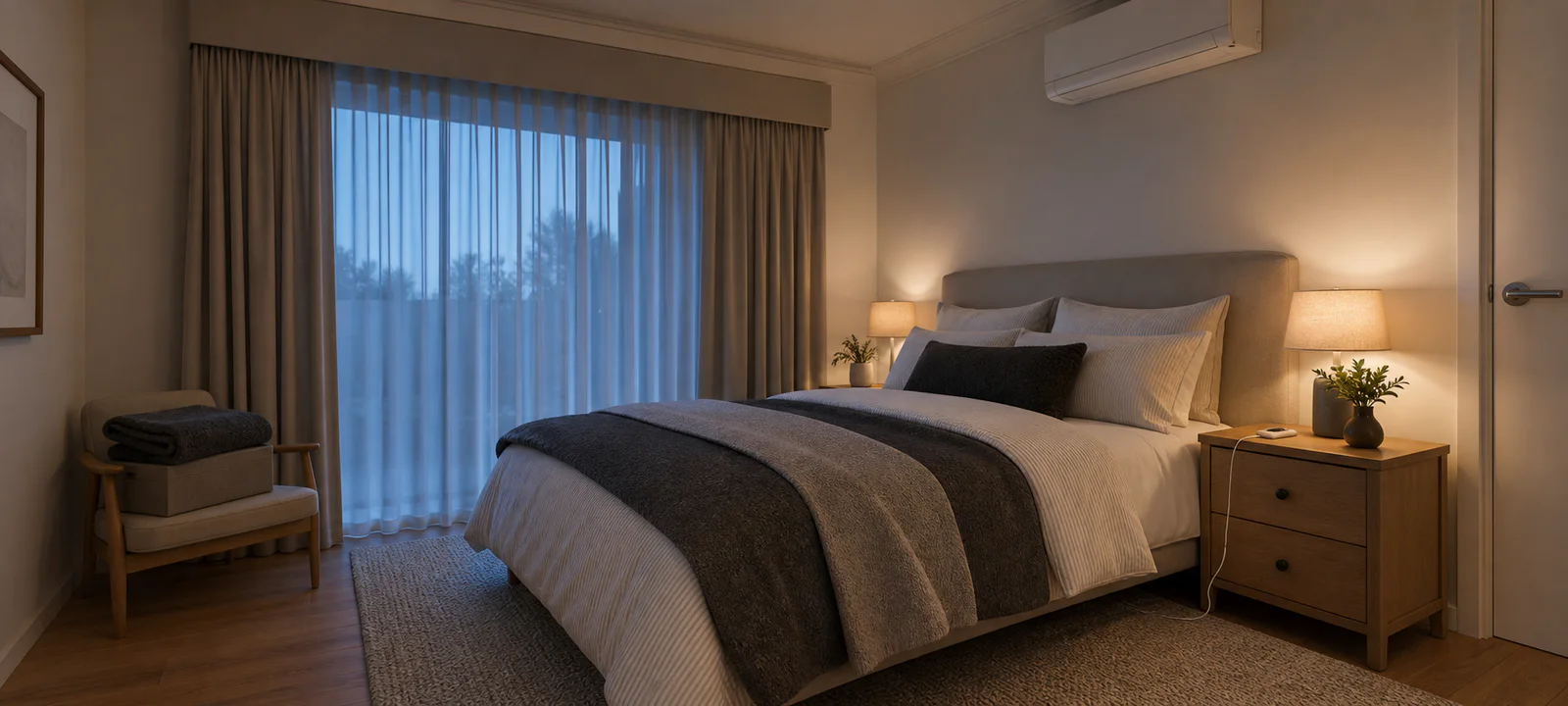
A cold bedroom does not always need to remain heated throughout the night.
The actual problem may be a cold bed, air leaking around a window, inadequate bedding or a room that loses warmth soon after the heater is switched off. Each points towards a different solution.
An electric blanket can pre-warm the bed without heating the entire room. A reverse-cycle air conditioner can warm the room before bedtime and provide controlled fixed heating where regular use justifies it. Portable heaters can provide short-term supervised warmth, but quiet operation and safety features do not make them suitable for being ignored while people sleep.
The right choice depends on whether the household needs to warm the bed, the person or the room.
Our Take
Separate bedtime comfort from overnight heating.
Begin by deciding whether the bedroom needs:
- a warmer bed
- short-term warmth while getting ready
- pre-heating before sleep
- regular fixed heating
- better insulation, curtains or draught control
- investigation of dampness or condensation
These are not the same task.
For many bedrooms, warm bedding and a prepared room provide better overnight comfort than a portable heater operating beside the bed for hours.
Start with the bedroom
Before comparing appliances, check:
- room dimensions and ceiling height
- whether the bedroom opens into an ensuite, robe or hallway
- window size and glazing
- curtains or blinds
- draughts around doors and windows
- ceiling, wall and floor insulation
- safe heater positions
- wall power points
- children, pets or bunk beds
- how long the room is occupied before sleep
A bedroom used only for sleeping has different requirements from one that also functions as a study, nursery or sitting area.
Where the room remains extremely cold or damp, investigate the building before relying on more heating.
Bedroom heating options at a glance
| Heating option | Usually suited to | Main advantage | Main limitation |
|---|---|---|---|
| Electric blanket | Pre-warming the bed | Targets the sleeping surface | Must fit correctly and be switched off before sleep |
| Heated throw | An awake person reading or sitting | Localised personal warmth | Not designed as an underblanket |
| Reverse-cycle air conditioner | Regular room heating and summer cooling | Efficient fixed heating | Requires suitable sizing, airflow and installation |
| Oil column heater | Supervised pre-bedtime room heating | Quiet, gradual warmth | Slow response, hot surfaces and floor space |
| Panel heater | Quiet heating in an enclosed room | Slim profile and possible wall mounting | Can be obstructed by furniture or curtains |
| Fan or ceramic heater | Brief supervised warm-up | Fast heat | Fan noise and poor suitability for sleep |
| Ducted heating | A bedroom connected to a whole-home system | Central control and zoning | Airflow and zone design must suit the room |
Decide whether the bed or room is cold
Ask:
- Is the room uncomfortable while getting ready for bed?
- Is the main problem getting into cold sheets?
- Does the sleeper feel comfortable once under the bedding?
- Does cold air move across the bed?
- Does the bedroom become extremely cold overnight?
- Is ongoing temperature control genuinely required?
- Is the room damp or affected by condensation?
Where the bed is the main problem, suitable bedding or electric bedding may be more direct than heating the complete room.
Where the room is persistently cold, check heat loss and fixed-heating options.
The broader Home Heating Options guide provides an overview of all major heating types.
Electric blankets
An electric blanket can pre-warm the sleeping surface without heating the whole bedroom.
Before buying, check:
- exact mattress size
- mattress depth
- fitted-skirt or tie-down design
- one or two controllers
- controller and cable position
- timer or automatic shut-off
- cleaning instructions
- adjustable-bed compatibility
Use the blanket only in the configuration specified by its manufacturer.
Current Product Safety Australia guidance advises warming the bed and switching the electric blanket off before sleeping.
Inspect it before each winter. Do not use it where there are:
- damaged cords
- cracked controllers
- scorch marks
- exposed elements
- worn fabric
- unusual hard areas
- intermittent operation
- signs of pet damage
Store it according to the manufacturer’s instructions. Current Australian guidance advises rolling electric blankets rather than folding them tightly.
The Electric Blankets vs Heated Throws guide covers fit, controls, cleaning and intended use in detail.
Heated throws
A heated throw is designed to sit over an awake person on a chair or sofa.
It can provide personal warmth while reading or working before bedtime.
It is not normally designed to:
- sit beneath a sleeper
- replace an electric underblanket
- be tucked around a mattress
- remain folded while operating
- operate beneath a person
- serve as a pet-heating mat
Use it only as directed.
A heated throw can reduce the need to warm the entire room while one person is awake, but it does not necessarily warm the bed.
Reverse-cycle air conditioning
A correctly sized reverse-cycle system can provide efficient fixed bedroom heating and summer cooling.
For bedroom comfort, the most important practical checks are:
- indoor-unit position
- airflow over the bed
- lowest fan speed
- indoor and outdoor noise
- display brightness
- control beeps
- timer behaviour
- filter access
- climate-zone heating performance
A unit installed directly opposite or above the bed may create uncomfortable airflow even when the temperature is suitable.
The easiest wall for installation is not automatically the best position for sleep.
Use the Reverse-Cycle Heating Explained guide for capacity, climate ratings, cold-weather behaviour and defrost cycles.
Pre-heating with a fixed system
A practical bedtime routine may involve:
- closing the bedroom
- closing curtains before outdoor temperatures fall
- setting a moderate target temperature
- allowing the room to warm while it is occupied
- directing airflow away from the bed
- switching the system off at bedtime where suitable
- retaining warmth through bedding and room preparation
Australian Government guidance recommends turning heating off overnight where suitable.
Some households may need continued temperature management because of climate, age, health or professional advice. Those circumstances require an appropriate fixed system and individual guidance rather than a portable heater operating beside the bed.
Portable electric heaters
Oil column, panel, fan and ceramic heaters may provide supervised warmth before bedtime.
Their main differences are:
- warm-up speed
- fan noise
- airflow
- floor or wall placement
- portability
- controls
Oil column and panel heaters provide quieter gradual warmth. Fan and ceramic heaters warm the room more quickly but produce fan noise and concentrated airflow.
None should be considered suitable for unattended sleep merely because it includes:
- a thermostat
- timer
- tip-over switch
- overheat protection
- child lock
- quiet operation
Use the Oil Column Heater vs Panel Heater guide or Fan Heater vs Ceramic Heater guide for detailed comparisons.
Portable-heater bedtime safety
Portable heaters should be switched off before leaving the room or going to sleep.
Keep them:
- on a stable, level surface
- outside walkways
- directly connected to a suitable wall power point
- at least one metre from bedding, curtains, clothing and furniture
- clear of drying laundry
- supervised around children and pets
Use one appliance per power point.
Do not use:
- power boards
- double adaptors
- joined extension leads
- damaged cords
- outdoor gas heaters
- barbecues
- charcoal appliances
- unflued gas heaters while sleeping
Never dry clothing or bedding on a heater.
Noise and controls
Bedroom noise may come from:
- fans
- compressors
- outdoor units
- thermostat clicks
- panel or oil-column expansion
- control beeps
- moving louvres
- vibration
A daytime showroom may not reveal what becomes noticeable at night.
Check:
- the lowest operating speed
- timer and relay sounds
- whether beeps can be disabled
- display brightness
- outdoor-unit position
- whether wall mounting transfers vibration
“Quiet” is subjective unless test conditions are provided.
Airflow over the bed
Map the bed, wardrobes, curtains, doors and possible future furniture positions before installing a fixed system.
Check whether the indoor unit can:
- direct warm air down into the room
- swing away from the bed
- operate at a comfortable low fan speed
- remain clear of curtains and furniture
- allow filters to be removed
A bedroom layout may change. An installation that suits the current bed position may become uncomfortable after furniture is rearranged.
Where warm air collects near a high ceiling, a reversible ceiling fan on its labelled winter setting may improve circulation. The fan does not create heat.
Ducted heating
Where a ducted system already serves the bedroom, check:
- whether the bedroom zone is open
- supply-airflow strength
- return-air path
- blocked grilles
- thermostat or sensor location
- zone schedule
- whether the system is designed to operate with the bedroom door closed
Do not close every unused ducted zone without understanding the system’s minimum-airflow requirements.
A bedroom that remains cold may have a balancing, duct, insulation or control problem rather than needing another portable heater.
Prepare the room before adding more heat
A bedroom may cool rapidly because of:
- poor window coverings
- draughts
- missing insulation
- cold hard floors
- open hallways
- furniture against cold walls
- large areas of glazing
Use existing curtains effectively and keep them clear of heaters. Open them where useful winter sun can warm the room, then close them before the temperature falls.
The draught-reduction guide explains how to reduce uncontrolled air leakage without blocking ventilation.
The Bedroom Lighting and Window Coverings guide covers curtain and blind planning.
Condensation and dampness
Heating can raise room and surface temperatures, but it does not repair:
- roof or plumbing leaks
- failed window seals
- inadequate bathroom extraction
- damp building materials
- recurring mould
A warm living room can also send moist air into a colder bedroom where it condenses on windows or walls.
Where the bedroom has persistent condensation, mould or musty odours, use the Winter Condensation and Mould guide rather than treating extra heating as the only solution.
Children, pets and bunk beds
Children and pets may:
- touch heaters
- alter controls
- pull cords
- push bedding into clearance zones
- cover grilles
- knock portable heaters
- damage electric bedding
A control lock does not prevent physical contact.
Bunk and loft beds also change safe clearances around:
- ceiling fans
- wall-mounted heaters
- curtains
- cords
- portable appliances
Do not place a heater where bedding from an upper bunk can fall into its clearance area.
Before You Buy Checklist
Before choosing bedroom heating, check:
- Is the main problem the bed, one person or the room?
- Can the bedroom be pre-heated rather than heated overnight?
- What are the room dimensions and ceiling height?
- Does it open into an ensuite, robe or hallway?
- Are curtains and blinds effective?
- Are draughts present?
- Is insulation known?
- Is condensation or mould present?
- Would suitable bedding solve the immediate problem?
- Does an electric blanket fit the mattress correctly?
- Can electric bedding be switched off before sleep?
- Are electric-bedding cords and controllers undamaged?
- Is a heated throw intended only for awake use?
- Would a fixed reverse-cycle system suit regular use?
- Will fixed-system airflow avoid the bed?
- Are noise, control beeps and display brightness acceptable?
- Is a portable heater only being considered for supervised pre-heating?
- Can at least one metre be maintained from bedding and curtains?
- Can the appliance connect directly to a suitable wall power point?
- Are children, pets or bunk beds present?
- Will portable heaters be switched off before sleep?
- Are smoke alarms maintained and exits clear?
- Are landlord or strata approvals required?
- Has the product been checked against current recalls?
Prepare the room and bed before adding more heat
Bedroom comfort is not determined by heater size alone.
Begin with the bed, window coverings, draughts, insulation and the way the room is occupied.
An electric blanket can pre-warm the bed and should be switched off before sleep. A reverse-cycle system can efficiently warm the room where regular use and fixed installation make sense. Portable heaters may provide supervised pre-bedtime warmth, but quiet operation and safety controls do not make them suitable for unattended sleeping use.
Choose the solution for the problem the room actually has.
A warm bed in a prepared room may provide better overnight comfort than a larger heater operating beside the bedding for hours.
Official guidance
- Australian Government guidance on household heating and cooling
- Australian Government winter energy savings guidance
- ACCC Product Safety winter home safety guidance
- Fire and Rescue NSW winter fire safety campaign
- Fire and Rescue NSW guidance for heaters and open fires
- Australian Government Your Home guidance on glazing
- Australian Government Your Home guidance on passive heating
- Australian Government Your Home guidance on condensation
- Australian Government Your Home guidance on ventilation and airtightness
- Product Safety Australia consumer product recalls search