
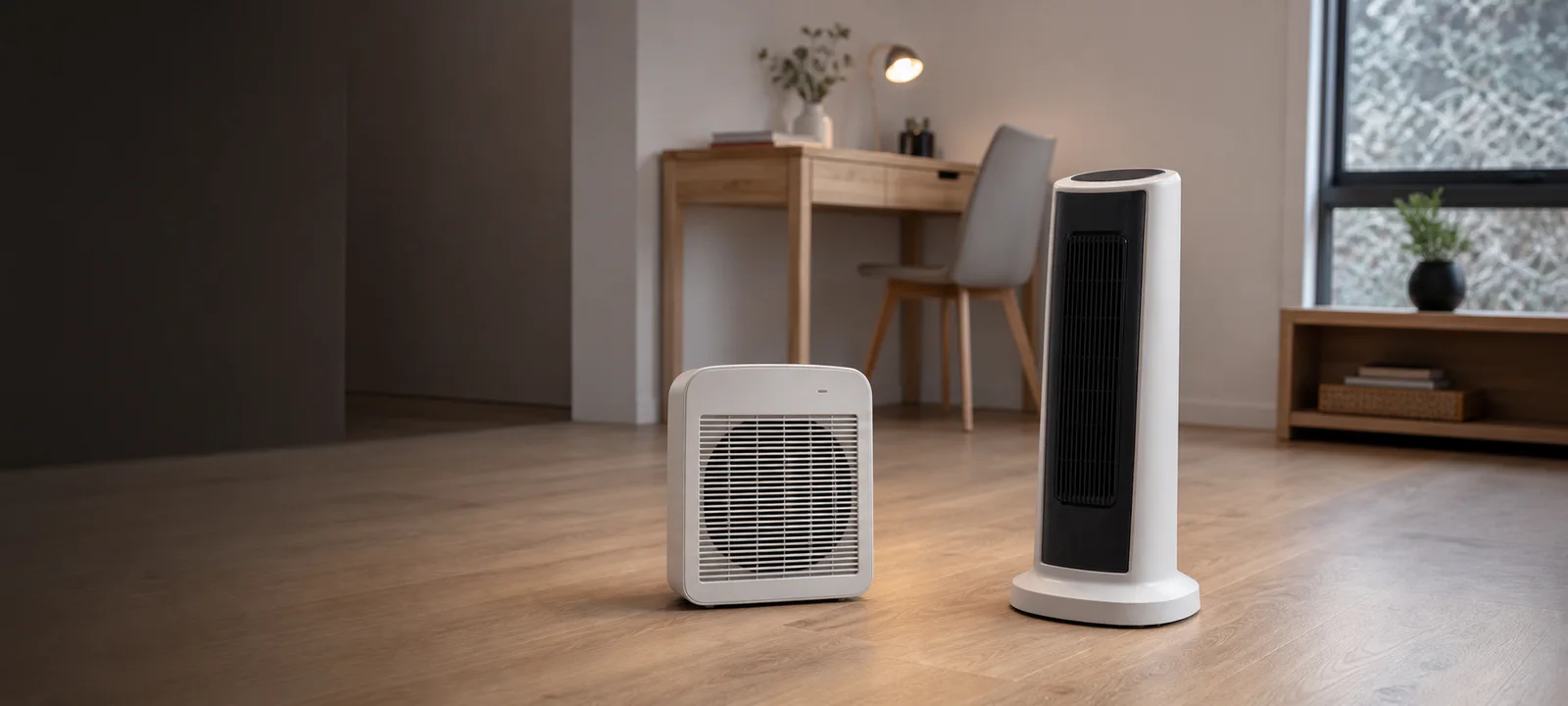
A conventional fan heater and a ceramic heater can look like different categories, but the distinction is narrower than product labels sometimes suggest.
Most ceramic heaters are still fan heaters. Both use electrical resistance to create heat and a fan to move warm air into the room. The main difference is the heating element, along with the controls, airflow and body format built around it.
“Ceramic” does not guarantee lower electricity use, silent operation or suitability for a larger room. Compare rated wattage, thermostat behaviour, heat settings, noise and safe placement before buying.
Our Take
A conventional fan heater can suit a short burst of direct warmth in a small enclosed room. A ceramic heater can provide the same fast fan-forced response, often with oscillation, a thermostat and more elaborate controls.
Choose the actual heater rather than the element label. A simple conventional model may do the required job; a ceramic model may distribute air more broadly or maintain a setting more conveniently.
Neither is a strong choice for a large open-plan space, several connected rooms, silent heating or unattended use.
Most ceramic heaters are still fan heaters
A conventional portable fan heater generally passes air across a metallic resistance element. The element becomes hot, and the fan pushes warmed air through the front grille.
A ceramic heater uses a ceramic-based resistance element, often with metal fins that increase the surface area available to warm passing air. Most portable ceramic room heaters also use a fan.
The comparison is therefore usually between a fan heater with a conventional metallic element and a fan heater with a ceramic element. It is not a fan heater versus a fan-free appliance.
The element can influence heat management and product design, but the whole appliance determines the practical result. Fan speed, grille shape, thermostat, controls and body size all matter.
Fan heater and ceramic heater comparison
Swipe sideways to compare the full table.
| Feature | Conventional fan heater | Ceramic heater |
|---|---|---|
| Heating element | Metallic resistance element | Ceramic resistance element, often with metal fins |
| Warm-up | Usually very fast | Usually very fast |
| Air movement | Often direct and concentrated | May be broader, especially with oscillation |
| Noise | Fan remains audible | Fan remains audible |
| Common format | Compact box or upright body | Compact body or tower |
| Controls | Basic to advanced, depending on model | Often includes thermostat, timer and oscillation |
| Electricity use | Depends mainly on wattage and operating time | Depends mainly on wattage and operating time |
| Typical use | Short, quick heating in a small room | Quick or maintained heating in a small enclosed room |
A conventional fan heater and a ceramic model to compare
These compact heaters suit brief, supervised spot heating after the room, power point and one-metre clearance have been checked. Compare the Heller's conventional fan-assisted element with the De'Longhi's self-regulating ceramic element; neither is for unattended or sleeping use.
Some links below are affiliate links. If you buy through one, we may earn a commission at no extra cost to you. Learn more.
2000W conventional fan heater
Heller Upright Fan Heater HUFH2000
A compact conventional fan-assisted heater with 1000W and 2000W settings, adjustable thermostat, overheat protection, tip-over switch and carry handle.
Research-supported option
View the Heller fan heater at Amazon AustraliaMay suit: brief supervised warm-up in a smaller room with a stable floor position and at least one metre of clearance.
May not suit: sleeping use, an unattended room, a location near bedding or curtains, or someone wanting low fan noise.
Drawbacks to consider:
- The 2000W setting is a high electrical load and needs direct use at a suitable wall power point without a power board, double adaptor or extension lead.
- Conventional fan-assisted heat is concentrated and audible, making this a brief supervised spot-heating option rather than a quiet whole-room or bedtime solution.
- The Heller brand has historical heater recalls for other exact models; buyers must confirm HUFH2000 on the label and recheck the recall register rather than relying on the brand name alone.
Evidence confidence: moderate. Last reviewed 24 August 2026. Research-based assessment; we have not tested this product firsthand.
1800W compact ceramic fan heater
De'Longhi Ceramic Capsule Fan Heater HFX30C18.IW
A compact ceramic fan heater with 900W and 1800W settings, mechanical room thermostat, summer ventilation, safety thermostat, tilt switch and carry handle.
Research-supported option
View the De'Longhi ceramic heater at Amazon AustraliaMay suit: brief supervised personal or small-room warm-up where the compact handle and lower 900W setting are useful.
May not suit: overnight heating, a large open room, a silent setting or a furniture layout that cannot preserve clearance.
Drawbacks to consider:
- The 1800W maximum is still a substantial electrical load and needs direct connection to a suitable wall power point without an adaptor, power board or extension lead.
- Ceramic self-regulation does not make the heater safe to leave unattended or use while sleeping, and the front discharge still needs a clear one-metre zone.
- Its compact format provides direct personal or small-room warmth, not a promise to maintain a large, open or draughty room.
Evidence confidence: moderate. Last reviewed 24 August 2026. Research-based assessment; we have not tested this product firsthand.
Warm-up speed and airflow
Both types can produce warm air soon after switch-on. The person in the airflow feels the effect before the whole room reaches a stable temperature, which makes these heaters useful for short supervised warm-up.
A fixed grille usually sends heat in one direction. A taller outlet or oscillating body can spread warm air across a wider part of a small room. That may feel more even, but it does not prove that the heater creates more heat.
Airflow also affects where comfort is noticed. A heater aimed towards an occupied part of the room may feel effective quickly, while furniture or an open doorway can divert the warm stream. Avoid directing hot air continuously at one person, and keep the outlet clear rather than using nearby objects to redirect it.
Fan-assisted warmth also cools quickly after switch-off because neither design stores much heat. For quiet, gradual background warmth, compare an oil column or panel heater.
Electricity use and rated wattage
Conventional fan heaters and ceramic heaters are electric resistance heaters. If two models draw the same wattage and run continuously for the same time, their electricity consumption will be broadly similar.
Use over a normal session depends on:
- rated input at the selected heat setting
- how long the element operates
- thermostat cycling and target temperature
- room heat loss and starting temperature
- how the heater is positioned and used
A ceramic heater with effective controls may cycle more appropriately than a basic model, but that advantage comes from its thermostat and suitability, not from “ceramic” wording alone.
Check the rated input in watts for each heat setting. A lower setting generally reduces power draw and heat output while selected; it does not make resistance heating inherently more efficient.
Thermostats, heat settings and fan-only mode
A basic mechanical thermostat may use an unnumbered dial, while a digital model may show a target temperature. Neither guarantees an exact room reading because the sensor sits in or near the heater and is affected by local warm air.
Useful controls include clearly stated heat levels, an adjustable thermostat, a simple timer and a manual override. Check what happens after a power interruption and whether the heater restarts automatically.
Some models include fan-only mode. This moves room-temperature air without activating the element. It may provide airflow, but it does not cool the room or reduce its actual temperature.
Timers, locks, tip-over switches and overheat protection are helpful safeguards or controls. Safety features do not replace supervision, correct placement or clear airflow.
Oscillation
Oscillation moves the outlet from side to side, distributing warm air over a wider arc. It can improve the way a small office or living area feels when more than one position needs airflow.
Oscillation changes distribution, not total heat output. It does not increase the heater’s rated wattage or make it suitable for a larger room.
Check that the base remains stable, the movement can be switched off, the power cord stays clear of the rotating body and the required clearance is available through the full sweep.
Noise
Both heater types remain audible because both normally use a fan. Sound varies with fan speed, motor quality, airflow through the grille, vibration, oscillation and thermostat clicks.
A ceramic element does not remove fan noise. A tower may add movement or control beeps, while a compact model may produce a more concentrated airflow sound. Consider whether that will distract from calls, focused work, television or sleep.
Tower versus compact formats
Ceramic heaters are commonly sold as towers, while conventional fan heaters are often short and compact. These are common formats, not fixed rules.
A tower can provide a higher outlet, wider oscillation and controls that are easier to see. Its narrow body still needs a stable base and enough side clearance for any movement.
A compact heater is easier to store and may have a lower centre of gravity. Its direct airflow can suit one nearby position, but compact size does not make it safe on furniture, carpet or beneath a desk crowded by legs, cables, paper or storage.
Compare footprint, stability, handle position, control access and cord storage rather than assuming tall or small is automatically better.
Best suited to short supervised use
Fan-assisted portable heaters make most sense for quick warmth in a small enclosed room. Examples include warming a compact home office at the start of the day, a bedroom while getting dressed or a small living area used briefly.
A conventional model may suit when low purchase complexity, compact storage and fixed-direction heat matter. A ceramic model may suit when oscillation, a clearer thermostat or digital controls are useful.
Neither should be judged only by broad packaging labels such as “small” or “medium room”. A high ceiling, open doorway, large windows or persistent draughts increase the heating task. Direct warmth near the heater is not the same as maintaining the whole room.
Consider how long the space is occupied and whether the door can remain closed. A brief morning warm-up is a different task from maintaining comfort through a full workday. For longer sessions, thermostat behaviour, noise and the room’s ability to retain heat become more important than the first sensation of warm air.
Concise portable-heater safety
Portable heaters should plug directly into a suitable wall power point. Use one appliance per power point. Do not overload a power board or use chains of adaptors and extension leads to reach an unsuitable position.
Keep the heater at least one metre from combustible materials, including bedding, curtains, furniture, clothing, paper and towels. Place it on a flat, level and stable surface outside walkways, wet areas and locations where a door can strike it.
Keep the rear intake and warm-air outlet unobstructed. Never cover a heater or use it near drying clothes. Supervise children and pets so the heater cannot be touched, moved, covered or knocked over.
Switch heaters off before leaving the room or sleeping. A timer, child lock, cool-touch housing, tip-over shut-off or overheat protection does not permit unattended use or incorrect placement.
Stop using a heater with a damaged cord, plug or casing, unusual heat at the outlet, intermittent operation or a burning smell. Do not improvise electrical repairs, and check the model against current product recalls.
When neither heater suits
Compare another heating option when the room is large or open-plan, several rooms need heat, silence is important, the heater would run for long periods each day or overnight temperature management is required.
A suitable reverse-cycle system can provide substantially more efficient regular room heating than electric resistance heaters. An oil column or panel heater may better suit quiet gradual warmth, while an electric blanket or heated throw may target personal warmth without heating the whole room.
Neither portable type is suitable when there is no stable position with the required clearance, the only available outlet is unsafe or the appliance cannot remain supervised. Resolve the placement or electrical problem rather than adapting the cord or reducing clearance.
If draughts or major heat loss remain, address those problems before relying on a higher-wattage portable heater.
Before You Buy Checklist
Before choosing a conventional fan heater or ceramic heater, check:
- Is the heater for short supervised use in a small enclosed room?
- Is direct airflow or wider distribution more useful?
- What is the rated wattage at each heat setting?
- Does the thermostat cycle the heater effectively?
- Are the timer and digital controls genuinely useful?
- Does the heater restart automatically after a power interruption?
- Is fan-only mode understood as airflow rather than cooling?
- Is oscillation needed, and can its full sweep remain clear?
- Is the fan, oscillation and control noise acceptable?
- Does a tower or compact format better fit the safe position?
- Is the base stable on the intended level surface?
- Are tip-over and overheat protections included?
- Can the heater plug directly into a suitable wall power point?
- Will it be the only appliance connected to that power point?
- Can at least one metre be kept clear of combustible materials?
- Will the intake, outlet and oscillation path remain unobstructed?
- Will children and pets remain supervised around it?
- Will it be switched off before leaving the room or sleeping?
- Are the cord, plug, casing and safety controls in sound condition?
Choose the heater, not the label
Conventional fan heaters and ceramic heaters both provide quick fan-forced warmth. A ceramic element may be paired with broader airflow and more controls; a conventional model may be smaller, simpler and adequate for brief use.
Compare rated wattage, thermostat behaviour, airflow, noise, stability and safe placement. The better choice is the heater that suits a small enclosed room and remains correctly positioned and supervised.