
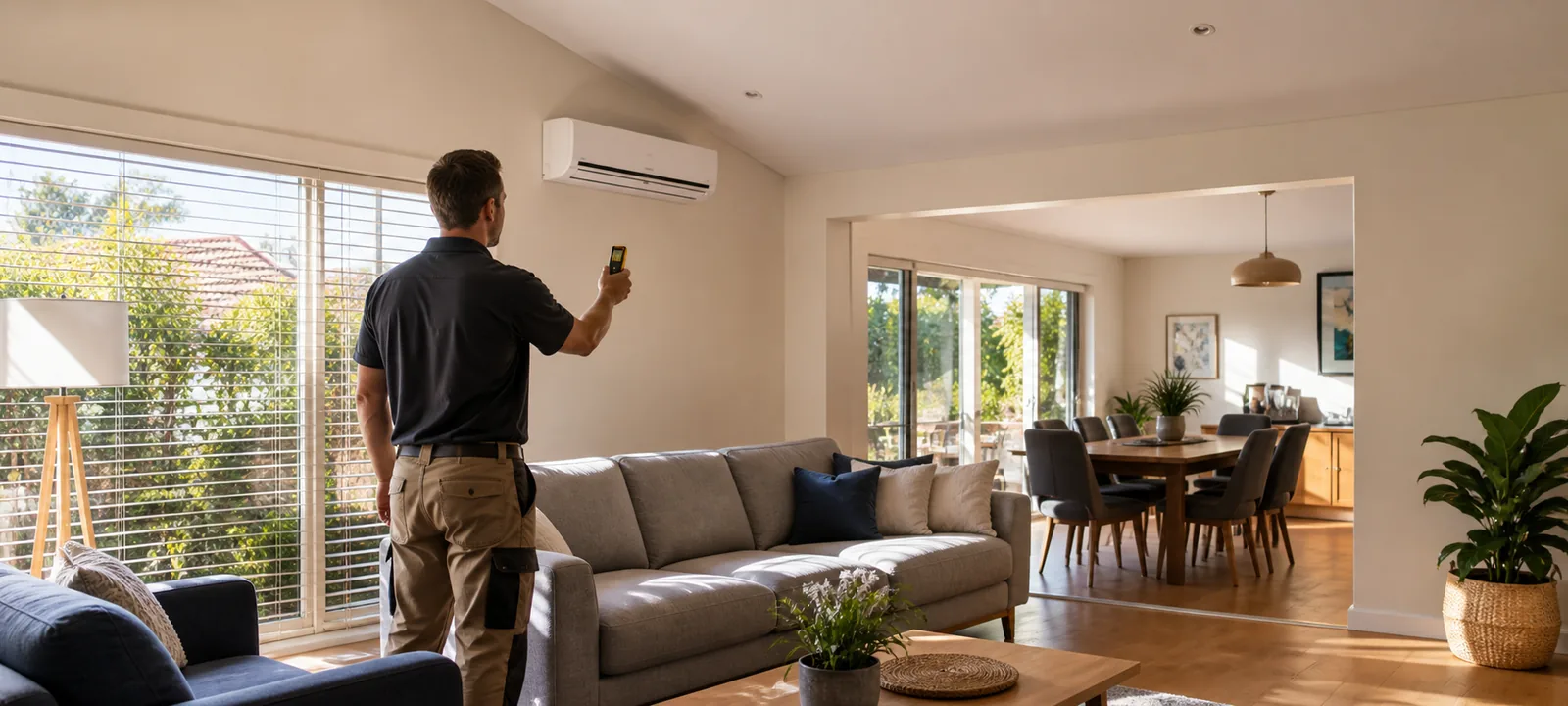
Choosing the right air conditioner is not as simple as matching floor area to a kilowatt figure.
Room size is a useful starting point, but the cooling load can also change with ceiling height, insulation, glazing, orientation, afternoon sun, local climate and whether the room opens into adjoining spaces.
If you are considering a permanently installed system, get installation quotes before buying where practical. A competent installer can assess the room, recommend an appropriate capacity and confirm whether the proposed installation is practical.
If you are still comparing system types, start with the Air Conditioning Buying Guide.
Start by measuring the space
Measure the length and width of the area you want to cool:
Length × width = floor area in square metres
For example:
4 m × 5 m = 20 m²
Also note the ceiling height. A 20 m² room with a standard ceiling is a different cooling problem from a 20 m² room with a high or raked ceiling.
For open-plan areas, measure the space the air conditioner will actually need to condition. A lounge that opens directly into a dining area, kitchen and hallway should not automatically be treated as an isolated room.
Why there is no simple room-size answer
Floor area alone cannot tell you the correct air-conditioner capacity.
A shaded, insulated bedroom with modest glazing may be relatively easy to cool. The same-sized room can have a much higher cooling load if it is upstairs, receives strong afternoon sun, has large exposed windows or sits beneath a poorly insulated roof.
That is why generic “X square metres = Y kW” charts should only be treated as rough starting points.
For a fixed system, use the room measurements to understand the likely range, then have the final capacity checked by the installer.
Check sun, windows and orientation
Windows can introduce a substantial amount of heat, particularly when exposed to direct summer sun.
Pay attention to:
- north- and west-facing glazing
- large windows and sliding doors
- external awnings, verandahs or other shade
- trees or neighbouring buildings that block sun
- whether the room is upstairs
- how effective the curtains or blinds are.
Orientation should not be considered by itself. A small shaded west-facing window presents a very different heat load from a large unshaded wall of glass facing the same direction.
Reducing heat gain with effective shading may also improve comfort without simply installing a larger air conditioner.
Consider insulation and the roof above
Insulation helps slow heat transfer into the home.
This is particularly important in rooms directly beneath the roof, where poor ceiling or roof insulation can increase the amount of heat the air conditioner needs to remove.
If you do not know whether the room is insulated, mention that when requesting quotes. Improving insulation or shading can sometimes be a better long-term solution than asking a larger air conditioner to compensate for excessive heat entering the room.
Think about how the room will actually be used
Sizing should reflect normal use, not just the dimensions on a floor plan.
Consider:
- how many people normally use the room
- whether doors to adjoining spaces will stay open
- heat-producing appliances
- large televisions or computers
- cooking areas within an open-plan space
- whether the room needs overnight bedroom cooling.
If you intend to cool several connected rooms, tell the installer rather than assuming one system will effectively reach them all.
Bigger is not automatically better
Buying extra capacity “just to be safe” is not the same as sizing the system correctly.
An undersized air conditioner may struggle to maintain comfortable conditions during hot weather. An unnecessarily large system can cost more to buy and may operate differently from a correctly sized system, affecting comfort, efficiency and moisture removal.
The aim is not to buy the biggest unit that fits the budget. It is to match the system to the actual cooling load.
Get installation quotes before buying
For split systems and other fixed air conditioners, arrange installation quotes before purchasing the unit where possible.
The installer can assess more than capacity. They can also check:
- suitable indoor and outdoor unit locations
- whether a simple back-to-back installation is practical
- refrigerant pipe length
- condensate drainage
- electrical requirements
- access and clearances
- potential noise issues.
Buying a discounted unit first can be false economy if the unit is unsuitable or the proposed installation turns out to be complicated.
A competent installer may also decline to install customer-supplied equipment they consider unsuitable or unsafe for the proposed installation.
Ask whether back-to-back installation is practical
A high-wall split system can often be installed with the indoor unit on an external wall and the outdoor unit immediately outside or nearby.
This usually keeps the refrigerant pipework, drain and cabling relatively short and can reduce installation cost.
Do not choose a poor condenser location purely to save on pipework, however. The outdoor unit still needs appropriate airflow, clearances, service access and a sensible position in relation to bedrooms and neighbours.
Our guide to split-system installation costs explains how pipe runs, drainage, electrical work, mounting and access can change the quote.
Climate matters too
Australian air-conditioner efficiency information recognises different climate zones, and local conditions should form part of the purchase decision.
In humid tropical and subtropical areas, moisture removal can be an important part of comfort as well as temperature reduction. Discuss humidity control, dry mode and wet-season performance when requesting recommendations.
Compare models after the sizing decision
Once the required capacity has been narrowed down, compare models within that appropriate range.
Useful factors include:
- energy efficiency for your climate
- indoor and outdoor noise
- reverse-cycle heating performance if required
- warranty
- controls and timers
- filter access and maintenance
- dry or dehumidification functions where relevant.
A highly efficient model is still the wrong purchase if it is not appropriately sized for the room. A suitable ceiling fan may also improve air movement without increasing the air conditioner’s capacity.
Questions to ask the installer
Before accepting a quote, ask:
- What capacity do you recommend, and why?
- What have you allowed for in the room's heat load?
- Is a back-to-back installation suitable?
- Where will the indoor and outdoor units go?
- Is extra electrical work required?
- Where will the condensate drain?
- Are there any noise or access concerns?
- Is there anything about the room that should be improved first?
If two installers recommend very different capacities, ask each to explain the assumptions behind the recommendation.
Before you buy
Measure the space, look at its sun exposure, glazing and insulation, and think about how the room connects to the rest of the home.
For a fixed system, get the installation assessed before buying where practical.
The goal is not to find a universal kilowatt figure for a given floor area. It is to choose a system that suits the room you actually have.