
The worst time to discover an air-conditioner problem is the first genuinely hot day of summer.
A few checks before peak cooling season can identify dirty filters, blocked airflow, drainage problems or signs that the system needs professional attention.
Some maintenance is straightforward for a householder. Refrigeration, electrical and internal repair work is not.
Start with the manufacturer’s instructions and stay within the routine cleaning and checks intended for the owner. For broader system questions, see our Air Conditioning Buying Guide.
Run the air conditioner before you desperately need it
Do not wait for a 35°C afternoon to switch the system on for the first time in months. Run it beforehand and check that it:
- starts normally and produces appropriate airflow
- responds to the remote or controls
- changes operating modes correctly
- does not make unusual noises or produce unusual smells
- does not leak water indoors.
Finding a problem early gives you more opportunity to arrange servicing before hot-weather demand increases. This check can sit alongside a wider spring home maintenance round.
Check the filters
Dirty filters restrict airflow and can reduce an air conditioner’s effectiveness and energy efficiency.
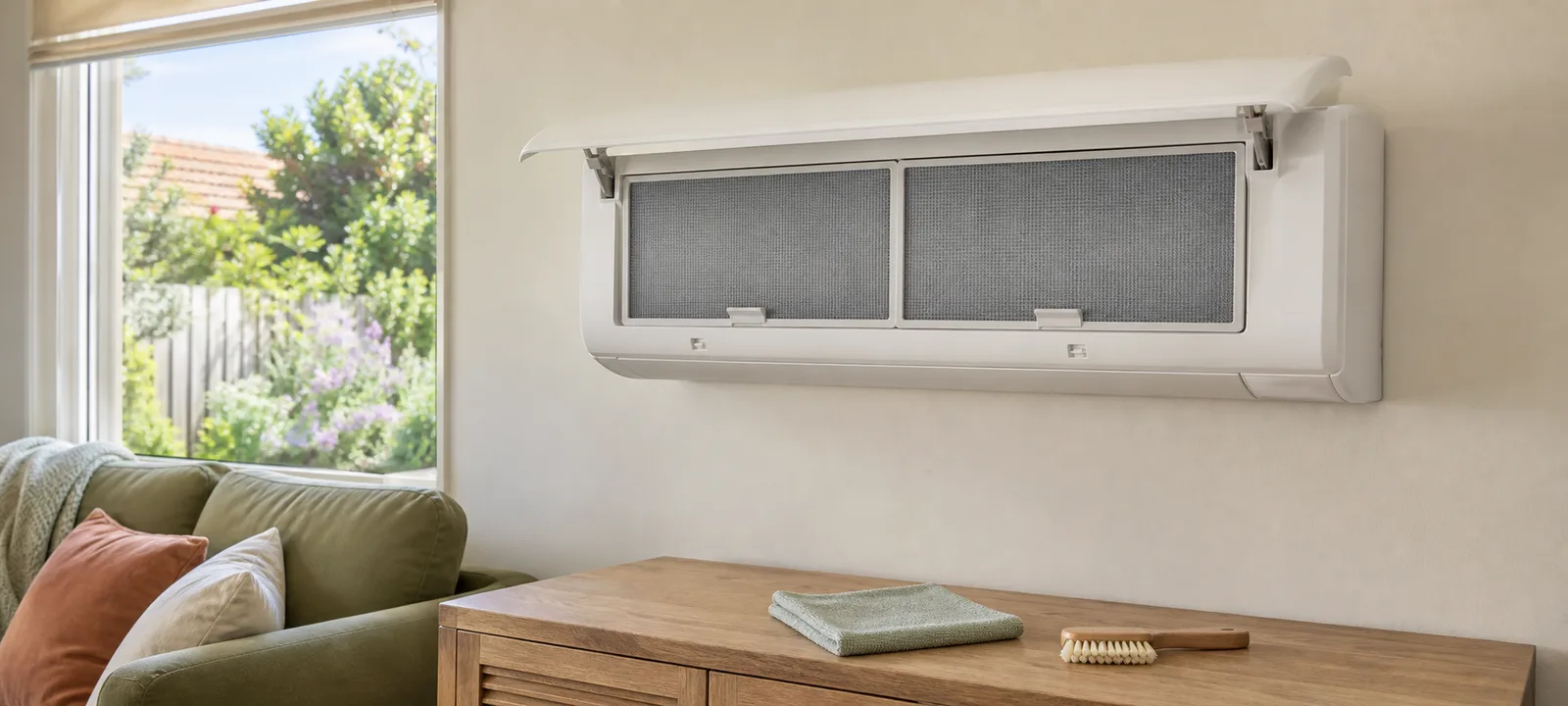
Many split systems have reusable filters that householders can remove and clean, but the procedure varies by model. Follow the manufacturer’s instructions: the filter may need vacuuming, washing or replacement.
Allow a washable filter to dry properly before reinstalling it where the instructions require this. Do not assume every filter is washable or remove anything beyond the normal owner-access area.
Wipe accessible vents and louvres
Dust can collect around the air outlet, louvres and accessible surfaces. These areas can generally be wiped carefully without dismantling the appliance.
Do not spray cleaning chemicals into the air conditioner or use harsh fluids unless the manufacturer specifically directs their use. If cleaning requires removing additional covers or components, leave it to an appropriate technician.
Check that nothing is blocking airflow
Furniture, curtains and stored items can interfere with indoor airflow. Make sure the unit can distribute air into the room without blowing immediately into a large obstruction.
Outside, check that leaves, garden growth and stored items are not blocking required airflow around the condenser. Follow the manufacturer’s clearances rather than crowding it with screens, storage or vegetation.
Do not dismantle the outdoor unit, reach inside it or pressure-wash its components. Reducing the room’s heat load can also help the system; see our guide to keeping your house cooler before increasing capacity.
Look for obvious drainage problems
Air conditioners produce condensate as they remove moisture from indoor air. Water should leave through the intended drainage arrangement.
Water dripping from the indoor unit, staining, repeated leaks, water appearing in an unusual place or gurgling associated with poor drainage deserves attention.
Do not dismantle drain systems or internal components to diagnose the problem. If the cause is not an obvious owner-maintenance issue covered by the manual, arrange professional assessment.
Check portable air conditioners too
For a portable refrigerated unit, inspect the exhaust hose and connections, window kit and seals, filters, condensate tank or drainage arrangement, caster stability, and the power cord and plug for obvious damage.
Make sure the exhaust route still matches the manufacturer’s instructions and has not become crushed, disconnected or unnecessarily extended. Our Portable Air Conditioners Australia guide covers those checks in detail.
Check the simple controls
Before assuming there is a fault, check the remote batteries, operating mode, timers, temperature and fan settings.
A system left in fan-only, dry or scheduled mode can behave very differently from normal cooling. Our guide to air-conditioner dry mode and humidity explains when dry mode is appropriate.
When should you call a technician?
Professional assessment is sensible for weak cooling despite clean filters and clear airflow, repeated water leaks, unusual mechanical noise, persistent unpleasant smells, electrical faults, repeated shutdowns or error codes, damaged components, or noticeably deteriorating performance.
Australian Government guidance recommends servicing by a licensed technician and suggests arranging inspections before peak use. The appropriate timing depends on the manufacturer’s instructions, usage, system condition and any faults; there is no identical fixed interval for every unit.
Does an air conditioner need routine regassing?
Do not treat “regassing” as normal scheduled maintenance. A functioning sealed refrigeration system should not simply consume refrigerant during ordinary operation.
If refrigerant charge is low, the reason should be investigated rather than the system being routinely topped up. ARC’s current code requires identified leaks to be repaired and the system leak-tested before recharging.
Work carrying a risk of fluorocarbon refrigerant being emitted requires an appropriate Refrigerant Handling Licence. Different licensing requirements may also apply to electrical work.
What should you leave alone?
Householders should not open the refrigeration circuit, add refrigerant, repair leaks, remove electrical covers, repair wiring, test live components, measure refrigerant pressure, or dismantle compressors, fan motors, indoor heads or outdoor condensers.
If you are unsure whether a task is intended for the owner, check the manual or use a qualified technician.
A useful pre-summer routine
Test the system → check the filters → clear obvious airflow obstructions → inspect accessible vents and the outdoor area → look for drainage problems → check the controls → arrange professional attention if something is not right.
Routine cleaning will not repair a faulty air conditioner. Finding a problem before the hottest weather arrives is still considerably better than discovering it when the system is needed most.
Sources and guidance
- Australian Government guidance on household cleaning, servicing and pre-peak inspections
- Australian Government summer guidance on filters, outdoor airflow and licensed servicing
- Energy Rating guidance on filter cleanliness, airflow and efficiency
- Australian Refrigeration Council Refrigerant Handling Licence requirements
- Australian and New Zealand Refrigerant Handling Code of Practice for split systems