
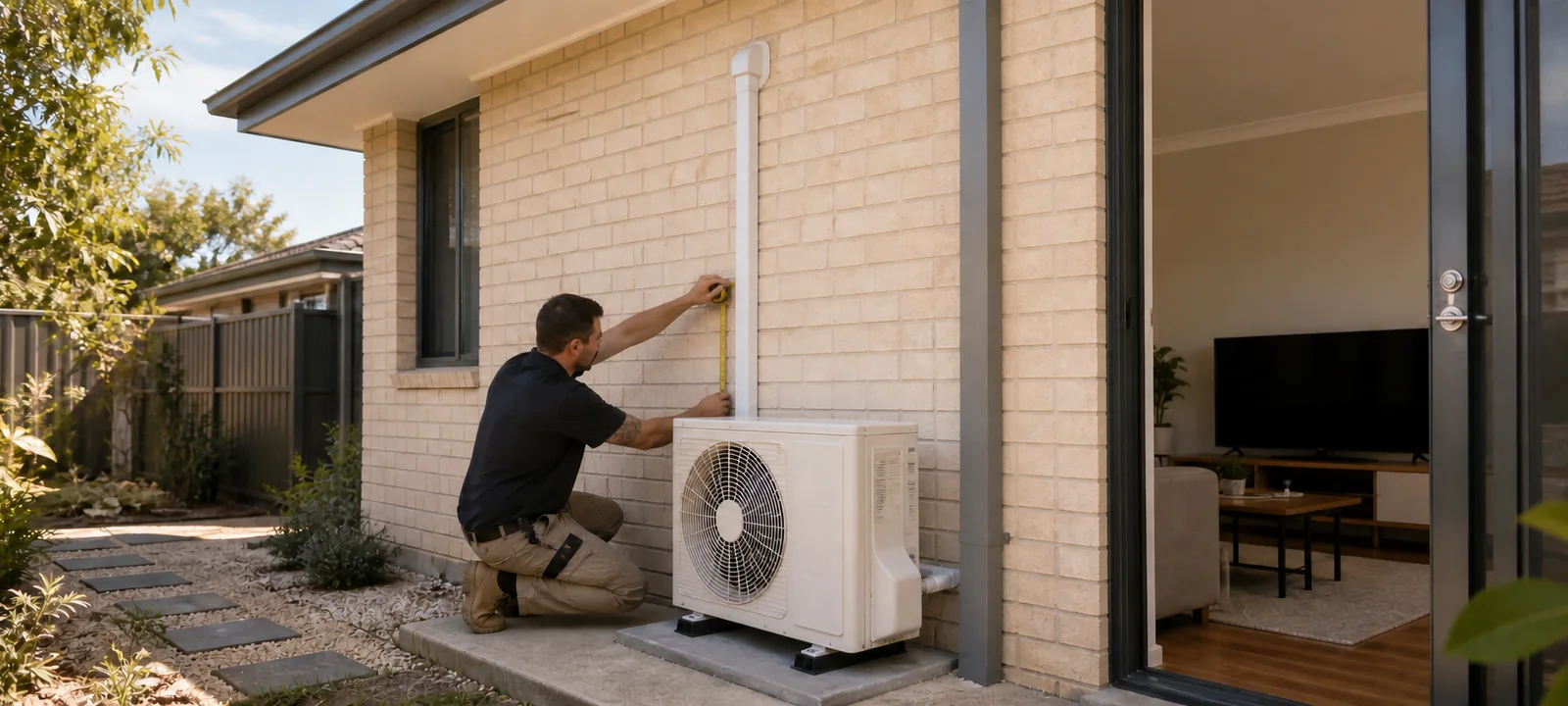
The price of a split-system air conditioner is only part of the total cost.
Installation can vary significantly depending on where the indoor and outdoor units go, how far apart they are, whether electrical work is needed, how condensate is drained and how easy the area is to access.
For that reason, it is usually worth getting installation quotes before buying the air conditioner.
A cheap unit can become an expensive purchase if the proposed installation is unusually difficult. If you are still comparing system types, start with the Air Conditioning Buying Guide.
What is a back-to-back installation?
A back-to-back installation is one of the simplest arrangements for a high-wall split system.
The indoor unit is mounted on an external wall, with the outdoor unit positioned immediately outside or nearby on the other side of that wall.
This keeps the connection between the two units relatively short.
A straightforward installation may therefore require less:
- insulated copper refrigerant pipe
- electrical cabling
- condensate drain pipe
- external duct cover
- installation labour.
That is why back-to-back installations are commonly used as the starting point when installers describe a standard installation.
Why longer pipe runs cost more
Split systems use copper refrigerant pipe between the indoor and outdoor units.
Copper is not cheap, and longer runs require more than just extra pipe.
They can also mean additional insulation, cabling, drain pipe, duct cover, fixing materials and labour.
A system installed on an internal wall, for example, may require pipework to travel through a ceiling space or along an external wall before reaching the outdoor unit.
This can make the installation noticeably more expensive than a simple back-to-back arrangement.
When comparing quotes, ask:
How much pipework is included, and what happens if the installation requires more?
The cheapest location is not always the best location
It makes sense to keep the pipe run short where practical, but installation cost should not be the only consideration.
The outdoor unit still needs:
- adequate airflow
- manufacturer-required clearances
- access for future servicing
- a suitable mounting location
- sensible noise placement
- somewhere appropriate for water drainage around the system.
Placing the condenser in a poor location simply to save on pipework can create other problems later.
The best installation is usually one that balances cost, system performance, access and practical use of the property.
Indoor-unit position affects the installation too
The indoor unit should not be placed solely according to which wall is cheapest to reach.
It needs to distribute conditioned air effectively across the room.
A poor position may blow directly onto a bed or seating area, discharge into a nearby wall or struggle to circulate air through the space.
This is another reason to have the installation location assessed before buying the unit.
A competent installer should be able to explain why a particular position is recommended.
Electrical work can change the quote
Depending on the system and the existing electrical installation, additional electrical work may be required.
This can include work associated with the air conditioner's supply, isolation or switchboard arrangement.
The amount of work required will vary between homes, so it is worth confirming whether electrical work is included in the quoted price or charged separately.
Older homes, difficult cable routes or larger systems may require more work than a straightforward installation.
Electrical work should be carried out by an appropriately licensed electrician.
Condensate needs somewhere to drain
Air conditioners remove moisture from the indoor air while operating.
That water needs to drain away correctly.
In a simple installation, gravity drainage may be straightforward. In a more difficult location, the drain route may be longer or require a different solution.
This is particularly important in humid climates, where an air conditioner can remove a considerable amount of moisture from the air.
Before accepting a quote, ask where the condensate will discharge and whether the proposed drain arrangement is included.
Outdoor-unit mounting can add cost
The outdoor unit needs a stable, suitable base.
Depending on the property, it may be installed on:
- a ground-level base
- a concrete surface
- wall-mounted brackets
- another manufacturer-approved support arrangement.
Wall brackets, difficult mounting positions or additional structural work can increase installation cost.
The outdoor unit should also remain accessible enough for future cleaning, inspection and servicing.
Access matters
A ground-floor back-to-back installation is usually very different from installing a system high on a second storey.
Difficult access can require additional equipment, more labour or a different installation method.
Potential complications include:
- second-storey work
- steep or restricted access
- difficult roof or ceiling spaces
- limited space beside the house
- long internal or external pipe routes
- obstacles between the proposed indoor and outdoor locations.
If access is difficult, mention it when requesting the quote rather than assuming it is covered by a standard installation price.
Replacing an existing system may involve extra work
Replacing an old split system is not always a simple swap.
The installer may need to assess:
- whether the existing pipework can be reused
- whether the old unit and brackets need removal
- whether the existing electrical arrangement is suitable
- whether wall penetrations or duct covers need repair or replacement
- disposal of the old equipment.
Ask whether removal and disposal are included in the quote.
What does “standard installation” include?
There is no reason to assume every company uses exactly the same definition.
Before comparing prices, check what each installer has actually included.
Useful questions include:
- Is the quote based on a back-to-back installation?
- How much refrigerant pipe is included?
- Is electrical work included?
- Is the outdoor-unit base or bracket included?
- Is condensate drainage included?
- Is external duct cover included?
- Are wall penetrations and sealing included?
- Are difficult-access costs included?
- Is removal of an existing system included?
- Are there additional charges if the pipe run is longer than expected?
Two quotes can look similar while covering quite different amounts of work.
Get the quote before buying the unit
For a fixed split system, the safest order is usually:
measure the room → get installation advice → confirm the required capacity → confirm the installation location → compare suitable units → buy.
This reduces the risk of purchasing an air conditioner that is difficult to install, incorrectly sized or unexpectedly expensive to connect.
For help determining the likely capacity required, see our guide to what size air conditioner you need.
A short, simple installation can help control costs, but the cheapest possible pipe route should never take priority over correct sizing, safe installation, airflow, drainage and long-term serviceability.