
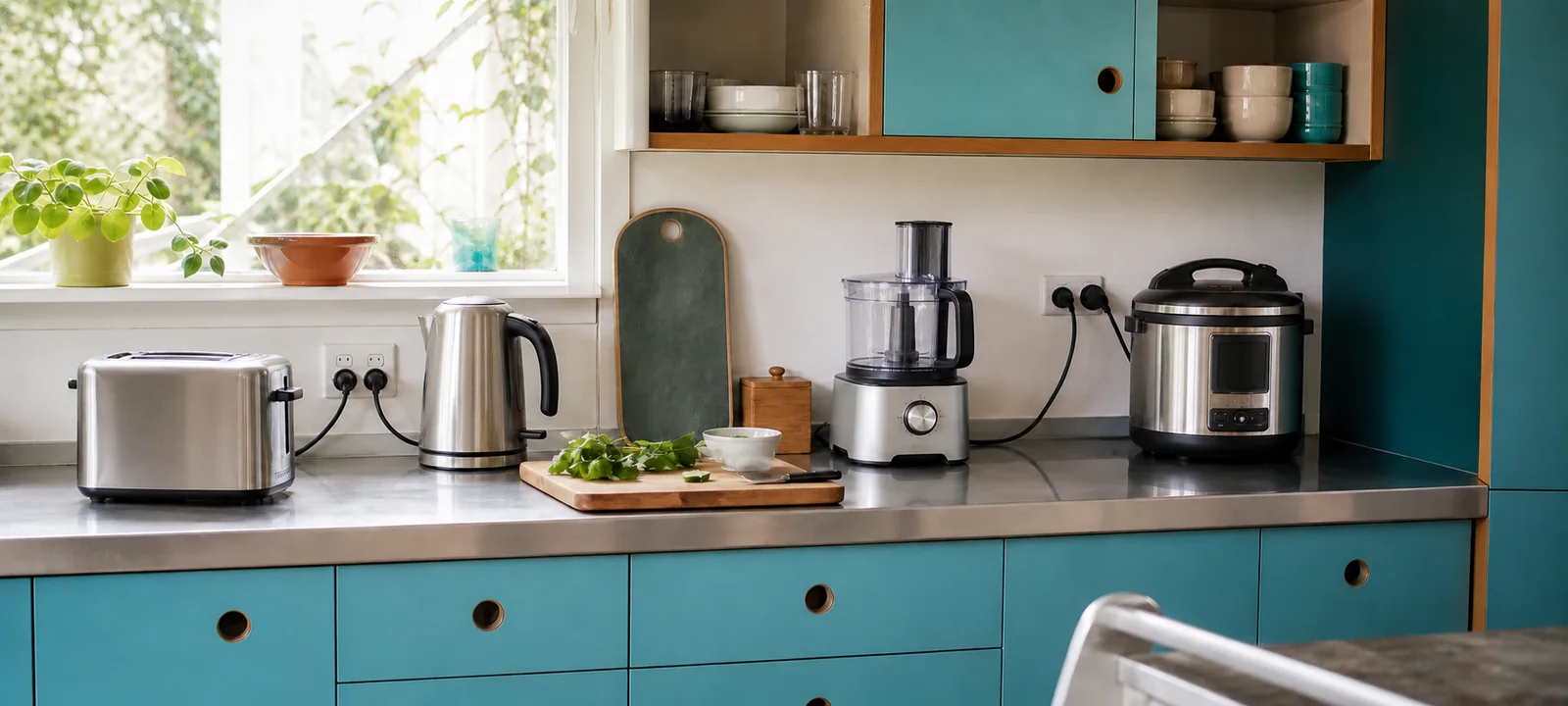
A small appliance can remove a repeated frustration or become a new one. The air fryer may handle weeknight meals but take the only clear preparation space. A blender may be compact until its jug, lid and blades need separate homes.
Follow the appliance through a normal week before comparing features: where it will stand, how it opens, where it plugs in, what needs washing and whether anyone will lift it from the cupboard. That is the real cost of its kitchen space.
For the wider storage plan, see Kitchen Storage That Makes Small Cupboards Easier to Use.
Name the repeated job
“Cook rice three nights a week” or “make coffee before work” is a useful brief. “Eat better” or “cook more” leaves too much work to the product. Decide which existing method the appliance will replace and how often that task actually occurs. For the coffee brief, compare the daily steps and cleaning load in the coffee machine types guide.
If the purchase supports a habit that has not started, try the simplest version first. A machine should not need permanent kitchen space to prove whether the household enjoys the food or routine.
Match the appliance category to the routine
Air fryers, stand mixers, high-powered blenders and multi-cookers can all justify their space, but they solve different bottlenecks. Compare capacity, operating shape and cleaning with the meals the household already makes. The useful choice is the one that fits that routine, not the model with the longest feature list.
Air fryers: compare basket shape, not just litres
A dual-basket air fryer suits households that regularly cook two foods at different times or temperatures. Equal drawers are useful for two similar batches; an uneven split can be more practical when the main food needs considerably more space than a side. Measure the open drawer depth and allow the maker's ventilation clearances before assigning it a position. The kitchen bench-space guide helps test whether that position leaves enough room to prepare the meal.
Stand mixers: let batch size and lifting decide
A tilt-head mixer with a medium bowl can suit regular cakes, biscuits and smaller doughs. A larger-bowl machine earns its footprint when baking is frequent or batches are genuinely big. Check the height with the head raised, the bowl's practical minimum and maximum quantities, and whether an 11-kilogram machine can realistically move between a cupboard and the bench.
Premium blenders: pay for the work you will repeat
Higher-powered blenders are most defensible for frequent smoothies, soups, nut mixtures or other demanding blends. Preset programs can reduce supervision, while manual speed control may matter more to cooks who adjust texture as they go. Check jug capacity, noise, blade cleaning, tamper storage and the full assembled height; power alone does not predict a convenient daily routine.
Multi-cookers: choose between focus and consolidation
A pressure-and-slow-cooking model keeps the job comparatively focused. A larger multi-cooker with air-frying and steam-crisp functions can replace more equipment, but it also adds size, weight, parts and a steeper control layout. Compare usable cooking capacity with normal batch sizes, then allow safe space above the machine for steam release and lid access.
Measure the appliance in use
Product width and depth are only the closed footprint. Add the lid, basket, door or mixing arm in its fully open position, plus the space required to load and operate it. Include attachments fitted during use.
Check the manufacturer's placement and clearance instructions. Heat, steam and ventilation requirements may rule out a position beneath overhead cupboards even when the machine fits there while switched off.
Protect the useful part of the bench
Mark the footprint where the appliance would realistically sit and prepare a normal meal around it. Keep the sink route, cooktop area and primary chopping space clear. A compact machine can still be disruptive if it occupies the only uninterrupted work surface.
Daily equipment may justify staying out. Weekly or occasional equipment needs a credible storage and lifting plan, not an assumption that it will somehow fit after purchase.
Decide where it sleeps
Measure the cupboard or pantry opening as well as its interior. The appliance must pass hinges and frames without being tipped in a way that releases loose parts. Allow for the cord and all pieces needed to use it.
Storage at an awkward height changes how often the appliance will appear. Keep heavier machines that are hard to grip lower and only where the intended user can move them comfortably. A product that is hard to retrieve is likely to become cupboard clutter.
Let weight decide whether it stays out
Check the actual product weight rather than judging by size. Handles, a stable grip and parts that remain secure can matter as much as the number on the specification. Imagine the return trip after use, when the machine is clean but still needs to be lifted and aligned with a shelf.
If it is too awkward to move regularly, either give it a suitable permanent position or reconsider the purchase. Do not plan to store a heavy appliance above a comfortable lifting height simply because the shelf is empty.
Use the power point the kitchen safely provides
The cord should reach the intended power point without crossing the sink, cooktop or walkway. Check what already uses that power point and follow the appliance instructions. Do not improvise an extension-lead or power-board arrangement to make a preferred bench position work.
Queensland's Electrical Safety Office guidance recommends using equipment only for its intended purpose, following manufacturer instructions and checking leads and appliances for damage. If the kitchen needs electrical work, use an appropriately licensed professional.
Count the washing, drying and reassembly
List every part that touches food, then check how it must be washed and dried. A machine that saves ten minutes of preparation can still be worthwhile, but only if its jug, filter, basket, seal or blade assembly fits the household's cleaning routine.
Look for corners that trap food, parts that cannot be immersed and components that need to be fully dry before reassembly or storage. Follow the care instructions rather than assuming removable means dishwasher-safe.
Give attachments one contained home
Blades, beaters, trays, racks, filters and spare seals form part of the appliance footprint. They need to remain findable and stored safely. One removable container or defined drawer section is usually easier to manage than scattering them across the kitchen.
Check sharp or fragile pieces and keep them appropriately controlled. The kitchen drawer guide helps if the accessories genuinely belong in a drawer.
Question overlapping functions
An air fryer and oven, blender and food processor, rice cooker and multi-cooker may overlap partly without being identical. Compare the meals and quantities the household makes rather than product labels. The new machine should do a frequent job materially better or replace an existing appliance.
If both remain, count the combined bench, cupboard and accessory space. Convenience in use can be cancelled by a kitchen that must store two versions of every function.
Be honest about frequency after the novelty
Use the calendar rather than aspiration. Daily coffee or weekly baking can justify accessible space. A machine for one annual occasion may be better borrowed, replaced by existing equipment or stored outside the prime kitchen zone where appropriate.
Read independent information and the product manual before buying, especially when cleaning, capacity or operating method will decide whether the appliance remains in use.
Make the plan portable in a rental
Renters may not be able to add an appliance shelf, change power points or create a built-in station. The appliance still needs a safe use position and storage that does not damage the kitchen or obstruct services.
Check the renter-friendly kitchen guide before buying a trolley, adhesive accessory or highly specific storage piece around it.
Reasons to leave it in the shop
- It solves a task the household rarely performs.
- An existing appliance already handles the useful part of the job.
- There is no safe operating position with the required clearances.
- It removes the kitchen's main preparation area.
- It is too heavy or awkward for its proposed cupboard.
- The cleaning process is longer than the household will accept.
- Attachments have no safe, contained storage.
- The available power arrangement does not suit the instructions.
Appliance options matched to a repeated job
Start by using or borrowing the equipment already available and remove any appliance that duplicates the useful part of the task. If a real weekly job remains, compare only the relevant air fryer, mixer, blender or multi-cooker options below, including their open footprint, washing load and storage path.
Some links below are affiliate links. If you buy through one, we may earn a commission at no extra cost to you. Learn more.
Air fryer — unequal dual baskets
Philips 3000 Series Dual Basket Airfryer NA352/00
A 9 L dual-basket model with a larger 6 L drawer and smaller 3 L drawer for households that usually cook a main item and a smaller side at the same time.
Research-supported option
View at Amazon AustraliaMay suit: larger households that often cook one main item with a smaller side; cooks who will use separate time and temperature settings in the two drawers.
May not suit: compact benches or cupboards that cannot accommodate the open drawers; households that usually need two equal-capacity cooking zones.
Drawbacks to consider:
- The 9 L body and fully opened drawers need substantial clear bench depth.
- The uneven drawer split is less flexible when two equally large batches are needed.
- Owner feedback is mixed on the touch controls and long-term basket coating, so care and warranty terms should be checked.
Evidence confidence: moderate. Last reviewed 17 August 2026. Research-based assessment; we have not tested this product firsthand.
Air fryer — equal dual zones
Ninja Foodi Max XXXL Dual Zone Air Fryer AF400ANZ
A 9.5 L model with two equal 4.75 L drawers for larger households that want two similar batches or different foods finished together.
Research-supported option
View at Amazon AustraliaMay suit: larger households cooking two similar-size batches or separate foods together; meal routines that will regularly use the synchronised finish and match-cook controls.
May not suit: small kitchens where the full drawer-opening depth would interrupt preparation space; single-person households or cooks who rarely need both zones.
Drawbacks to consider:
- Its wide body and two long drawers require a generous permanent operating position.
- Two equal zones are less space-efficient when one part of the meal is consistently much smaller.
- The drawers, crisper plates and exterior create more cleaning and storage work than a compact single-basket model.
Evidence confidence: moderate. Last reviewed 17 August 2026. Research-based assessment; we have not tested this product firsthand.
Stand mixer — regular home baking
KitchenAid Artisan Tilt-Head Stand Mixer KSM195
A metal tilt-head mixer supplied with 4.7 L and 2.8 L bowls for regular cakes, biscuits, smaller doughs and recipes that benefit from switching bowls.
Research-supported option
View at Amazon AustraliaMay suit: regular home bakers making cakes, biscuits, frostings and moderate dough batches; households that will use the two included bowl sizes and bundled baking tools.
May not suit: occasional bakers who must lift the mixer out for every use; frequent bulk bread or large-batch baking that needs a bigger bowl and capacity.
Drawbacks to consider:
- At about 11 kg, it is awkward to retrieve from a high or deep cupboard for occasional use.
- The 4.7 L main bowl is less suitable for very large dough batches than an XL machine.
- Optional hub attachments add cost and need their own safe storage.
Evidence confidence: moderate. Last reviewed 17 August 2026. Research-based assessment; we have not tested this product firsthand.
Stand mixer — large-batch baking
Kenwood Titanium Chef Baker XL KVL85.004BK
A 1200 W XL stand mixer with 7 L and 5 L bowls plus built-in weighing for frequent bread, cake and multi-stage baking in larger quantities.
Research-supported option
View at Amazon AustraliaMay suit: frequent bread makers and batch bakers who will use the 7 L and 5 L bowls; bakers who value weighing directly into the bowl during multi-stage recipes.
May not suit: compact kitchens without head-lift clearance or a permanent bench position; households mainly mixing small batters or baking only occasionally.
Drawbacks to consider:
- The XL body, raised mixer head and 11.5 kg weight demand a large, stable permanent position.
- Its capacity and controls are unnecessary overhead for small or occasional baking jobs.
- The large accessory range can add cost and storage pressure if bought without a defined use.
Evidence confidence: moderate. Last reviewed 17 August 2026. Research-based assessment; we have not tested this product firsthand.
Premium blender — guided batch blending
Braun PowerBlend 9 Jug Blender JB9040
A 1600 W blender with a 2 L jug, ten manual speeds and 18 program-and-texture combinations for frequent smoothies, soups and larger blended batches.
Research-supported option
View at Amazon AustraliaMay suit: households making frequent smoothies, soups or other larger blended batches; cooks who prefer preset texture choices but still want manual speed control.
May not suit: small-quantity blending or kitchens with limited assembled-height clearance; noise-sensitive households or buyers who prefer a removable blade assembly.
Drawbacks to consider:
- The 2 L jug and motor base occupy more height and depth than a compact smoothie blender.
- Independent testing found it loud at high speed, which matters in open-plan homes.
- The blade assembly is not removable, so cleaning depends on the cleaning program and careful access around the fixed blades.
Evidence confidence: moderate. Last reviewed 17 August 2026. Research-based assessment; we have not tested this product firsthand.
Premium blender — heavy-duty blending
Vitamix A3500i Ascent Series Smart Blender
A 2 L high-performance blender with five programs and manual speed control for frequent demanding blends, larger batches and cooks who will use automated cycles.
Research-supported option
View at Amazon AustraliaMay suit: frequent heavy-duty blending, large smoothies, soups, nut mixtures and repeated batch work; households that will use both automated programs and manual texture control.
May not suit: occasional smoothies or buyers unlikely to use its capacity and program range; tight budgets, compact benches or households wanting a small personal blender.
Drawbacks to consider:
- It is a very expensive choice unless demanding blending is a frequent household task.
- The broad motor base and 2 L jug still require a substantial permanent storage position.
- Owner feedback includes isolated container-detection and support concerns, so registration and warranty documentation should be retained.
Evidence confidence: moderate. Last reviewed 17 August 2026. Research-based assessment; we have not tested this product firsthand.
Multi-cooker — pressure and slow cooking
Breville the Fast Slow GO BPR680BSS
A 6 L multi-cooker with a stainless-steel cooking bowl and pressure, slow-cook, sauté, steam, sous-vide and yoghurt settings for batch cooking without an air-fryer function.
Research-supported option
View at Amazon AustraliaMay suit: batch cooks wanting pressure and slow cooking with a stainless-steel inner bowl; households that prefer a focused multi-cooker without air-frying parts and controls.
May not suit: buyers specifically trying to replace both a pressure cooker and air fryer; small kitchens without safe steam clearance or room to store the lid and accessories.
Drawbacks to consider:
- The lid and steam release need clear space above the machine during pressure cooking.
- It does not air fry, so it will not consolidate that appliance for households wanting crisping functions.
- The stated one-year replacement warranty is shorter than the cover offered with some premium alternatives.
Evidence confidence: moderate. Last reviewed 17 August 2026. Research-based assessment; we have not tested this product firsthand.
Multi-cooker — larger-household consolidation
Ninja Foodi SmartLid Multi Cooker OL650ANZ
A 7.5 L, 14-function multi-cooker combining pressure cooking, slow cooking, steaming and air frying for larger households trying to consolidate several cooking jobs.
Research-supported option
View at Amazon AustraliaMay suit: larger households wanting pressure, slow-cook, steam-and-crisp and air-fry functions in one machine; batch cooks with a permanent bench position who will use several of the 14 functions.
May not suit: compact kitchens, frequent cupboard storage or users who cannot comfortably move an 11.4 kg appliance; households wanting a simple pressure cooker with minimal parts and controls.
Drawbacks to consider:
- At about 11.4 kg and roughly 38 cm high and deep, it is difficult to move and store in a compact kitchen.
- The cooking pot, basket, rack, lid components and sealing parts create a more involved cleaning routine.
- Australian owner feedback is mixed on the non-stick pot and after-sales support, so the surface, replacement-part path and warranty terms should be checked.
Evidence confidence: moderate. Last reviewed 17 August 2026. Research-based assessment; we have not tested this product firsthand.
A final test before buying
- Name the repeated job and what the appliance replaces.
- Measure the footprint with every moving part open.
- Check manufacturer clearances, ventilation and power requirements.
- Plan the full washing, drying and storage routine.
- Confirm the weight and lifting path suit the intended user.
- Include attachments and cords in the storage footprint.
Give permanent kitchen space only to appliances that support real routines. A useful machine should make the meal easier without making preparation, cleaning or storage harder every other day of the week.
If an appliance depends on supplies stored nearby, use the pantry storage guide to check shelf depth and everyday access before adding containers.
Common Questions
How do you decide whether a small kitchen appliance is worth it?
Name the repeated job it will solve and how often that job occurs after the novelty wears off. Compare the full operating footprint, storage, weight, washing and attachments with the current method. A worthwhile appliance improves the complete routine enough to justify the bench or cupboard space it permanently claims.
What should I measure before buying a kitchen appliance?
Measure the appliance body plus handles, plugs, open lids, baskets and removable attachments. Check the required operating space and ventilation in the maker's instructions, the available power point and the path to its storage place. Also measure the sink, drying area and cupboard opening if parts must be washed and stored separately.
Which small appliances should stay on the kitchen bench?
Bench space is strongest for appliances used frequently, awkward to lift and simple to clean without taking over the preparation area. Less-used pieces can live in a reachable cupboard if moving them is realistic. Test the appliance in its operating position, because a compact body may need much more room when its lid or drawer opens.