
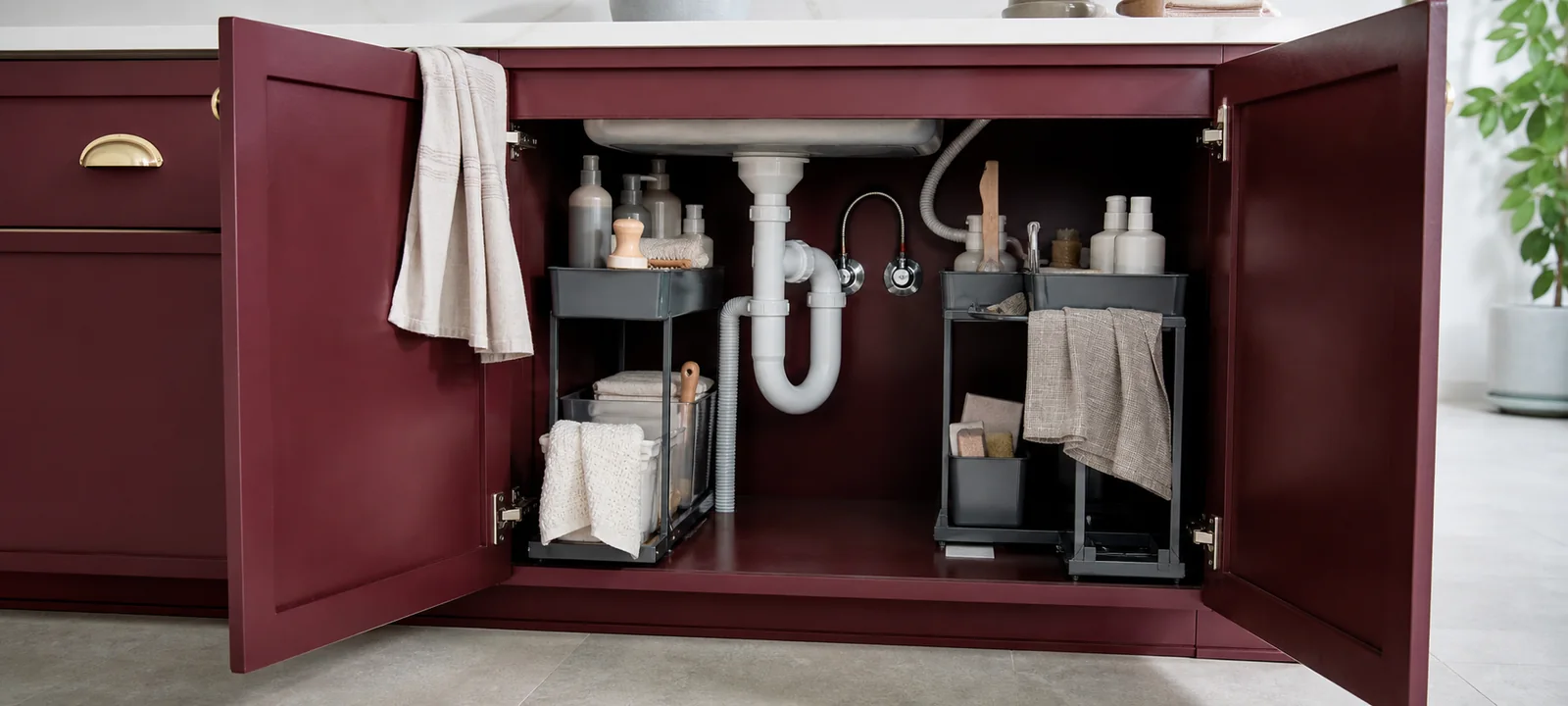
The cupboard beneath the sink looks like a box until the doors open. Pipes divide the back, hinges claim the sides, the bin needs room to lift out and every stored bottle makes the next leak harder to see.
Empty and inspect the cabinet before adding shelves, drawers or caddies. The priority is access to plumbing and controlled storage for suitable products—not filling every gap.
For the wider room plan, see Kitchen Storage That Makes Small Cupboards Easier to Use.
Empty the cabinet and inspect the base
Remove everything, wipe the interior and look for damp, swelling, staining, corrosion, odour or an active drip. Check hoses, filters and valves without disturbing them. A liner or organiser must not hide a problem that needs repair.
Deal with leaks and persistent moisture before reorganising. Storage can contain a small spill; it cannot fix plumbing or make a damp cabinet suitable for sensitive supplies.
Map the pipework in three dimensions
Measure usable width, depth and height in front of, beside and beneath each obstruction. Note traps, hoses, filters, valves and any fittings that need inspection or service access. A U-shaped shelf works only when its opening matches the real pipe position.
Photograph the empty cabinet and record dimensions on the image. Product diagrams are easier to compare when the awkward sections are visible.
If dishwasher hoses or connections use this cabinet, keep their specified route clear. Before replacing the appliance, use the dishwasher sizes guide to check the 600 mm cavity, height, installed depth, services and open-door clearance together.
Measure the door opening and hinge sweep
The cabinet interior may be wider than the path through its doors. Measure the narrowest opening, centre stile and the space swept by hinges. Test a bin or caddy at the angle needed to remove it.
Pull-out storage also needs a straight travel path and enough clearance for the handle. If a full drawer catches a hinge, it will become a fixed shelf with inaccessible contents behind it.
Decide what is appropriate to store there
The location may suit a modest group of dishwashing and cleaning supplies, bin liners, brushes or a portable caddy. Follow every product label and keep chemicals in their original containers. Do not mix products or decant them into food or drink containers.
Children and pets change the storage decision. If the cupboard cannot provide the control a product requires, store it in a more appropriate location. Food, medicines, paper goods, electrical items and moisture-sensitive supplies generally need another home.
Choose storage around the awkward zone
A low tray can contain minor drips and make bottles easier to remove. A caddy suits products carried to another task. Narrow drawers may use space beside pipes, while a simple shelf can create a second level where height allows.
Check loaded stability, cleaning access and whether the product blocks plumbing. A clever multi-level system is not useful if it must be dismantled to inspect a hose.
Practical options around the pipework
First fix leaks, remove unsuitable supplies and mark the pipe, valve, hinge and bin clearances on a cabinet photo. If usable side pockets remain, compare these expandable shelf and pull-out formats only where they can be removed quickly and leave the cabinet floor visible.
Some links below are affiliate links. If you buy through one, we may earn a commission at no extra cost to you. Learn more.
Expandable under-sink shelf
SimpleHouseware 2-Tier Expandable Under-Sink Shelf
An adjustable shelf for using kitchen-cabinet width around measured plumbing, waste fittings and cleaning products.
Research-supported option
View at Amazon AustraliaMay suit: wide cabinets with plumbing concentrated to one side.
May not suit: crowded cabinets or frequent plumbing access needs.
Drawbacks to consider:
- A central trap, disposal unit or water filter can sharply reduce usable shelf space.
- Current dimensions, variant, price, stock and seller details should be rechecked before ordering.
Evidence confidence: moderate. Last reviewed 18 August 2026. Research-based assessment; we have not tested this product firsthand.
Two-tier pull-out organiser
SimpleHouseware 2-Tier Pull-Out Under-Sink Organiser
A narrow sliding organiser for daily kitchen cleaning supplies where bottle height and door hardware allow full travel.
Research-supported option
View at Amazon AustraliaMay suit: deep cabinets storing small frequently used supplies.
May not suit: bulk containers or cabinets with low clearance.
Drawbacks to consider:
- Tall sprays and plumbing obstructions may prevent full use of the upper tray.
- Current dimensions, variant, price, stock and seller details should be rechecked before ordering.
Evidence confidence: moderate. Last reviewed 18 August 2026. Research-based assessment; we have not tested this product firsthand.
Let the bin keep its full working space
Measure the bin with its lid open and the liner being removed. Leave room for the hand to lift it without catching a shelf or pipe. A second waste stream only belongs there if both bins can be used and cleaned without crowding the doors.
Do not force bottles into the narrow space behind a bin where they cannot be seen or retrieved. If the bin consumes the cabinet, that may simply be the cabinet's main job.
Use surfaces that reveal spills
Smooth, removable and wipeable trays make residue and leaks visible. Avoid materials that absorb liquid, trap moisture or conceal the cabinet base. Raised storage can help with minor splash exposure, but it must remain stable and easy to clean beneath.
Keep daily items in the front row
Dishwashing liquid, the current cleaner or a small caddy should be reachable without shifting refills. Move bulk supplies and rarely used products to suitable controlled storage elsewhere. Fewer bottles also make changes in the cabinet easier to notice.
Use rental-friendly products without assuming no risk
Freestanding trays and caddies usually avoid altering the cabinet. Adhesive, tension or mounted products still require checks against the lease, finish and instructions. Do not attach storage where it blocks services or could damage a damp or ageing surface.
The renter-friendly kitchen guide covers surface and approval questions across the room.
Where under-sink storage goes wrong
- An organiser hides a leak, valve or service point.
- Measurements ignore pipe depth, hinges or the door opening.
- A bin cannot open or lift out when the storage is full.
- Absorbent baskets trap residue and moisture.
- Hazardous products remain accessible to children or pets.
- Food, medicines or electrical items are stored in an unsuitable damp zone.
- Bulk refills crowd out the few products used each day.
What to note before choosing anything
- Internal width, depth and height around every pipe and fitting.
- The narrowest door opening and hinge sweep.
- Required plumbing inspection and service access.
- Bin footprint with its lid open and liner being removed.
- The height and label requirements of products that may stay.
- Child, pet, spill, cleaning and rental controls.
Under-sink storage works when the cabinet stays easy to inspect and the correct daily items are easy to reach. Empty space around plumbing is not wasted space; it is access.
If unrelated overflow is creating the pressure, solve it at the source: use the pantry guide for food, the drawer guide for small tools and the appliance guide for equipment that needs a suitable dry home.
Common Questions
What can you store under the kitchen sink?
Keep only items suited to the location, such as a contained cleaning group or a bin with enough operating room. Follow product labels, and do not store hazardous products there if children or pets can access the cupboard. A smaller collection makes pipe connections, leaks and the cabinet floor easier to inspect.
How do you measure an under-sink kitchen organiser?
Record the cabinet's internal width, depth and height, then map the pipes, trap, hinges and door opening in three dimensions. Include bottle heights, bin lift-out space and the route a loaded basket must travel. Measure each usable pocket separately rather than treating the cupboard as one clear rectangular box.
Are pull-out organisers worth using under a kitchen sink?
A pull-out can improve access when its runners, loaded basket and handle have a completely clear path around plumbing and hinges. It is a poor fit if it hides moisture, reduces the bin's movement or cannot be removed quickly. A simple tray or open basket may use an awkward side pocket more effectively.