
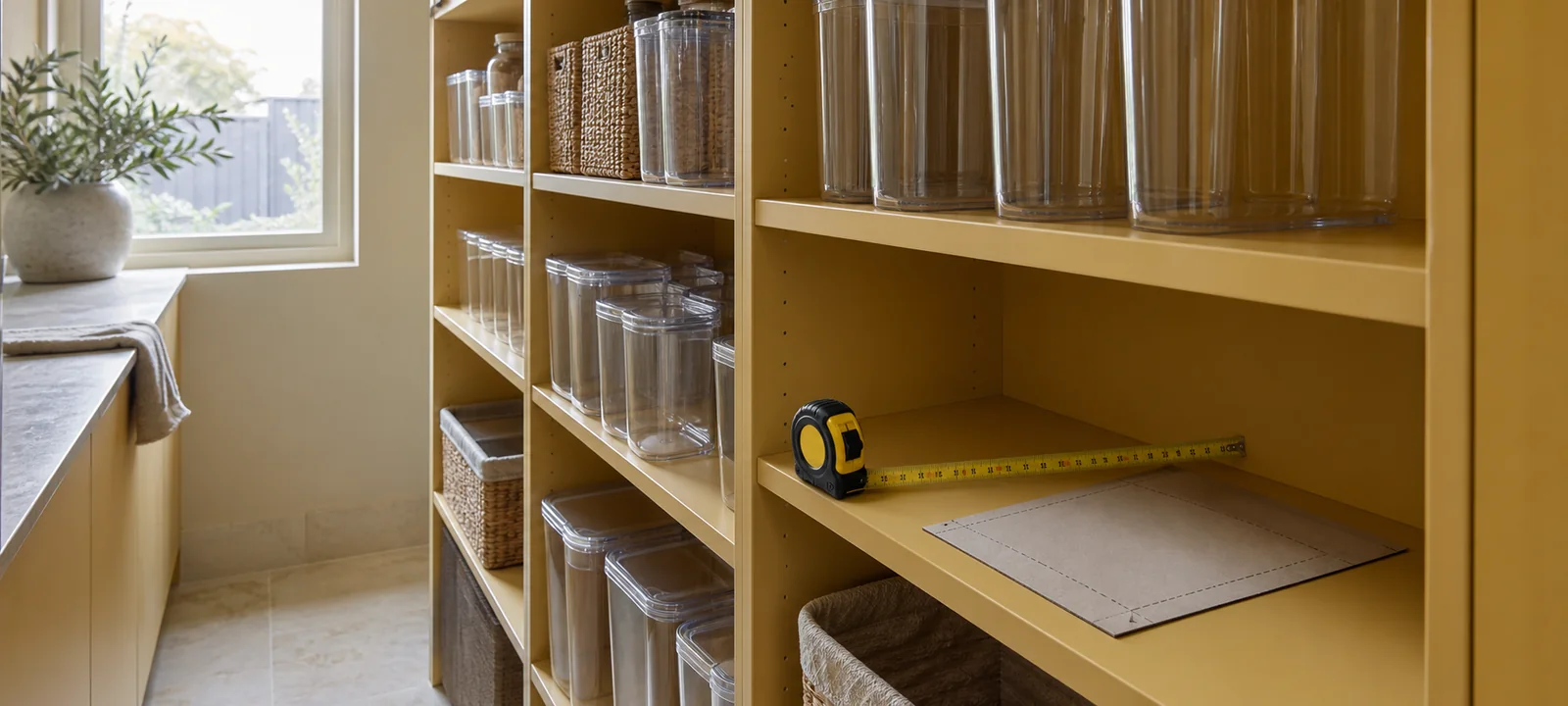
Pantry organisers fail in ordinary ways. A basket fits the shelf but catches on the hinge. A riser makes the back row visible but leaves no room to lift a jar out. Matching containers hold most of a packet and create a second home for the remainder.
Measure the usable shelf, opening and food before comparing products. The aim is not to make every shelf match; it is to make breakfast, lunchbox packing and dinner preparation easier to see and reset.
For a shorter ideas-led overview, start with Pantry Storage Ideas for Australian Kitchens. The main kitchen storage guide covers cupboards, drawers and benches as well.
Name the pantry problem before the product
Empty enough of the pantry to see what is happening. Deep shelves may hide cans, open packets may collapse and duplicate sauces may occupy the useful front row. These are different problems.
- Use a pull-out basket when a related group disappears at the back.
- Consider a riser when short jars are hidden behind one another.
- Use a turntable for a small group of bottles in a suitable corner.
- Sort expired, duplicate or unwanted food before adding capacity.
Write down the one routine that is difficult. “Pack lunch without hunting for snacks” is a better brief than “organise the pantry”.
Measure the usable shelf depth
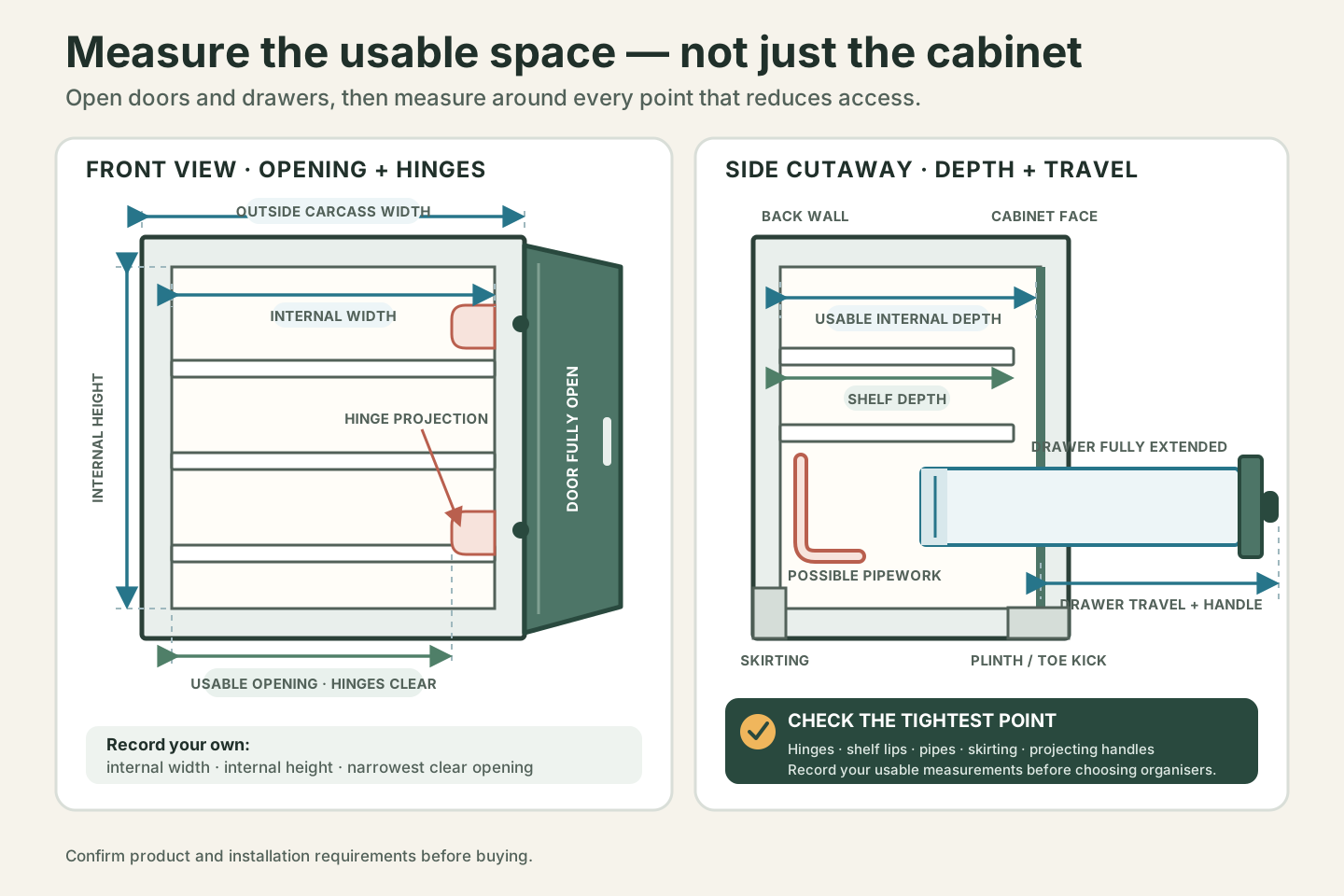
Measure from the front edge to the back wall, then subtract anything that prevents full use: a shelf lip, door track, pipe or the space needed to grip and pull a basket. A product should not overhang or force the door to press against its contents.
Deep storage only helps when the back remains reachable. If a full basket becomes too heavy or needs the front row removed, divide the group into shallower loads rather than filling the entire depth.
Measure height with the food in place
Record the clear gap between shelves and measure the tallest regular packets, bottles and containers. Include lids, handles and the extra height needed to lift an item from a riser. Adjustable shelves may solve the problem without another organiser.
Do not optimise every gap to the last centimetre. A shelf needs enough room for a slightly different cereal box, a new sauce bottle and the hand returning them after shopping.
The opening can be narrower than the shelf
Hinges, frames and sliding doors often reduce access. Measure the narrowest clear opening and test the direction in which a basket must leave the cupboard. Corner pantries may provide generous internal width but no straight path for a wide tray.
Use the opening measurement as the product limit. An organiser that fits only when tilted may spill or become too frustrating for weekly use.
Use a real grocery shop as the size test
Lay out the packets bought regularly: rice, pasta, flour, cereal, snacks, spices, tins and sauces. Measure the largest normal packet and note which products change brand or size. A container set based on one week's packaging may not survive the next shop.
When decanting is genuinely useful, choose a food-contact container that suits the product and follow its directions. Keep the food name, date and any cooking, allergen or storage information the household needs. Avoid topping up a container without the cleaning and stock rotation the food requires.
Choose the organiser by the access problem
Baskets and pull-out tubs
These suit packet groups such as breakfast, baking or lunchboxes. Check that the sides are low enough to see labels, the base is easy to clean and the full basket remains comfortable to pull and lift.
Risers
A riser can reveal cans, spices or short jars, provided both levels remain accessible. Test the tallest item on the upper level and the hand movement needed to remove something below.
Turntables
Turntables can make oils, sauces and spreads easier to reach in a deep corner. Measure the full rotating diameter and allow clearance around walls and hinges. Rectangular packets generally use rectangular shelf space more efficiently.
Clear containers
Containers can help with a small number of frequently used dry staples. They add refilling, labelling and washing, so use them where those steps solve a repeated problem rather than across the pantry by default.
Test the system full and slightly untidy
A shelf photographed immediately after organising is not a useful test. Fill it with a normal shop, open two packets and ask another household member to put everything away. Labels should remain visible and no daily item should require a chain of other items to move.
Keep the categories broad enough to understand at a glance. Too many small bins turn a quick grocery reset into a sorting task.
Use removable storage carefully in a rental
Freestanding risers, tubs and turntables usually adapt more easily than fixed systems, but over-door and adhesive products still need checks. Confirm door clearance, weight limits, surface suitability, product instructions and the lease before attaching anything.
Removable does not guarantee damage-free. A product worth taking to the next home should also work without leaving this cupboard marked or difficult to close.
Prove one shelf before repeating it
Start with breakfast, baking, snacks or another problem group. Measure it, make one change and use it through at least one grocery cycle. If people can see, reach and return the contents, repeat the principle elsewhere—not necessarily the same product.
A pantry needs fewer organisers when the first one solves the actual access problem.
Where pantry organisers disappoint
- The product fits the shelf but not the opening.
- A full basket is too heavy or deep to pull comfortably.
- Risers improve visibility but remove lifting clearance.
- Turntables lose too much rectangular storage space.
- Decanting hides dates or creates leftover packets.
- Adhesives, hooks or over-door racks do not suit the surface or lease.
- The pantry still contains expired food, duplicates and items nobody uses.
Pantry organiser types to compare
Compare an organiser only after one shelf has been sorted and measured. The useful option is the one that improves visibility or access without creating another decanting or cleaning job.
Shallow pantry baskets
- May help with
- Grouping packets used for one routine, such as breakfast, baking or lunchboxes.
- Measure first
- Shelf depth and width, opening width and the height of the packets that need to stand inside.
- Check before buying
- Whether the basket can slide out past hinges and whether labels remain visible from the aisle.
- Avoid if
- The basket will hide expiry dates, hold unrelated food or occupy more depth than the packets need.
Shelf risers
- May help with
- Making shorter cans and jars visible at the back of a tall shelf.
- Measure first
- Usable shelf height, riser width and the height of items on both levels.
- Check before buying
- Whether items can be lifted from the lower level without removing the front row.
- Avoid if
- The shelf is already low, the riser blocks tall staples or the back row will still be hard to reach.
Turntables
- May help with
- Keeping a small group of bottles or jars accessible in a deep corner.
- Measure first
- The full rotating diameter, shelf depth and clearance around hinges and side walls.
- Check before buying
- Whether the regular bottles fit without catching and remain stable when the tray turns.
- Avoid if
- A rectangular shelf would lose too much usable space or tall bottles would be crowded together.
Decanted pantry containers
- May help with
- A limited group of dry staples the household reliably refills and labels.
- Measure first
- Packet volume, container footprint, lid clearance and the shelf height available when stacked.
- Check before buying
- Food-contact directions, cleaning, label space and whether the original cooking information must be retained.
- Avoid if
- Original packaging already fits, refilling is unlikely or a matching set would create unused sizes.
Practical options for the shelf that still fails
First remove expired food, group one real grocery category and test whether moving it to a better shelf solves the problem. If access is still awkward, compare these turntable and under-shelf options against the measured opening, packet height and hand movement before repeating anything across the pantry.
Some links below are affiliate links. If you buy through one, we may earn a commission at no extra cost to you. Learn more.
11-inch pantry turntable
OXO Good Grips 11-inch Turntable
A compact rotating tray for a small group of jars, bottles or condiments in a deep pantry corner once its full diameter and nearby clearance have been checked.
Research-supported option
View at Amazon AustraliaMay suit: small groups of bottles, sauces or jars in a deep, accessible pantry corner; shelves with clear rotation space around an approximately 28 cm tray.
May not suit: narrow rectangular shelves where a basket uses the footprint more efficiently; tall bottles with limited clearance above or beside them.
Drawbacks to consider:
- A circular tray leaves unused space on a rectangular shelf.
- Tall or closely packed bottles can catch on a shelf above or on the pantry wall while turning.
- It improves access to a small group; it does not create capacity for a broad pantry category.
Evidence confidence: moderate. Last reviewed 4 August 2026. Research-based assessment; we have not tested this product firsthand.
Under-shelf film, foil and bag organiser
Joseph Joseph CupboardStore Film, Foil & Bag Organiser
An under-shelf holder for rolls, boxes and bags where the cupboard is wide enough and the shelf surface, thickness and door clearance suit its adhesive installation.
Research-supported option
View at Amazon AustraliaMay suit: cupboards where rolls, foil, baking paper or bags are taking up a useful shelf; households able to follow the installation instructions and wait before loading it.
May not suit: rental or delicate surfaces where adhesive mounting is unsuitable; shelves with limited door clearance or no spare space beneath them.
Drawbacks to consider:
- It relies on adhesive installation, which may not suit every shelf surface, rental or cupboard finish.
- It is intended for rolls and boxes, not a broad mix of pantry packets.
- The cupboard needs enough width and door clearance for the organiser and the items hanging beneath the shelf.
Evidence confidence: moderate. Last reviewed 4 August 2026. Research-based assessment; we have not tested this product firsthand.
Pull-out under-shelf spice rack
Joseph Joseph CupboardStore Under-shelf Spice Rack
A pull-out rack for up to seven standard spice jars where the shelf is at least 32 cm wide, no more than 2 cm thick and suitable for the supplied adhesive mounting.
Research-supported option
View at Amazon AustraliaMay suit: a small, frequently used group of spice jars that disappears behind pantry items; cupboards with a suitable shelf and enough clearance for a 32 cm pull-out rack.
May not suit: wide spice collections, oversized jars or shelves thicker than 2 cm; rental or delicate surfaces where adhesive mounting is unsuitable.
Drawbacks to consider:
- It is limited to smaller spice jars and is not a substitute for broad pantry storage.
- The adhesive installation and shelf-thickness limit need to suit the cabinet before purchase.
- A poorly placed rack can interfere with the cupboard door or reduce the space beneath the shelf.
Evidence confidence: moderate. Last reviewed 4 August 2026. Research-based assessment; we have not tested this product firsthand.
Measurements to take shopping
- Usable shelf width, depth and height.
- The narrowest door or hinge opening.
- The tallest and widest regular packets.
- The full volume of foods intended for decanting.
- Grip, lift and rotation clearance.
- The loaded weight of a pull-out group.
- Cleaning, labelling and rental requirements.
Pantry storage earns its place when a normal shop still fits and the next meal is easier to start. Measure the food and the hand movements as carefully as the empty shelf.
Common Questions
What should I measure before buying pantry organisers?
Measure usable shelf width, depth and height, then record the narrower cabinet opening, hinges and supports. Include the real height and width of packets, jars and cans from a normal grocery shop. Check the room needed to grip and lift items, because an organiser can fit the shelf yet remain awkward to remove when full.
Are baskets, turntables or containers best for pantry storage?
Choose by the access problem. Baskets can gather packets from one routine, risers reveal short jars at the back and turntables can bring small items forward when rotation space is clear. Containers suit foods that benefit from decanting and fit the shelf well. No single organiser type is best for every pantry category.
How do you test a pantry storage system before buying more?
Change one difficult shelf and use it through a normal grocery cycle. Test the organiser full and slightly untidy, slide it past hinges, lift the tallest item and check whether labels and dates remain visible. Repeat the product elsewhere only after the household can return food easily without creating packet remainders or hidden duplicates.