
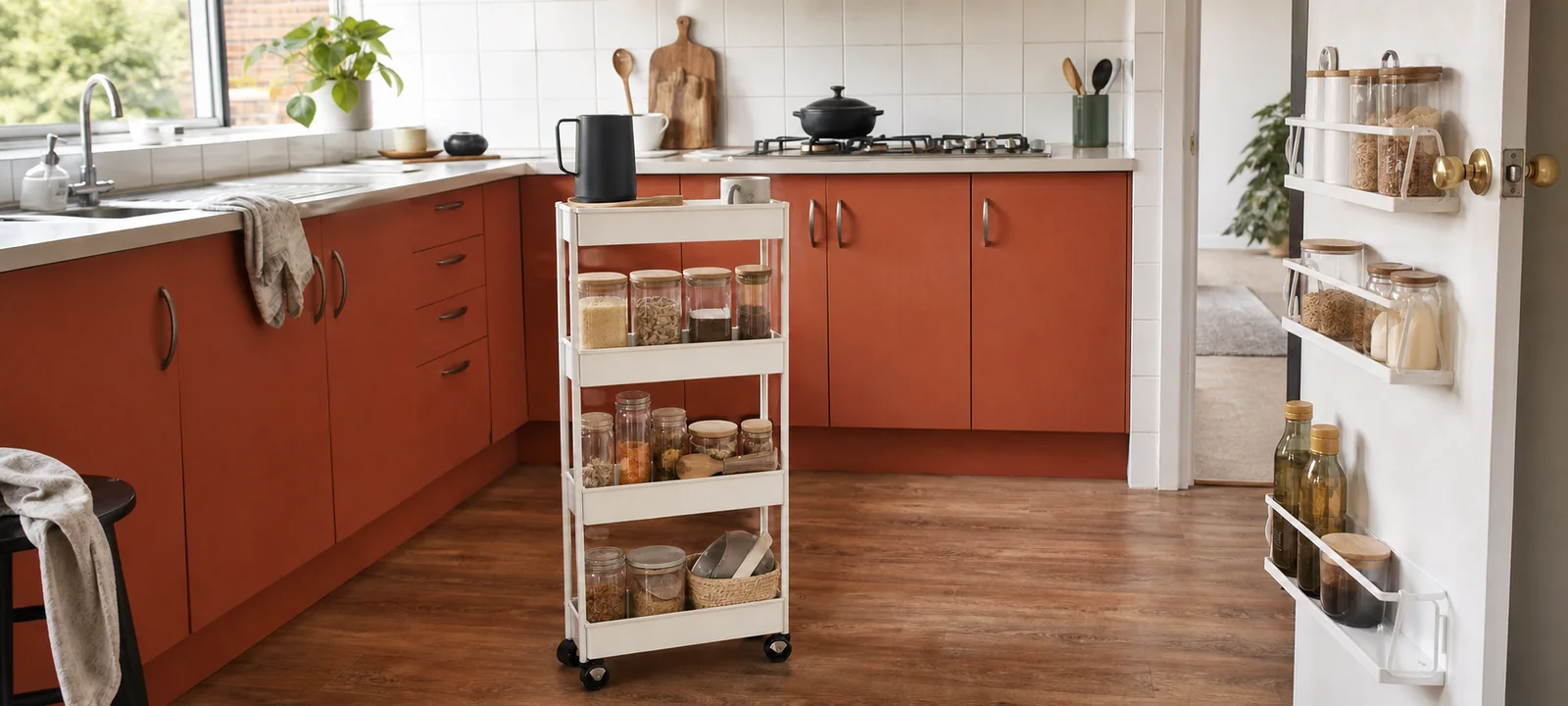
A rental kitchen can have a storage problem the tenant is not free to rebuild. Narrow cupboards, one useful drawer and a poorly placed power point still have to support groceries, cooking, coffee, lunchboxes and cleaning.
The strongest fixes usually sit inside the existing kitchen and move with the household. Measure first, check the lease and surface, and favour pieces that improve a routine without claiming the walkway or leaving a repair behind.
For the broader room plan, see Kitchen Storage That Makes Small Cupboards Easier to Use.
Separate fixed limits from movable clutter
Cabinet layout, bench shape, drawer depth and power point position may be fixed. Duplicate utensils, hidden pantry food and unused appliances are not. Sort the movable problem before spending money around the fixed one.
Choose the first change by routine: unloading cutlery, finding dinner staples, clearing food preparation space or reaching cleaning supplies. “More storage” is too broad to measure against the lease or the next home.
Check the lease before relying on “removable”
Requirements vary by property and jurisdiction. Review the current lease and seek the appropriate approval before drilling, screwing or otherwise altering walls, tiles, cabinets or doors. Keep a written record where approval is required.
Adhesive does not mean damage-free. Paint, laminate, veneer, grout and aged cabinet finishes can mark, lift or hold residue. Check both the storage product and surface instructions, and do not assume a small hook carries no risk.
Measure the working opening, not the visible gap
Record cupboard and shelf dimensions, but also measure hinges, frames, handles and the path an organiser must take to come out. Inside drawers, use the narrowest internal width, depth and height. Beneath the sink, map pipes, valves, the bin and any moisture.
Freestanding pieces need a second set of measurements: fridge, oven and dishwasher doors open; people passing; and the space required to clean around the unit. A slim trolley can fit beside the fridge and still stop its door opening fully.
Choose storage worth carrying to another home
A reusable piece has ordinary proportions, a clear job and more than one possible location. Shallow tubs, adjustable dividers and a modest trolley may transfer between kitchen, laundry and bathroom. A custom insert for one unusual cupboard may not.
Portability is not enough by itself. Check loaded weight, stability, cleaning and whether the item can be packed without a collection of loose fittings.
Start inside the drawers
Removable trays and dividers can improve a rental without touching the property. Give each drawer one main job and remove duplicates before measuring an insert. An organiser cannot make a shallow drawer accommodate long, stacked utensils.
Use the kitchen drawer guide to measure the interior, frame clearance and actual tools.
Improve pantry visibility without altering shelves
Pull-out baskets, freestanding risers and turntables can make food visible when they suit the shelf and opening. Start with one group that disappears at the back rather than buying a matching system for the whole pantry.
The pantry measurement guide covers packet size, hinge clearance and the space needed to lift or rotate an organiser.
Make an over-door rack pass the closing test
Measure door thickness, the gap above it, hinge clearance and the space between the closed door and internal shelves. Protect the finish where the product instructions allow and check that the loaded rack does not strain, scrape or stop the door closing.
Keep loads modest and stable. A rack is not a sensible home for heavy glass jars, large bottles or sharp objects merely because they fit.
Do not trade the walkway for a trolley
Freestanding storage can add a useful surface, but also narrows the room. Mark its full footprint and test the kitchen at its busiest: appliance doors down, another person passing and a cupboard open.
A stable trolley that holds a repeated routine may earn the floor space. One that becomes pantry overflow beside the fridge has simply moved the clutter into view.
Treat adhesives as a surface decision
Heat, steam, oil, texture, moisture and age all affect how an adhesive performs and removes. Follow the product's surface, load and removal instructions. Avoid suspending heavy, sharp or breakable items from an uncertain fixing.
A freestanding shelf, drawer tray or removable bin is often easier to assess. Even those options still need airflow, cleaning clearance and a stable position.
Protect one clear section of bench
Bench organisers often consume the work surface they promise to tidy. Keep only items used frequently enough to justify being out, group a real routine such as tea or coffee, and move occasional appliances into accessible storage.
When the bench is already crowded, edit the contents before adding a riser or rack. Clear preparation space is a kitchen function, not unused storage capacity.
Let appliances influence storage, not dominate it
An appliance used every day may deserve a safe, accessible position. One used monthly should not force new shelving, a permanent trolley and a cable route through the preparation area. Measure the appliance in use, including lids, doors, attachments and manufacturer clearances.
Do not alter electrical fittings or improvise unsafe power access to make a storage idea work. If the fixed kitchen does not support the appliance, choose a different location, product or plan.
Where renter-friendly storage goes wrong
- An adhesive product is trusted without checking the surface or lease.
- An over-door rack stops the door closing or marks the finish.
- A trolley blocks an appliance door or the main path.
- An insert fits the cabinet frontage but not the usable interior.
- The product is so custom that it will not suit another room or home.
- More containers are bought before expired food and duplicates are removed.
- The bench gains storage but loses its only clear work area.
Questions to answer before bringing storage home
- What repeated kitchen task will this improve?
- Does the lease or property manager require approval?
- Have the usable opening and moving parts been measured?
- Will it stay stable and cleanable when full?
- Could it mark a surface or obstruct an appliance, service or walkway?
- Is it useful enough to take to another home?
- Would sorting or removing an unused appliance solve the problem first?
Renter-friendly storage should make this kitchen easier without committing the household to this exact layout. The best piece is measured, modest and easy to reuse—not simply labelled removable.
Common Questions
How can I add kitchen storage in a rental without renovating?
Improve the existing drawers and shelves first with measured dividers, bins or risers, then consider a stable freestanding piece only if the walkway allows it. Protect a clear section of bench and choose products useful beyond this address. Check the agreement before fixing, drilling or attaching anything to the property.
Are removable adhesive hooks safe in a rental kitchen?
Do not assume removable means risk-free. Paint, laminate, tile, grout, heat, grease and the age of a surface can change how an adhesive holds and releases. Check the lease and product directions, test only on a suitable inconspicuous area, and avoid relying on an adhesive fitting for a load the surface cannot safely support.
Is a kitchen trolley useful in a small rental?
A trolley helps when it has a genuine parking place, carries a defined group and can move without blocking doors, appliances or the main walkway. Mark its full footprint on the floor and test the room while cooking. Choose a broadly useful size rather than one designed only for an unusual gap in the current kitchen.