
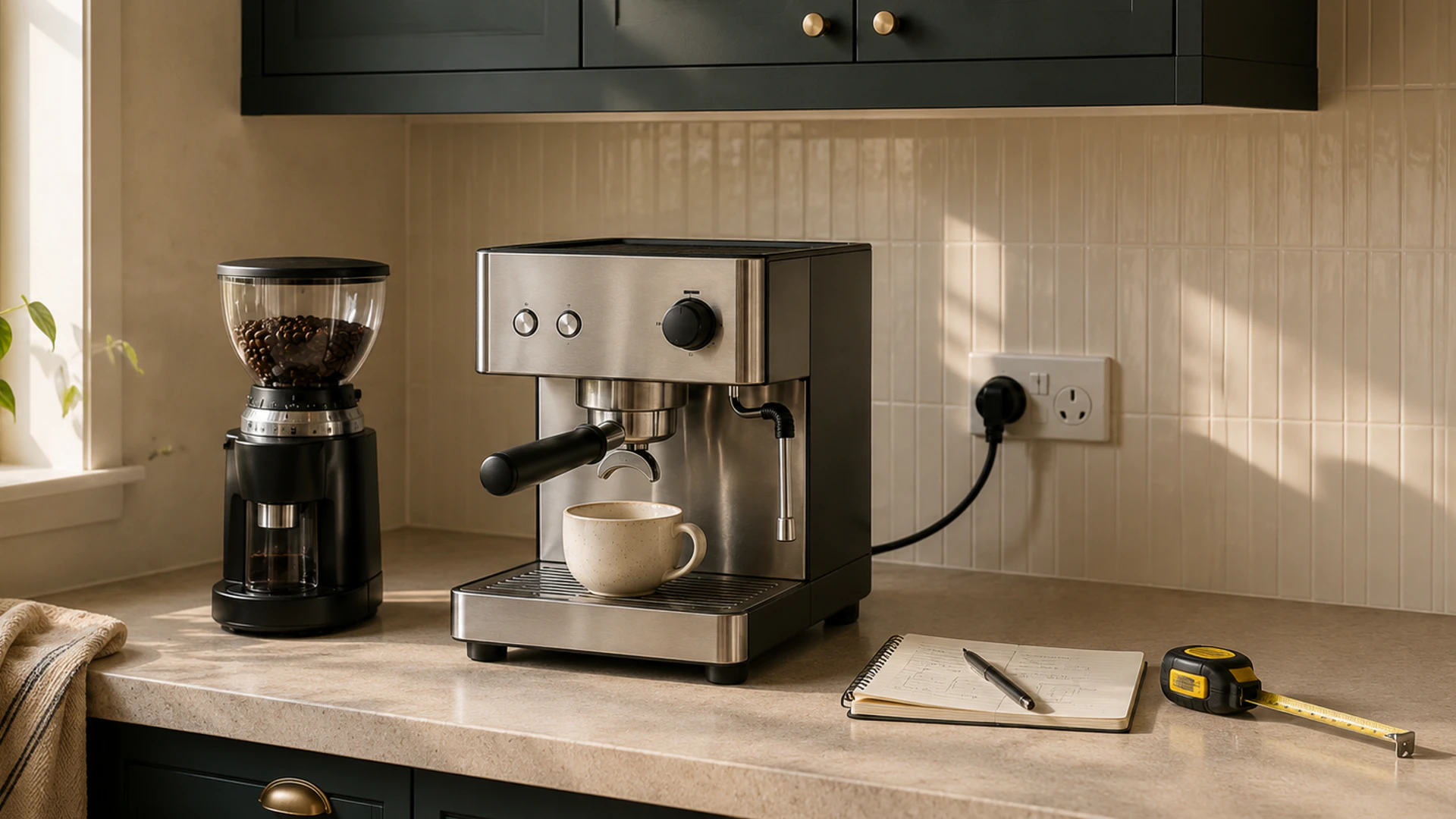
The right coffee machine is the one whose routine still suits the household on a rushed weekday. A manual espresso machine may offer more control, but it asks someone to grind, dose, tamp, extract, texture milk and clean the working parts. A fully automatic machine handles more of that sequence internally, then asks for its own rinsing, milk care and scheduled maintenance.
Start with the drinks, people and available bench position rather than a long feature list. Australian Home Collective has not tested these machines. This guide compares the practical trade-offs between formats and uses a small, sourced set of current models as examples rather than declaring one machine best for every home.
Choose the daily workflow before the machine
Count what is made on a normal morning. One long black before work creates a different brief from four flat whites using dairy and oat milk. Include who will learn the controls, whether settings need to be saved for several people and how much cleaning time is realistic after the last drink.
Swipe sideways to compare the full table.
| Format | Daily workflow | Space and access | Cleaning and consumables | Who it may suit |
|---|---|---|---|---|
| Pod or capsule | Fill water, insert a capsule and manage milk separately or through an attached system | Often a smaller body, but the tank, capsule bin and milk accessory still need access | Used capsules, descaling and any milk parts; the compatible capsule supply remains an ongoing commitment | One or two people who value a short, repeatable sequence more than grind and extraction control |
| Manual or semi-automatic espresso | Grind, dose, tamp, lock in the portafilter, extract and texture milk | Add a separate grinder where one is not built in, plus room for the portafilter, steam wand and knock box | Rinse baskets and portafilter, wipe and purge the wand, and follow the required backflush and descale routine | Someone prepared to learn the process and adjust it when beans, grind or milk change |
| Assisted manual espresso | Use a portafilter while the machine guides or performs selected grinding, dosing, tamping or milk steps | An integrated grinder can reduce the combined footprint, but the hopper, tank and tamping system still need access | The visible coffee and milk parts need hands-on care, along with cleaning cycles for the integrated systems | Someone who wants a portafilter routine with help at the steps they find least consistent |
| Fully automatic | Select a drink while the machine grinds, doses and extracts internally; attach or fill milk where required | Check body depth, top hopper access, tank direction, grounds-bin travel and storage for milk containers | Automatic rinsing does not remove the need to empty trays, clean the milk path, care for the brew group and buy specified products | Several users who want a consistent button-led routine and will follow the machine's maintenance prompts |
| Filter or batch brewer | Add ground coffee and water, then brew into a cup or carafe | Allow lid or basket access above, carafe removal in front and a separate grinder if using whole beans | Paper or reusable filters, carafe and basket washing, descaling and hotplate care where fitted | Households that mainly drink black coffee or want several cups without making individual espresso shots |
Measure the machine while it is being filled, used and cleaned
Product dimensions describe the body, not the full operating envelope. Mark the stated width and depth on the intended bench, then trace every part that opens, swings or slides. The kitchen bench space guide can help decide whether a permanent coffee station leaves enough uninterrupted preparation room.
- Measure from the bench to the lowest overhead cupboard, shelf, door or projecting power point.
- Check whether the bean hopper lid opens fully and whether beans can be poured in without pulling the machine forward.
- Confirm whether the water tank lifts out from the top or slides from the front, side or rear.
- Allow the portafilter handle and steam wand to move without striking a wall, appliance or splashback item.
- Pull the drip tray, used-capsule bin, grounds container and brew group through their full removal paths.
- Leave a stable landing place for a milk jug or carafe, cups, a knock box and the parts being rinsed.
A machine that fits only when it is empty may be frustrating every day. If the tank is at the rear or the hopper is close to a cupboard, include the weight and grip needed to move the appliance without dragging it across the bench.
An integrated grinder saves one decision but joins two systems together
A manual machine without a grinder needs a grinder capable of the adjustment its basket and beans require. Add that cost and footprint before comparing it with an integrated model. Also allow room for dosing, tamping and clearing loose grounds rather than measuring the two appliance bodies as a neat rectangle.
An integrated grinder can make the routine more compact and allow the machine to guide the dose. The trade-off is that the grinder and espresso system share one product, service path and bench position. Check the grind range, hopper access and how old beans are removed. A household that swaps regularly between caffeinated and decaffeinated beans may need a bypass chute, a second grinder or a hopper designed for practical bean changes.
The milk system often decides the real cleaning burden
A manual steam wand keeps the milk path visible, but it needs wiping and purging promptly after each use and requires technique to create the intended texture. Automatic milk containers and hoses reduce that technique, not the need for hygiene. They may need rinsing after each session, deeper cleaning, refrigeration and space to dry before reassembly.
List every milk used in the household. Automatic settings for dairy or plant-based alternatives do not guarantee the same result across every brand and temperature. Check the exact manual for permitted milk types and cleaning steps, then judge the result during a demonstration where possible. A machine that handles the household's two regular drinks well can be more useful than a larger menu that adds parts and choices no one uses.
Read the cleaning schedule at three levels
Automatic rinsing and a cleaning prompt are useful only when the remaining tasks are understood. Download the manual before buying and separate the work required after a drink, at the end of the day and when a scheduled cycle appears.
After a drink
Knock out or contain used coffee, rinse the basket where required, wipe and purge a steam wand, or run the specified milk rinse. Leaving milk residue until later makes the apparent convenience misleading.
At the end of the day
Empty the drip tray, used-capsule or grounds container and standing water. Wash the milk container or hose as directed, and give removable parts enough ventilated space to dry.
When the machine requests maintenance
Follow the maker's instructions for cleaning tablets, water filters, descaling, backflushing, brew group care and lubrication. Confirm which products are proprietary and where they are readily available before choosing the machine.
As examples of the detail available before purchase, Breville's espresso cleaning overview, De'Longhi's Australian manual library and Nespresso Australia's machine assistance show how much the routine can vary by model. Use the instructions for the exact model code rather than transferring one brand's schedule to another machine.
Consumables need money and storage after the machine arrives
Use current prices and the amount the household will actually use. Add beans or compatible capsules, milk, paper filters where relevant, water filters, cleaning tablets, milk cleaner, descaler and any separate grinder. Include delivery intervals and a dry, accessible storage place.
A water filter does not remove every maintenance task, and its replacement interval can depend on water hardness and use. Check the manual rather than assuming a headline cup count will apply to the household. Avoid choosing a format because of a short sale when its daily routine or ongoing supplies do not fit.
Coffee machine options for different routines
First decide which grinding, milk and cleaning steps the household will repeat on an ordinary morning; keeping the current method is sensible if no machine reduces that friction. If an assisted or automatic workflow still fits, compare these options by in-use clearance, daily cleaning and ongoing consumables.
Some links below are affiliate links. If you buy through one, we may earn a commission at no extra cost to you. Learn more.
Assisted manual espresso machine
Breville Barista Touch Impress BES881BSS
An assisted portafilter option for someone who wants control over extraction with integrated grinding, dosing and tamping guidance plus automatic milk texturing.
Research-supported option
View at Amazon AustraliaMay suit: someone who wants a portafilter routine with guidance at the grinding, dosing, tamping and milk steps; a permanent coffee station with rear water access and room above the hopper.
May not suit: a household wanting a fully automatic one-touch bean-to-cup routine; a shallow bench or low-cupboard position that makes rear and overhead access difficult.
Drawbacks to consider:
- The rear water tank can make refilling awkward beneath cupboards or against a splashback.
- The top bean hopper still needs enough overhead clearance to open and fill.
- Assisted dosing, tamping and milk texturing do not remove the portafilter and steam-system cleaning routine.
Evidence confidence: moderate. Last reviewed 17 August 2026. Research-based assessment; we have not tested this product firsthand.
Fully automatic machine with hot and cold milk
De'Longhi Eletta Explore ECAM450.55.G
A 26 cm wide but 45 cm deep fully automatic example for a household that will use both hot and cold milk drinks and has storage for two carafes.
Research-supported option
View availability and terms at Amazon AustraliaMay suit: a household wanting a button-led routine for both hot and cold milk drinks; a deep permanent bench position with storage and cleaning space for two milk carafes.
May not suit: a shallow bench or household that will not use the cold-drink system; someone wanting direct portafilter control over dosing, tamping and extraction.
Drawbacks to consider:
- Its 45 cm body depth needs a generous bench and clear access to the top bean hopper.
- The hot and cold milk system adds two carafes that need cleaning, refrigeration and storage.
- When checked, Amazon's buy box did not offer its standard change-of-mind return, so the current terms need careful review.
Evidence confidence: moderate. Last reviewed 17 August 2026. Research-based assessment; we have not tested this product firsthand.
Fully automatic machine with removable milk container
Philips 5500 LatteGo EP5541/20
A 24.6 cm wide, 43.3 cm deep fully automatic example for someone prioritising a short milk routine and a two-part container that can be rinsed or put in the dishwasher.
Research-supported option
View at Amazon AustraliaMay suit: someone prioritising a button-led bean-to-cup routine and a milk container with only two main parts; a permanent bench position with room above and enough depth for the 43.3 cm body.
May not suit: a shallow bench or low cupboard position that restricts hopper access; someone who wants to adjust and control the portafilter extraction process directly.
Drawbacks to consider:
- Its 43.3 cm body depth and top bean access still require a deliberately measured bench position.
- Filters, cleaning tablets, descaler and brew group lubricant remain part of ownership.
- The automated drink menu offers less direct extraction control than a portafilter machine.
Evidence confidence: moderate. Last reviewed 17 August 2026. Research-based assessment; we have not tested this product firsthand.
A practical buying checklist
- Count the drinks made on a normal morning, the people using the machine and the milk types involved.
- Choose how much grinding, dosing, tamping, extraction and milk work is genuinely acceptable.
- Measure the machine in use, including overhead clearance and tank, hopper, wand, tray and grounds access.
- Add a separate grinder, milk frother, knock box, carafe and drying space where the format needs them.
- Read the after-drink, daily and scheduled cleaning instructions for the exact model.
- Check the current cost and local availability of capsules, filters, tablets, descaler and other specified consumables.
- Confirm the Australian model code, included milk accessories, seller, return terms and written warranty.
- Investigate authorised service, spare parts and support in the household's location.
For the wider appliance decision, the small kitchen appliances guide covers power access, weight, storage and the effect on everyday preparation space.
Common Questions
What type of coffee machine is easiest to use?
A capsule machine usually has the shortest black coffee sequence, while a fully automatic machine can reduce the drink-making steps for milk coffee. Both still need filling, emptying and cleaning. Compare the exact steps in the manual for the drinks your household makes rather than treating one format as universally easiest.
How much bench space does a coffee machine need?
Start with the product width, depth and height, then add the space needed to remove or fill the water tank, open the bean hopper, swing a steam wand, lock in a portafilter and pull out the drip tray or grounds container. Check the lowest overhead cupboard and keep a clear route to the sink.
Is filter coffee the same as espresso?
No. A filter machine passes water through ground coffee into a cup or carafe without producing espresso under the same pressure-based process. It may suit households that mainly drink black coffee or prepare several cups at once, but milk drinks need a separate milk routine.