
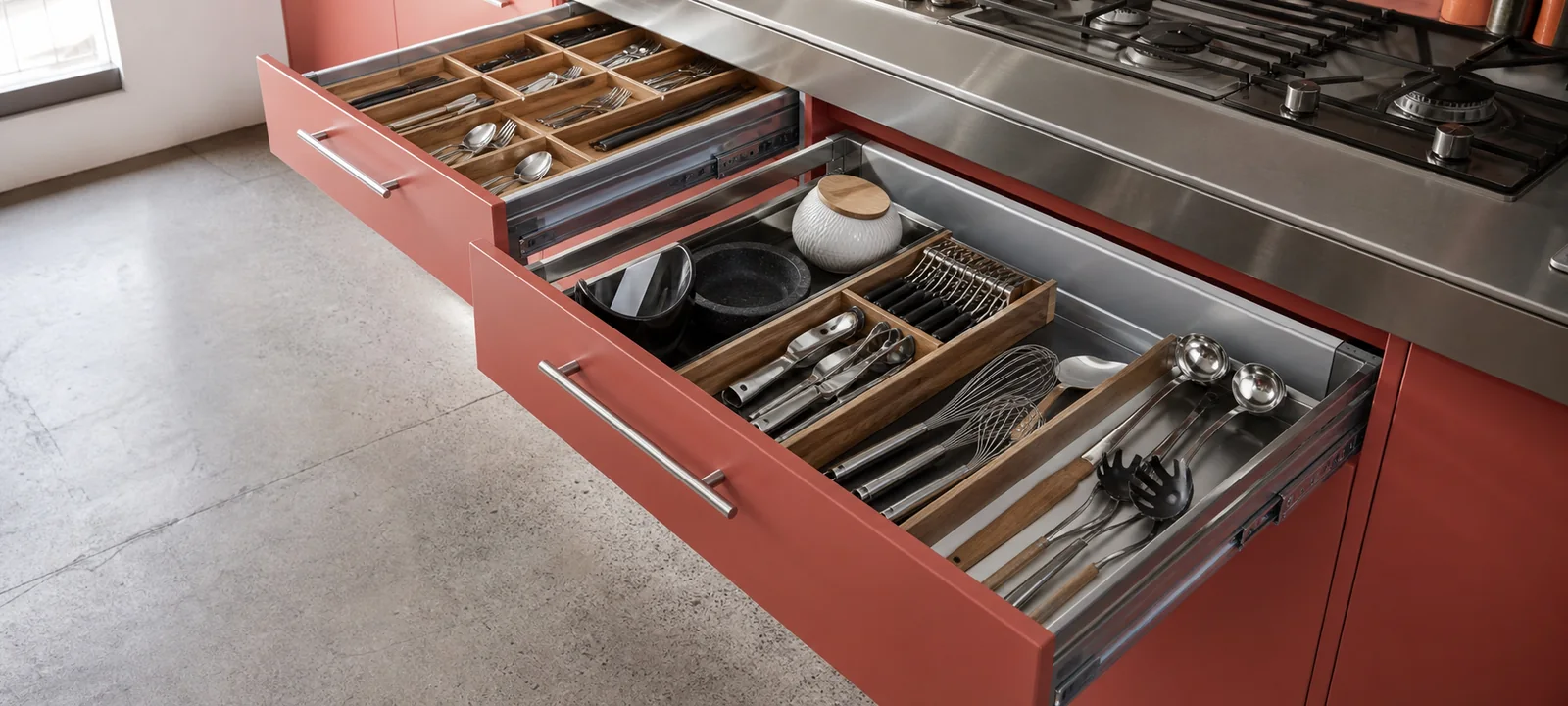
A kitchen drawer can be wide enough and still refuse to close. Tongs sit diagonally, measuring spoons slide beneath a ladle and an organiser designed for cutlery leaves nowhere sensible for the tools used at the cooktop.
Give the drawer one main job, lay out the items that belong there and measure the actual interior. A useful organiser makes weekly tools easier to lift and return; it does not simply divide a crowded drawer into smaller crowded sections.
For the wider room plan, see Kitchen Storage That Makes Small Cupboards Easier to Use.
Find the moment the drawer fails
Open the drawer during a real task. Does a long utensil catch? Do small parts disappear, or does the drawer contain tools for cooking, baking, lunchboxes and household repairs at once? Each failure points to a different answer.
- Sliding cutlery may need a fitted tray.
- Long tools may need an open zone or another location.
- Small loose parts may need one removable tray.
- A drawer containing duplicates and unrelated items needs sorting first.
Give the drawer one main job
Cutlery, cooking utensils, wraps, baking tools and lunchbox parts each create different compartment needs. Two categories can share a drawer when they are used together and fit without stacking. Cutlery and bulky utensils usually compete; wraps and food bags may not.
Location matters. Put everyday cutlery near the unloading or dining route and cooking tools near the preparation area where practical. Moving the wrong category may solve more than a new insert.
Measure the drawer's real interior
Measure internal width, depth and height at the base and near the top. Curved sides, runners, screw heads and a narrowing frame can make the usable space smaller than the cabinet front suggests.
Close the empty drawer slowly and note where the frame passes over its contents. An organiser can fit inside the box but still catch at the opening. Record the smallest dimension as the limit.
Use the longest and tallest item as the test
Lay out the tongs, spatulas, whisk, ladle and any protected knives intended for the drawer. Measure the longest item and its handle height. Include stacked measuring cups or utensils whose handles naturally sit upward.
If a tool only fits diagonally, an organiser cannot recover the lost corners. Move it to a deeper drawer, suitable upright holder or another storage position rather than designing the whole drawer around one awkward item.
Check the lifting space above each compartment
Compartment dimensions should accommodate the item and the hand removing it. A narrow slot may hold a peeler neatly but make it difficult to grip. Deep sections can conceal small tools beneath larger ones.
Leave some tolerance around the organiser. A tray wedged tightly into an irregular drawer is harder to remove for cleaning and may not expand or contract as intended.
Edit duplicates before dividing the space
Empty the drawer and group similar items. Keep the versions used and in good condition, then remove broken clips, takeaway cutlery, appliance parts with no appliance and duplicate tools that never leave the drawer.
“Came in a set” is not a drawer job. Prime space should go to the equipment used in this part of the kitchen each week.
Compare organiser types by their compromise
Fixed trays
A fixed tray is simple and stable for a predictable cutlery set. Check compartment length, cleaning access and the strip of drawer space left beside it. That leftover strip should have a defined use rather than becoming another narrow dumping ground.
Expandable organisers
Expansion can produce a close fit in a standard drawer, but measure both closed and fully expanded dimensions. Check stability, the shape of the new compartments and whether extending the sides creates gaps that collect crumbs.
Adjustable dividers
Dividers suit broad categories and awkward lengths when their fixing method suits the drawer. Check the end material, pressure and instructions before using them against a delicate finish. Heavy tools can shift a lightly held divider each time the drawer closes.
Small removable trays
One tray can contain clips or measuring spoons. Several tiny trays can fragment the space and turn returning tools into a puzzle. Use the fewest divisions that keep small items visible.
Keep sharp tools deliberately controlled
Do not leave blades loose where a hand can meet an edge while searching. Use storage suited to the tool and follow its instructions. Consider who can access the drawer and whether a safer position or additional control is needed in the household.
Knife blocks, magnetic storage and in-drawer systems each depend on their placement, installation and users. This guide does not replace the product's safety directions.
Use removable organisers in a rental
A fitted tray, freestanding divider or removable box can move with the household. Avoid adhesives or modifications unless the lease, drawer finish and product instructions allow them. A product that works only in one precisely sized drawer may not be worth carrying to the next kitchen.
Test the drawer during cooking and clean-up
Use it for a week. The tools should be reachable during preparation and easy to return when unloading or washing up. Watch for compartments that overflow, items that migrate and an organiser that shifts or traps crumbs.
If the household ignores the divisions, simplify them. A system that needs careful placement after every meal is unlikely to remain useful.
Where drawer organisers fail
- External cabinet dimensions were used instead of the drawer interior.
- The organiser or tallest tool catches as the drawer closes.
- Long utensils still sit diagonally across several sections.
- Compartments fit the product category but not the actual items.
- Too many small divisions make the drawer fiddly to reset.
- Duplicates and unrelated items remain in prime space.
- The tray cannot be removed easily for cleaning.
Drawer organiser types to compare
Choose the organiser style only after the drawer has one main job and the items have been laid out. Fit, compartment shape and cleaning matter more than the organiser's packaged dimensions.
Fixed cutlery trays
- May help with
- Keeping a stable set of everyday cutlery in one drawer.
- Measure first
- Internal drawer width, depth and height, including any curved sides or raised screw heads.
- Check before buying
- Compartment length, cleaning access and whether the tray leaves a useful strip of drawer space.
- Avoid if
- Long utensils must be forced into short compartments or the tray wastes much of an irregular drawer.
Expandable organisers
- May help with
- Using more of a standard drawer when the final width is known.
- Measure first
- Drawer width at the base and top, plus the organiser's closed and fully expanded dimensions.
- Check before buying
- Whether the expanded sections stay stable and whether the drawer still closes at its narrowest point.
- Avoid if
- Expansion covers useful compartments, creates gaps that are hard to clean or relies on pressure against delicate sides.
Adjustable dividers
- May help with
- Separating larger utensils, wraps or lunchbox parts whose sizes do not suit fixed trays.
- Measure first
- Drawer depth and height, item length and the space needed to lift each item out.
- Check before buying
- How the divider is held in place and whether its ends suit the drawer surface.
- Avoid if
- The drawer contains too many unrelated items or the dividers will shift whenever a heavy utensil is returned.
Small removable trays
- May help with
- Grouping clips, measuring spoons or other small items inside a broader drawer zone.
- Measure first
- The remaining space after everyday tools are laid out and the height of the smallest loose items.
- Check before buying
- Whether each tray has one clear job and can be removed for cleaning.
- Avoid if
- Several tiny trays would make the drawer more fragmented or conceal duplicates that should be removed.
Drawer organisers for the remaining access problem
First remove duplicates, give the drawer one job and lay the kept tools out by use; that may be enough without an insert. If items still collide or disappear, compare these expandable organisers against the drawer's narrowest internal dimensions, longest utensil and lifting clearance.
Some links below are affiliate links. If you buy through one, we may earn a commission at no extra cost to you. Learn more.
Expandable utensil drawer organiser
OXO Good Grips Expandable Utensil Drawer Organiser
A removable-tray organiser for cutlery, utensils and small loose items once the drawer width, depth and 6 cm clearance have been checked.
Research-supported option
View at Amazon AustraliaMay suit: drawers holding a mix of cutlery, irregular tools and small kitchen gadgets; households that want removable sections for setting the table or cleaning.
May not suit: shallow drawers or drawers with runner, screw or curved-side obstructions; households needing a fixed cutlery-only layout.
Drawbacks to consider:
- Its 6 cm height and wide expanded footprint will not suit every drawer.
- It is designed to be wiped clean rather than used as a dishwasher-safe tray.
- The open section will not resolve mixed, excess contents by itself.
Evidence confidence: moderate. Last reviewed 4 August 2026. Research-based assessment; we have not tested this product firsthand.
Expanding cutlery, utensil and gadget organiser
Joseph Joseph DrawerStore Expanding Cutlery, Utensil & Gadget Organiser
An expanding tray with deep cutlery and gadget compartments for drawers with at least 7.5 cm internal height.
Research-supported option
View at Amazon AustraliaMay suit: households sorting cutlery, small utensils and kitchen gadgets in one drawer; drawers with enough height for the tray and enough width for its expanding sides.
May not suit: shallow or unusually shaped drawers; drawers dominated by long-handled utensils or oversized knife handles.
Drawbacks to consider:
- It needs a minimum internal drawer height of 7.5 cm and still depends on the drawer's actual width and depth.
- Long or unusually shaped tools may need another solution.
- It should be hand washed and dried rather than treated as a dishwasher-safe insert.
Evidence confidence: moderate. Last reviewed 4 August 2026. Research-based assessment; we have not tested this product firsthand.
Large expandable kitchen-tool drawer organiser
OXO Good Grips Large Expandable Kitchen Tool Drawer Organiser
A wide, adjustable organiser for longer or irregular kitchen tools, once the drawer can accommodate its 46 cm expanded width and 6 cm height.
Research-supported option
View at Amazon AustraliaMay suit: wide drawers storing long-handled or irregular kitchen tools; households that need a few adjustable zones rather than fixed cutlery compartments.
May not suit: shallow, narrow or unusually shaped drawers; drawers used mainly for a stable, compact cutlery set.
Drawbacks to consider:
- Its expanded width and 6 cm height rule out many shallow or narrow drawers.
- The dividers are adjustable rather than fixed, so a heavily loaded drawer may need a simpler layout.
- It is wipe-clean only and is more organiser than a solution for excess or unrelated utensils.
Evidence confidence: moderate. Last reviewed 4 August 2026. Research-based assessment; we have not tested this product firsthand.
Measurements to take shopping
- Internal width, depth and height at the narrowest points.
- Frame, runner, screw and curved-side obstructions.
- The longest utensil and tallest handle or stack.
- Compartment length, width, depth and lifting clearance.
- The organiser's closed and expanded dimensions.
- Cleaning access and the fixing method.
Start by removing what does not belong, then let the drawer's job and dimensions choose the insert. For shelf-based food storage, use the pantry measurement guide.
Common Questions
How do you measure a kitchen drawer for an organiser?
Measure internal width, depth and height at several points, allowing for curved sides, screw heads and any narrower section. Record the longest and tallest utensils, then check the space needed to lift them from a compartment. The organiser must fit at the drawer base and still allow the loaded drawer to close.
What type of kitchen drawer organiser is best?
A fixed tray works for a stable cutlery set, while adjustable dividers or small removable trays suit changing groups and irregular tools. Choose from the drawer's main job and its contents, not the number of compartments. The best organiser uses the awkward space without making frequently used items harder to lift or clean around.
How can I stop utensils jamming a kitchen drawer?
Remove duplicates, relocate tools used elsewhere and test the longest items before buying inserts. Long tongs and ladles may need a dedicated lengthwise zone rather than a short compartment. Leave enough clearance above handles and avoid stacking tools so high that a shifted utensil can catch on the cabinet frame.