
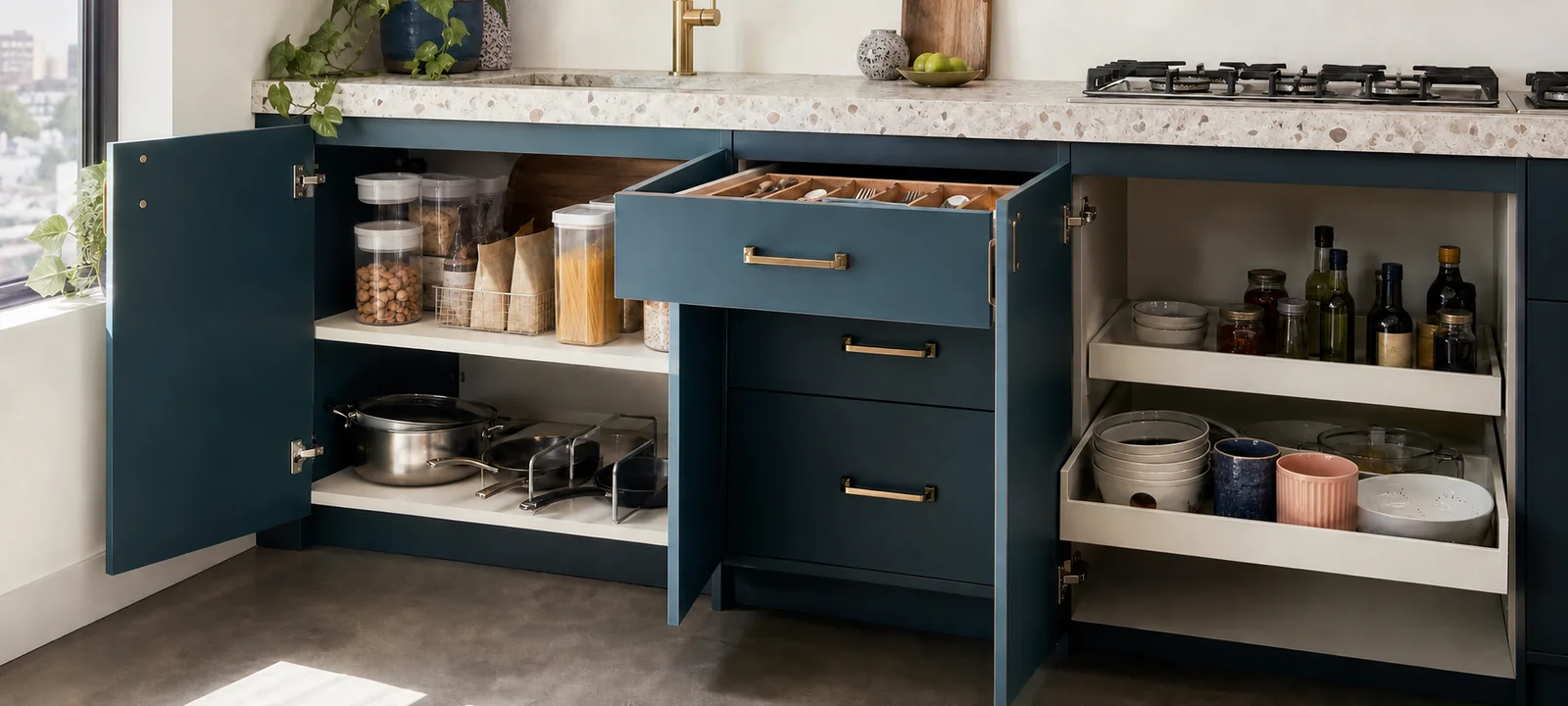
A cupboard can be full and still fail at breakfast. The lunchboxes are behind the baking gear, lids have separated from their containers and the appliance used every morning has nowhere to go except the bench.
Before buying organisers, identify the part of cooking, unpacking groceries or packing lunches that keeps breaking down. Remove what no longer belongs, measure the usable opening and choose one change that makes that routine easier.
Fix one recurring frustration
A divider may help when utensils tangle together. A shallow basket may bring lunchbox food to the front of a deep shelf. Neither will help if the drawer contains tools nobody uses or the pantry is holding expired food.
Watch what gets left on the bench, dropped into the wrong drawer or forgotten at the back. That behaviour reveals whether the assigned place is too far away, too crowded or difficult to use.
If bench space is limited
Decide which appliances and tools genuinely earn a permanent place. Move occasional items into cupboards before adding racks or shelves to the benchtop.
If the kitchen is a small rental
Work inside existing cupboards and drawers first. Check the lease and surface before using adhesive, over-door or tension-mounted products; removable items can still mark finishes or interfere with doors.
If containers are the problem
Match every lid, remove damaged pieces and group the sizes the household uses. Only then decide whether another set would fill a genuine gap.
If drawers are full of gadgets
Pull out duplicates and single-purpose tools that no longer earn their space. Divide what remains by use rather than trying to organise the full collection.
If pantry items are hard to find
Group food by routine—breakfast, baking or lunchboxes—then place frequently used groups at the easiest height. Containers are optional; visibility is the goal.
If cupboards are deep and awkward
Use shallow groups that can be pulled forward. A basket or turntable should expose the back of the cupboard, not create another layer in front of it.
Measure the usable opening, not the cabinet
Internal width and depth are only the beginning. Hinges, shelf lips, door frames, pipes, handles and curved drawer sides can make the opening narrower than the space behind it.
- Measure the internal width, depth and height.
- Measure the narrowest point of the cupboard opening.
- Note hinges, pipes, shelf supports and other obstructions.
- Check whether the shelf can be adjusted before buying a riser.
- Allow enough clearance to lift or slide the organiser out when full.
Use the intended plates, packets, jars or containers while measuring. An organiser that fits the shelf but not the items solves nothing.
Drawers must close when the organiser is full
Measure the internal width, depth and height, including any curved sides or raised screw heads. Check the longest utensils and the height of stacked items. Expandable organisers still need clearance to open without catching.
Appliances need lifting and operating room
- Measure handles, lids, cords and other projections.
- Check the manufacturer's clearance and ventilation instructions for use.
- Make sure the appliance can be lifted from the shelf comfortably.
- Keep weekly appliances where retrieving them does not require shifting other items.
A heavy appliance above shoulder height may be technically stored but rarely used safely or conveniently.
Doors and services keep their working space
A slim trolley beside the fridge must leave room for doors, handles, drawers and the walkway. Under the sink, allow for pipes, hoses, filters, bins and signs of leaks. Do not turn a narrow gap or service space into storage simply because a product can be squeezed into it.
The organiser must work when it is dirty and full
Kitchen storage encounters crumbs, oil, spills and dust. Look for surfaces and removable parts that suit the job. A fabric basket may be fine for clean tea towels and frustrating around pantry spills; timber may suit one dry cupboard and not a damp under-sink area.
Load a prospective system mentally as well as physically. Can the back jar still be reached? Can a full basket be lifted? Will everybody return an item without opening three lids? Storage that only works when styled for a photograph will not survive a busy week.
Choose the storage type from the problem
Drawer dividers
Useful for a drawer of regularly used cutlery or utensils. Edit duplicates first and check the longest item before choosing fixed compartments.
Pantry bins and baskets
Useful for pulling a whole group forward on a deep shelf. Keep the categories broad enough that the household can return things without constant relabelling.
Stackable containers
Useful when regularly purchased packets spill or collapse. Buy for the foods and quantities actually stored, not for the number of pieces in a matching set.
Tiered shelves and turntables
Useful for small jars, cans, oils and sauces when they improve visibility. Circular storage may waste space around square packets, and tiers do not fix a shelf that is too deep to reach.
Pull-out organisers
Useful in lower or deep cupboards when the mechanism fits around hinges and services. Check installation requirements, load rating and rental approval before committing.
Over-door and under-shelf racks
Useful for lightweight items only when the rack leaves hinges, doors and the space below working properly. Check thickness, clearance and load limits.
Slim trolleys
Useful when the trolley remains stable and can be pulled out without blocking a walkway. Avoid top-heavy loads, breakables and bottles that exceed the rated capacity.
Renters should assume removable can still leave a mark
Freestanding shelves, drawer organisers and pantry bins are usually easier to take to another home than fixed systems. Over-door racks, tension rods and adhesive products still need a suitable surface and may damage doors, paint or cabinet finishes.
Check the lease and obtain approval before drilling, modifying cabinetry or making a permanent change. Keep instructions and original parts so the storage can be removed without guesswork.
When the kitchen needs less, not more
Expired food, duplicate utensils, containers without lids, unused appliances and cookware that no longer suits the household are not storage problems. Remove or relocate them before buying something designed to hold them more neatly.
Then regroup by task. Keep lunchbox items together, place everyday cookware near the stove and move occasional serving pieces out of the easiest positions. A cupboard with fewer, better placed items may need no organiser at all.
Take this shortlist when you compare storage
- What exact problem am I solving?
- Have I measured the usable space?
- Will this fit around hinges, handles, doors, shelves and pipes?
- Will the intended items fit as well as the organiser?
- Is it easy to clean?
- Is it suitable for a rental if needed?
- Does it make daily use easier?
- Does it work with what I already own?
- Will it still work when full?
- Have duplicates and unused items already been removed?
Start with the drawer, shelf or routine that causes the most friction. Improve that one area, use it for a week and notice what changed. The next purchase should be based on that evidence, not on the temptation to make every cupboard match.
Common Questions
How can I maximise storage in a small kitchen?
Fix the most repeated frustration first instead of filling every gap. Keep frequently used items near their task, remove duplicates, make deep cupboards easier to see and protect useful bench space. Measure the real openings and moving parts before adding dividers, risers, baskets or pull-outs, then test one changed zone before repeating it.
What should I measure before buying kitchen organisers?
Record the usable internal width, depth and height plus the narrower door opening, hinges and shelf supports. For drawers, include curved sides, hardware and the clearance above tall utensils. Check appliance lids and doors in use, and confirm a loaded organiser can still slide out, lift up or allow the cabinet to close.
Do food containers always save pantry and cupboard space?
No. Containers help when they protect food or solve a clear stacking and visibility problem, but a poorly sized set can leave packet remainders and consume more shelf depth. Measure the food and shelf together, decant only what the household will maintain, and use baskets or risers where packets already work well.