
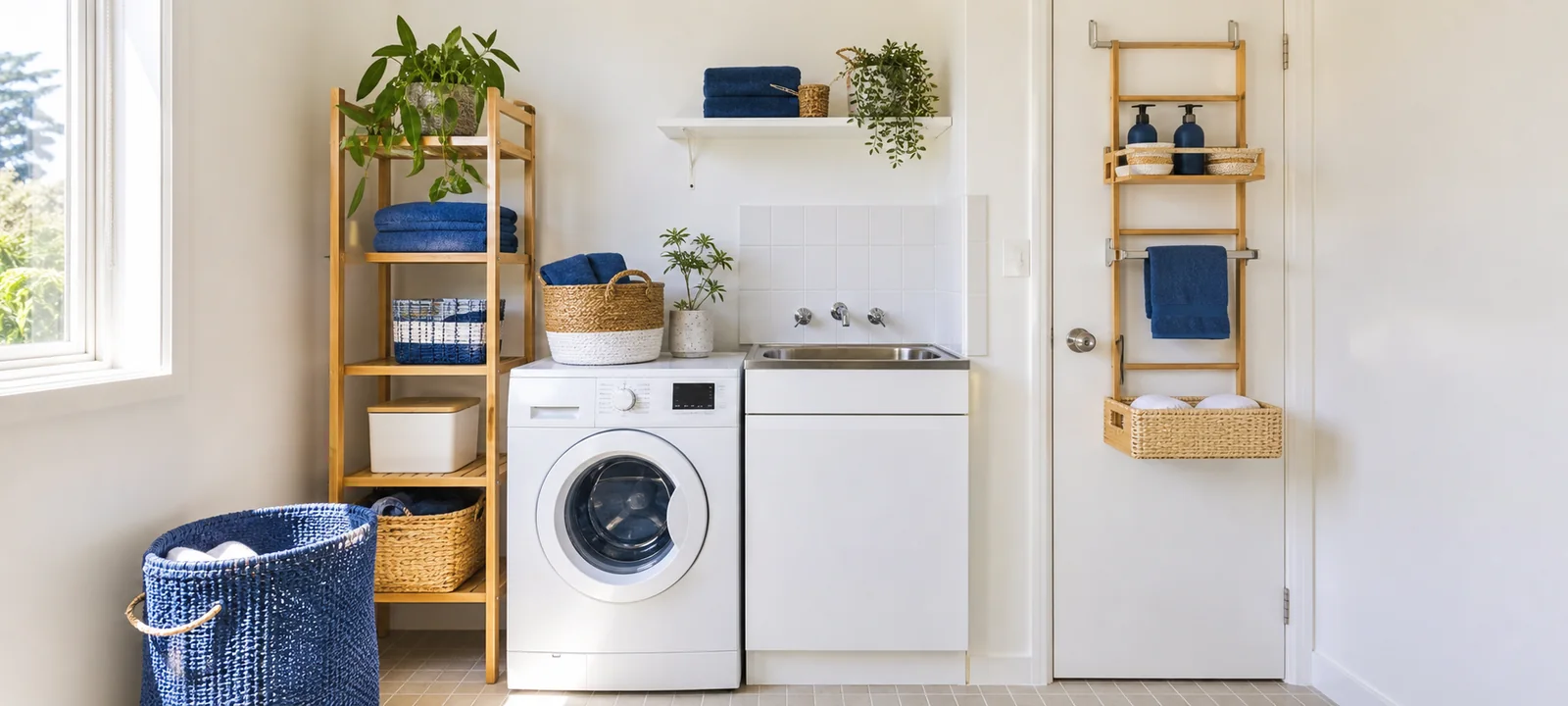
In a rental laundry, the cabinets, appliance connections and bare patch of wall are usually fixed. The task is to make washing day work around them without creating damage, blocking access or buying an organiser that suits only this one address.
Live with the room for a few loads before choosing anything. A cupboard laundry may need a folding basket more than shelves; a bathroom shared with the washing machine may need clear floor space more than a trolley. The problem becomes clearer once doors, lids and wet washing are all in motion.
Check the lease and seek permission where required. Freestanding and portable pieces are often easier to take to the next home, but they still need to be stable, moisture tolerant and measured for the actual room.
For broader laundry planning, see our main guide: Laundry Storage That Keeps Everyday Items Within Reach.
Separate fixed limits from movable problems
The tub, taps, connections, cupboards, doors and power points are generally fixed. Basket placement, drying equipment, product grouping and loose under-tub storage are easier to change. Focus first on the part of the routine the household controls.
A useful renter's diagnosis is specific: “the hamper blocks the front loader door” is easier to solve than “the laundry needs more storage”. If floor area is the constraint, another freestanding unit may deepen the problem. The guide to small laundry storage helps identify the working clearances worth protecting.
Check permission before choosing the product
Anything screwed, nailed, glued or otherwise attached to a wall, ceiling, tile, cabinet or door may need approval and may create repair obligations. Read the agreement and use the applicable property process before making a change. This guide is practical planning, not legal advice.
“Removable” is not the same as damage-free. Adhesive products can lift paint, leave residue or mark laminate and older finishes; over-door racks can rub a door or strain a hinge. Test suitability as the manufacturer directs and avoid using light-duty attachments for heavy, sharp, breakable or chemical items.
Measure the laundry while it is working
Open every room, cupboard and appliance door, put the usual basket in place and note where a drying rack stands. Measure:
- the clear floor area and narrowest walkway
- washing machine lid or door clearance
- dryer door, ventilation and maintenance access
- taps, hoses, filters, drains and power points
- the true under-tub opening around hinges and pipes
- the airer's full open size and folded storage size
A trolley may fit beside the machine yet catch on skirting or hoses. A hamper may occupy the only loading position. Portable storage still has to work with the room, not merely fit inside it.
Buy for the next address as well as this one
Adaptable pieces are easier to justify when they can change jobs later. A caddy can move to a bathroom, a trolley to a pantry and a folding airer to a balcony or spare room. Look for storage that is:
- freestanding or genuinely portable
- stable when loaded
- easy to wipe and dry
- simple to pack or collapse
- not cut to one unusual gap
- useful in more than one room
A custom fit can be appealing, but a product with only a few millimetres to spare may be useless after a move. Leave reasonable tolerance unless the product's function requires a precise fit.
Choose portable drying before fixed drying
Folding airers, peg hangers and compact racks avoid permanent changes and can follow better airflow between rooms. Measure the product open and folded, and make sure it can stay in place for a full drying cycle without blocking an exit, appliance or main walkway.
Balconies and shared areas may have property or body corporate rules, while indoor drying needs suitable airflow and attention to persistent moisture. The guide to laundry drying space covers wet-weather loads, drips and rack capacity.
Let baskets follow the household
A hamper does not need to live beside the machine if clothes are removed elsewhere. Bedroom or bathroom collection can reduce floor pressure in a cupboard laundry, provided damp items are handled appropriately and the baskets remain easy to carry.
Choose only as many sorting sections as people already use. A collapsible carry basket may suit a small flat; a divided sorter may earn its footprint in a family rental. Check the entire route and routine with the guide to laundry baskets and sorters.
Keep freestanding storage stable and clear
Freestanding shelves and slim trolleys avoid wall fixings, but they are not automatically low risk. Check floor level, the loaded centre of gravity and clearance from appliance movement. A narrow trolley full of heavy detergent can become awkward or unstable.
Do not block taps, hoses, filters, ventilation or power points. The appliance area may need the apparently empty gap for operation, cleaning or servicing. Use the detailed guide to Australian laundry dimensions before filling it.
Treat cleaning supplies as a safety decision
Remove empty and duplicate products before choosing a caddy or shelf. Keep chemicals in their original labelled containers, close them after use and follow their storage directions. Where children or pets may gain access, a low open basket is not secure storage.
Portable caddies and removable trays can work when they have a safe home and remain easy to inspect for leaks. The guide to cleaning product storage explains bottle measurement, access and spill containment.
Keep the tub cupboard easy to empty
Under-tub baskets, loose trays and small freestanding shelves can adapt around pipes without modifying the cabinet. Inspect for leaks or swelling before adding anything, keep plumbing visible and choose pieces that pass through the opening and lift out quickly.
Avoid screw-fixed runners or door-mounted organisers unless permission and fit are clear. The guide to laundry tub storage explains how to measure around each pipe.
Recognise when portable storage still backfires
- an adhesive rack is assumed to remove without damage
- a trolley fits the gap but blocks hoses or a machine door
- the airer has no open or folded home
- a sorter takes the only useful floor area
- heavy products sit high on unstable storage
- under-tub baskets conceal moisture or pipework
- the product only works in this exact laundry
Live with the room for another wash cycle if the obstacle is still unclear. Empty bottles, unused racks, broken baskets and household overflow can create an apparent storage shortage that disappears after a proper reset.
Run the renter's final check
- identify the precise wash-day problem being solved
- confirm permission before attaching or altering anything
- measure with doors, appliances and baskets in use
- keep plumbing, power, ventilation and service access clear
- check stability and cleaning access when the storage is full
- choose a product that can work in another room or home
- make chemical storage secure and label-led
- clear clutter before buying more capacity
Renter-friendly storage is not defined by a marketing label. It is measured, reversible and useful enough to improve the laundry without leaving damage or another bulky item to move.
Common Questions
How can renters add laundry storage without permanent changes?
Use portable drying racks, baskets that follow the washing route and stable freestanding storage that leaves machines and doors clear. Improve the existing tub cupboard with lift-out pieces that can empty quickly. Choose products likely to work at another address, and check the lease before fixing or attaching anything to the property.
What should I measure in a rental laundry?
Measure the room while a load is in progress: appliance doors or lids open, basket on the floor and drying equipment in position. Include hoses, taps, power access, cupboard doors and the route to the line. These working dimensions reveal whether a trolley or shelf will block the routine even if it fits the empty gap.
Can a renter install a wall-mounted clothes airer?
A fixed airer changes the property, so check the rental agreement and obtain any required permission before planning around one. A portable airer is the more reversible starting point, provided it has enough open room for a real load and a defined storage place when folded. Removable products still need suitable surfaces and careful use.