
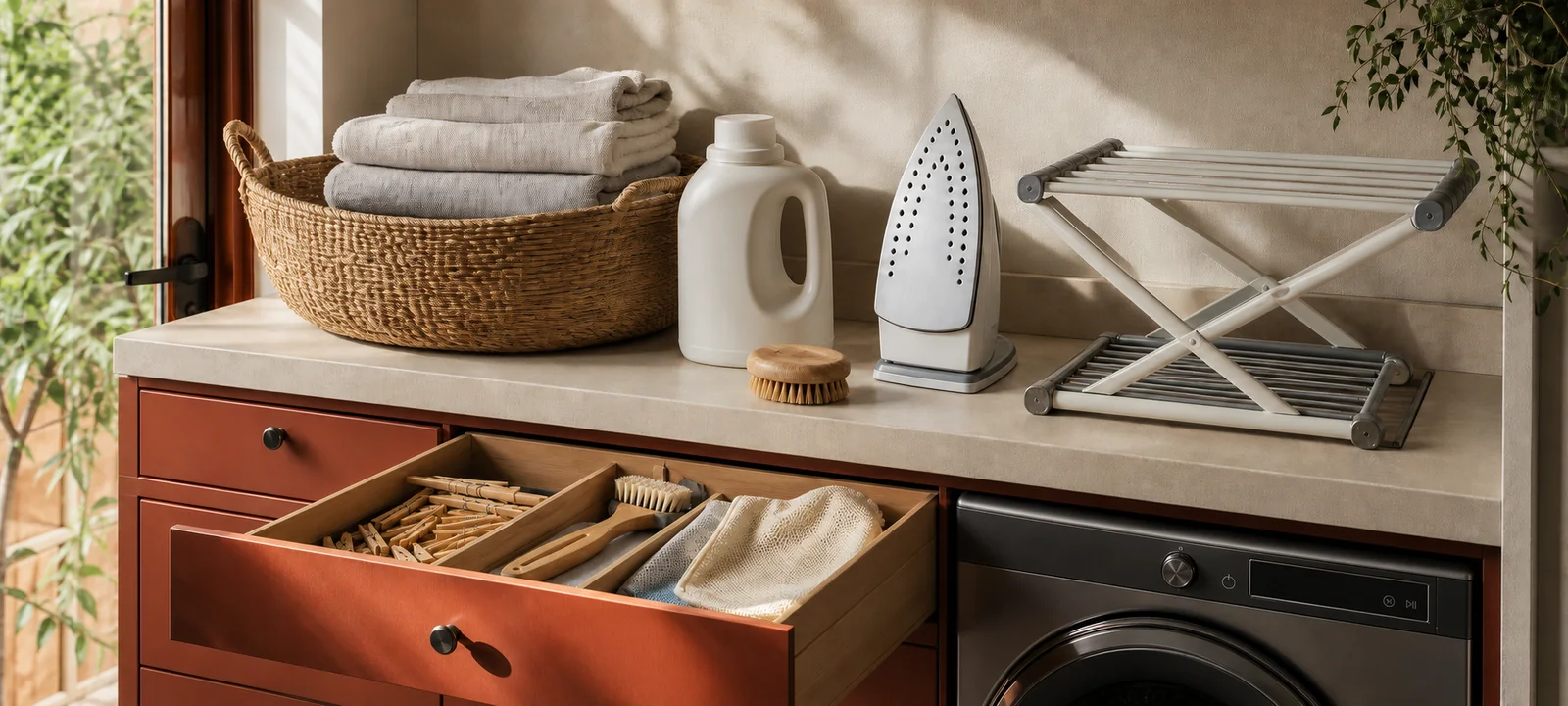
Laundry essentials reveal themselves during a difficult load: a basket handle digs into a hand, school clothes need drying before morning or there is nowhere clean to fold a towel. Those moments are more reliable than a long list of products sold as must-haves.
Follow one load from hamper to cupboard and notice where it stalls. Most homes need a way to collect clothes, carry them, wash them, dry them and treat the occasional stain. Ironing, steaming, elaborate sorting and specialist pet-washing gear depend on the household.
Follow the load, not the product list
Begin where dirty clothes are removed. Does one hamper work, or are loads already separated by person, colour or fabric? Then follow the basket to the machine, the wet load to its drying place and the clean washing to the room where it is folded or put away.
Write down only the repeated friction. It may be a missing place for delicates, an airer that blocks the hallway or a bench buried beneath bulk supplies. Fixing that hand-off usually adds more value than another organiser.
Choose a hamper for the way washing is sorted
A single washable hamper can suit a small household. Separate sections may help a family whose loads are genuinely sorted before wash day, but unused compartments simply consume floor space. Check the filled weight, handles, ventilation and the route to the machine.
Put the hamper where clothes are taken off, not automatically in the laundry. A bedroom or bathroom position may prevent piles on the floor, provided damp towels are not trapped with dry clothes for long periods.
Use a basket that survives the whole route
The laundry basket needs to clear doorways, turn through the hallway and sit in the place where clean clothes are folded. Measure those points and try the carrying grip. A large basket is not useful if a full load becomes too awkward to lift.
If the same basket carries dirty and clean washing, keep it easy to wipe. A second basket may help a busy household, but only when it has a defined place between loads.
Keep washing products controlled and readable
Store detergent, stain products and other laundry chemicals according to their labels, in their original containers and where children and pets cannot reach them. Keep incompatible products separated as directed and do not decant them into food or drink containers.
Daily products can sit near the machine if the position is dry and controlled. Bulk refills and occasional treatments may belong elsewhere. Leave labels visible and keep the measuring tool with the product so the routine does not rely on guesswork.
Give stain treatment a small, deliberate place
Stain care may need only a suitable product, a small brush or cloth and somewhere to set the garment briefly. Follow the garment and treatment instructions, test where directed and avoid leaving treated clothing where it can be forgotten or reached by children or pets.
A caddy can group the supplies without claiming the whole laundry tub. Move anything rarely used out of the prime washing zone.
Make the drying plan work in bad weather
Outdoor lines may handle most loads until rain, humidity or smoke changes the day. Decide where urgent school clothes, towels and delicates can dry when the usual method is unavailable. An indoor airer needs enough open space and ventilation without blocking a bedroom, hallway or exit.
Before adding shelves around appliances, measure the machine, hoses, doors and working clearance with the Australian laundry dimensions guide. Do not obstruct ventilation, services or access required by the appliance instructions.
Keep pegs where the line routine starts
A peg basket, bag or apron is useful when it travels easily to the line and has somewhere dry to return. Replace brittle or damaged pegs rather than keeping an overflowing mix. If the container lives outside, check whether sun and rain are shortening the life of both the pegs and their holder.
Use mesh bags for a real category
Mesh wash bags can contain small socks, bra hooks or items whose care instructions permit machine washing. Keep only the sizes the household uses and store them empty and dry near the hamper or machine. They are a sorting tool, not a substitute for reading garment labels.
Protect one clear folding surface
Folding is easier on a clean bench, table or bed than on top of detergent bottles. Choose where the task will happen and keep that surface available. In a compact laundry, the folding place may be outside the room; forcing in a permanent bench can make access worse.
Return folded clothes promptly. If clean loads repeatedly remain in the basket, the problem may sit at the bedroom or wardrobe end of the route rather than in the laundry.
Store ironing and steaming equipment only if it is used
An iron or steamer needs a stable working position, access to power as intended, cooling time and a safe storage place. An ironing board also needs enough room to open without blocking the main path. Follow the appliance instructions and keep hot equipment and cords controlled.
If ironing happens rarely, avoid giving the board the most accessible wall or cupboard. A compact option may suit occasional use, provided it remains stable and practical.
Keep cleaning tools from taking over the tub
The laundry often becomes the home for brooms, mops, buckets and household cleaners. Store them so they can dry, cannot fall into the walkway and remain appropriately restricted. The tub should still be usable without moving a collection of bottles and brushes.
Hooks or wall rails can help only when the wall, fixings, rated load and rental conditions suit them. A freestanding caddy or cupboard may be the more flexible answer.
Give pet washing a separate reset
Pet towels, bedding and cleaning cloths can share the laundry without merging into household supplies. One washable basket or labelled shelf is often enough. Shake out hair and debris, follow item and machine-care instructions, and let everything dry before storage.
Move bulk supplies out of the working zone
Toilet paper, paper towels and large refill packs can fill the laundry before the next load arrives. Keep a practical amount close and move overflow to a dry storage area if possible. Buying in bulk only helps when the products can be stored without blocking appliances, taps, switches or the folding surface.
Before adding another laundry item
- Name the point in the laundry route it will improve.
- Measure it with appliance doors, cupboards and walkways in use.
- Decide where it will dry or wait between loads.
- Keep chemicals controlled and instructions readable.
- Protect access to services, ventilation and the laundry tub.
A well-equipped laundry is not the room with the most accessories. It is the one where a load can move from hamper to cupboard without stopping in a doorway, losing its pegs or surrendering the only clear bench to spare supplies.
Common Questions
What are the basic essentials for a home laundry?
Most routines need a collection point, a basket that manages the full route, suitable washing products, a stain-treatment spot and a workable drying plan. Pegs, mesh bags, ironing equipment and special tools are useful only when the household actually uses them. Start by following one load rather than copying a long product checklist.
How do you organise laundry essentials in a small space?
Keep the everyday washing products controlled and readable near the task, move bulk refills out of the active zone and protect one surface for folding or sorting. Give baskets, pegs and the folded airer specific parking places. Vertical storage helps only when items remain easy to lift and appliance access stays clear.
Are mesh laundry bags necessary?
They are useful when they support a real category, such as keeping small items together or separating pieces that the care instructions allow to be washed that way. They are not an essential purchase for every household. Keep only the sizes that enter the routine and give empty bags one visible return point.