
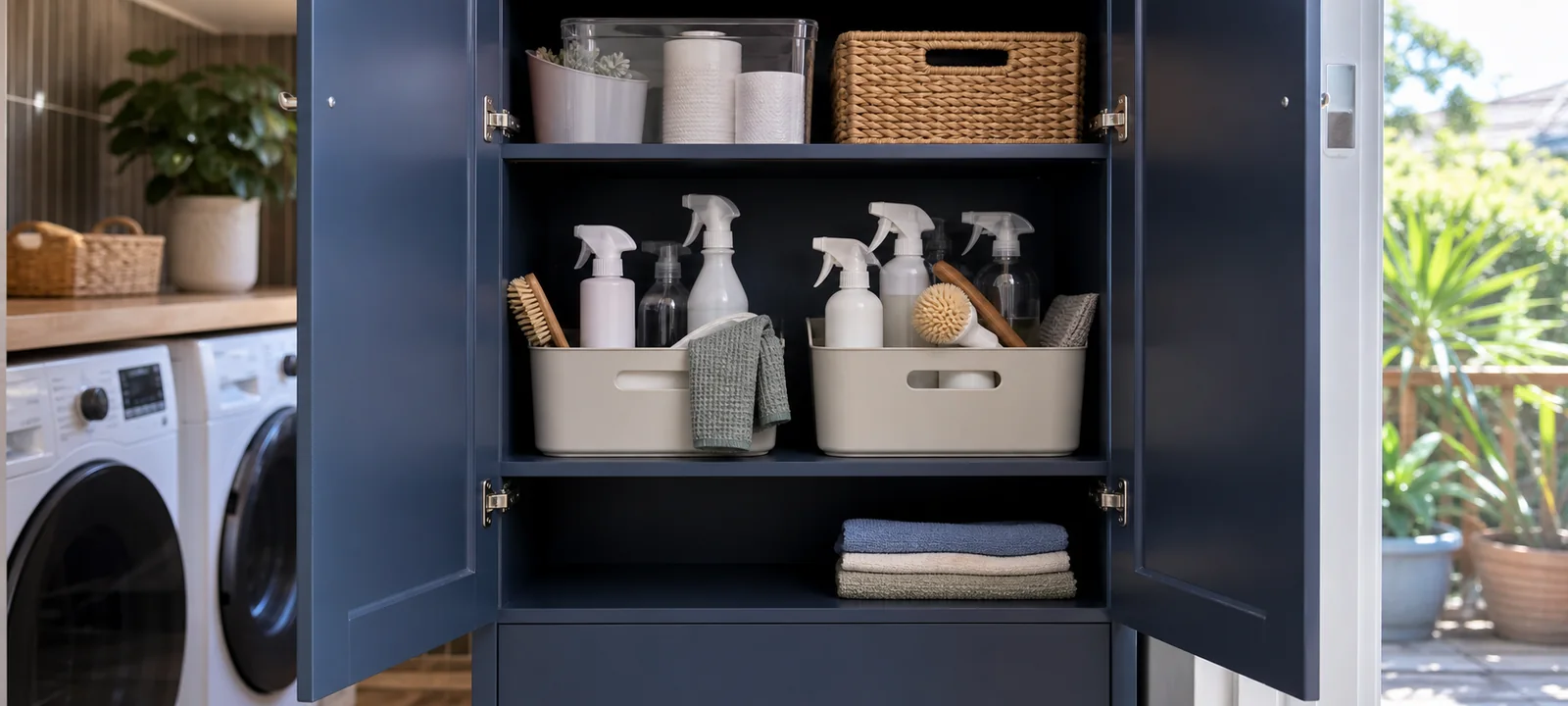
The laundry cupboard often becomes the place where every spray, refill and half-used bottle goes to disappear. By the time detergent, stain remover, mop heads and bathroom cleaners are sharing a shelf, it can be hard to see a leak or remember what the household already owns.
Take the collection out before measuring for cabinets or caddies. Keep products in their labelled original containers, set aside empties and duplicates, and move room-specific supplies closer to where they are used when that can be done safely.
Storage comes after that edit. It should contain small spills, keep instructions readable and stop children or pets reaching hazardous products. A neat row on an open shelf is not a good result if access has become less safe.
For broader laundry planning, see our main guide: Laundry Storage That Keeps Everyday Items Within Reach.
Edit the collection before the cupboard
Put similar products together on a wipeable surface. This quickly exposes three common causes of crowding: duplicates, refills for products no longer used and several specialist cleaners doing much the same job.
Review each item for:
- a clear, current use in the household
- an intact, readable label and secure closure
- leaks, damage or residue around the cap
- a matching product for any refill
- specific storage or disposal directions
- whether it belongs in the laundry at all
Do not combine leftover products or decant chemicals into drink bottles or unlabelled containers. If a product is no longer wanted, follow its label and local disposal guidance rather than pouring or mixing it by guesswork.
Let the label set the storage rules
Check every product for directions about heat, sunlight, ventilation, upright storage, incompatible products and access by children. The organiser cannot make an unsuitable position safe.
Product Safety Australia advises keeping household chemicals in their original containers, closing them after use and storing them securely out of children's reach and sight. A child-resistant closure is useful, but it does not replace secure storage.
Pets can also knock over or chew accessible containers. Where children or animals share the home, a low open basket is a grouping tool, not a safety barrier. Choose a secure location that also complies with the individual product labels.
Measure the bottles, the opening and the lift-out space
Start with the tallest detergent bottle or spray trigger. Measure its full height and width, then allow room to grasp and lift it out without tilting. For the proposed cabinet, shelf or caddy, record:
- clear internal width, depth and height
- the opening left by doors, hinges and frames
- the tallest bottle and widest refill pack
- handle height and loaded weight for a portable caddy
- comfortable reach height for regular products
- clearance from machines, tubs, walkways and door swings
Deep shelves create capacity but can hide products and leaks at the back. A removable basket can make the rear easier to inspect, provided every bottle remains upright and the basket can be lifted through the opening. In a compact room, use the guide to small laundry storage to check competing clearances.
Choose a container for the way supplies move
Portable caddy
Useful for a small group of sprays, cloths and gloves carried between rooms. Check the handle with a realistic load and give the caddy a secure home when it is not in use.
Open basket or tray
Groups products inside an existing cupboard and lifts out for cleaning. Choose a smooth, wipeable base that does not conceal residue or force bottles to lie down.
Closed cabinet
Keeps products out of sight and may support secure access, but it still needs internal clearance, regular inspection and any ventilation required by the product labels.
Wall shelf
Can free a small floor, although wall type, fixing requirements, rated load and tenancy approval all need checking. Avoid storing heavy bottles where they are awkward to lift.
Make leaks easy to find
Store liquids upright on a surface that can be seen and wiped. A shallow removable tray can contain minor residue and speed up cleaning, but it is not a reason to keep a damaged or leaking container.
Avoid absorbent fabric baskets for liquids. Leave enough light and access to inspect the back of the shelf, and do not pack products so tightly that a slow leak remains hidden. A damp under-tub cabinet or swollen shelf needs attention before another organiser is added.
Separate tools by whether they are clean, wet or chemical
Clean cloths can share a dry basket. Used cloths, sponges, gloves, brushes and mop heads may need to dry before being enclosed. Burying damp tools among bottles makes both the tools and any leaks harder to inspect.
Keep tools used with a particular product clearly associated with that job, and wash or dispose of them as directed. The purpose is a simple hand-off: clean and dry items go back; used or wet items have somewhere else to wait.
Keep everyday access simple
Store frequently used laundry products where an adult can reach them without moving several containers, while still meeting the safety requirements of the home. Less-used refills and specialist products can sit in a separate secure zone if their labels allow it.
Avoid a system that requires constant decanting or rearranging. Labels should face outward, the oldest matching product should be easy to finish first, and each container should return to its place in one movement.
Watch for storage that only hides the problem
- a larger caddy bought before duplicates are removed
- shelves too short for bottles to stand upright
- deep containers that hide leaks and unread labels
- chemicals left accessible to children or pets
- damp cloths enclosed with bottles
- heavy products stored above a comfortable reach
- a cabinet that blocks an appliance, door or walkway
- an organiser chosen without reading product directions
The useful collection is the one the household can identify, inspect and use safely. More capacity is not an improvement when it simply gives forgotten products somewhere deeper to disappear.
Run the safety and fit check
- remove empty, damaged, duplicate and unneeded products
- keep each chemical in its labelled original container
- follow the label's storage and disposal directions
- use secure storage where children or pets may gain access
- measure bottle height and the space needed to lift it out
- keep liquids upright and leaks easy to see
- separate damp tools from clean cloths and product containers
- check the storage remains easy to clean and does not block the room
Sort first, let the labels guide the safety decisions, then choose the smallest storage setup that keeps the useful products visible and under control.
Common Questions
Where should cleaning products be stored at home?
Follow each product's label and keep hazardous products secured out of children's reach and sight, while also accounting for pets. Bottles should remain upright, readable and easy to inspect for leaks. Separate chemicals from clean cloths and unrelated supplies, and avoid packing the cupboard so tightly that damaged packaging disappears behind refills.
Is a cleaning caddy better than a cupboard?
A caddy suits a small group that genuinely moves from room to room, while a cupboard suits stationary supplies and reserves. Choose from the routine rather than appearance. A portable caddy should remain comfortable to carry when loaded, and a cabinet still needs visibility, spill control and enough room to remove bottles without tipping them.
How can cleaning product leaks be contained without hiding them?
Stand bottles in a shallow washable tray or open basket that makes drips visible and can be removed for cleaning. Keep labels facing out and inspect the base regularly. Deep opaque tubs may contain a spill, but they can also conceal damp packaging and duplicate bottles if the contents are packed beyond easy view.