
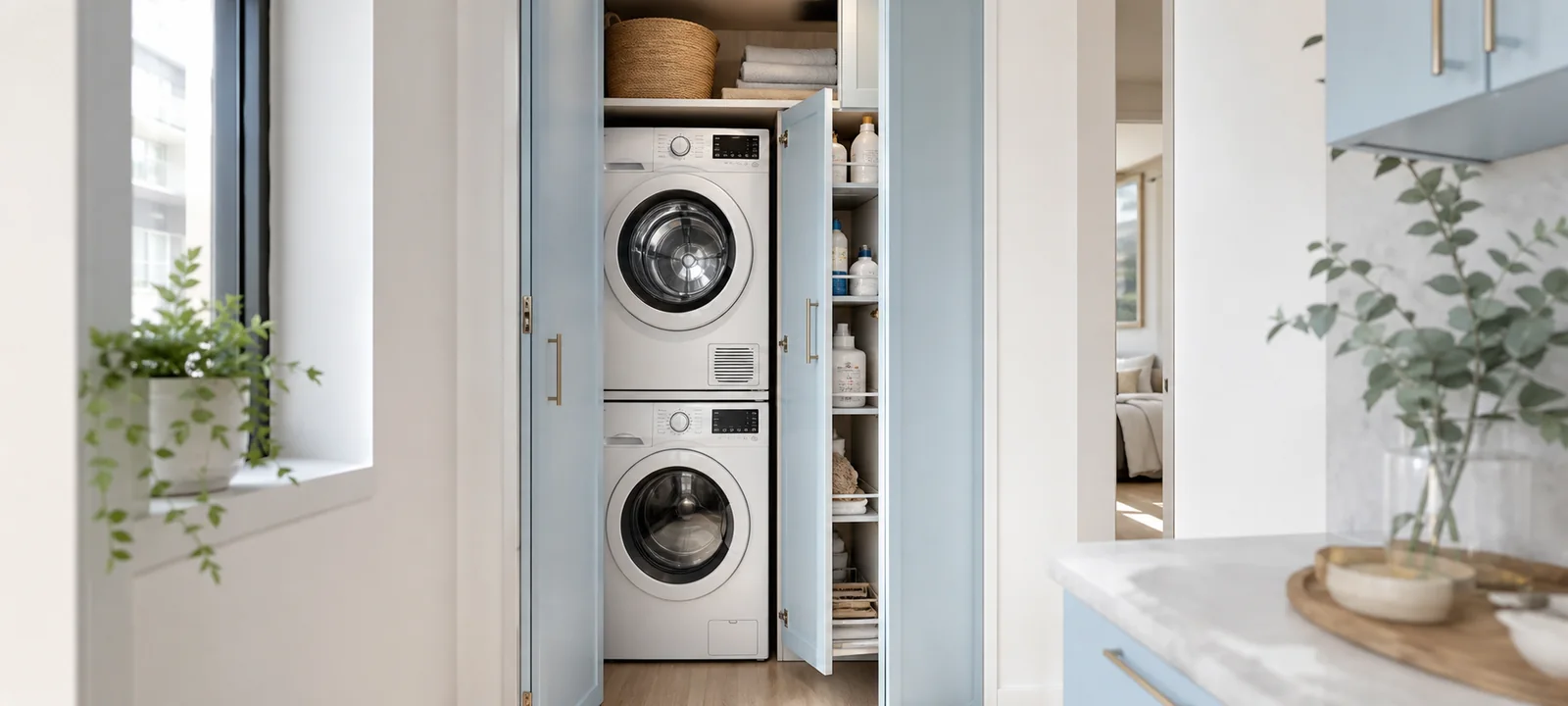
A small laundry can look perfectly orderly until the machine door opens and a basket lands on the floor. Then the trolley blocks the cupboard, the drying rack has nowhere to stand and every clever organiser begins competing for the same patch of room.
Laundry cupboards, apartment laundries and rooms shared with a bathroom need space to change throughout the day. Doors must open, wet clothes need somewhere to wait and people still need to move through the room. Treat that working space as part of the layout, not as an empty gap waiting to be filled.
Keep only the items that solve a repeated problem. A narrow trolley can earn its place beside a machine; three extra baskets stacked in front of the tub probably cannot.
For broader laundry planning, see our main guide: Laundry Storage That Keeps Everyday Items Within Reach.
Protect the room's working space
Start by naming the recurring obstruction. It may be a basket in the doorway, no place to open the airer, cleaning products across the tub or a machine door that collides with a cupboard. Each problem needs a different response.
Floor space is working space in a compact laundry. Before adding anything that stands on it, make sure there is still room to:
- open the room, cupboard and appliance doors fully
- stand in front of the machine and unload it
- carry a full basket through the normal route
- reach the tub, taps, hoses and power points
- set up the drying rack when the weather turns
- clean around and, when needed, service the appliances
A product can fit the dimensions and still fail this test. Measure with the laundry in use, not after every movable item has been cleared away for the tape measure.
Let the appliances set the boundaries
The washing machine and dryer control most of the layout. Record:
- each appliance's width, depth and height
- the usable gaps beside and behind it
- the position of taps, hoses, vents, filters and power points
- the full door swing or top loader lid height
- any movement during the spin cycle
- the clearance needed for cleaning and maintenance
A top loader needs clear height above it; a front loader needs clear floor area in front. Follow the manufacturer's placement, ventilation and stacking instructions for the dryer. Do not turn an apparent side gap into storage if hoses, skirting or appliance movement make it unusable.
Before choosing storage around either machine, use the washing machine dimensions guide to check the exact width, height, installed depth, services and full opening space.
Use height without creating a lifting problem
Shelves above a machine can free the floor, but only when the contents are safe and comfortable to reach. Check wall material, services, fixing requirements, rated loads and whether drilling is allowed before choosing fixed storage.
Keep vertical storage practical:
- keep daily products between comfortable reaching heights
- reserve high shelves for lighter, less frequently used items
- leave the machine lid, doors and controls unobstructed
- allow enough room to lift a basket or bottle off the shelf
- choose materials suited to the room's moisture and cleaning needs
- keep heavy bottles away from high or unstable positions
Over-door storage also uses height, but measure the door thickness and hinge clearance and make sure the door still closes without marking the surface.
Test narrow-gap storage properly
Slim trolleys are appealing because the gap already exists. The useful measurement, however, is not just the width between machine and wall. Check:
- the narrowest width from floor to handle height
- skirting, taps, hoses and protruding connections
- whether the trolley can roll fully out without turning
- clearance from appliance, room and cupboard doors
- stability with the intended bottles loaded
- access to anything behind it that may need attention
If it has to be unloaded before it can move, the gap is not doing useful storage work.
Give baskets and airers somewhere to go
A divided hamper may suit a family that already separates loads. It can be needless bulk for a household that sorts at the machine. Measure the basket's permanent footprint, lid clearance and the route used to carry it when full.
A basket system should account for:
- dirty clothes where they are actually removed
- damp towels or activewear that need to air
- clean washing waiting to be folded or put away
- a carry basket that can pass through doors and hallways
An airer needs two homes: one while open and one while folded. Test both. A compact rack used in a better-ventilated room may be more practical than a larger one wedged into the laundry. Do not sacrifice the only workable drying area for cupboard or trolley space.
Make cleaning product storage safe before making it neat
Remove empty bottles and review duplicates before measuring for a caddy or shelf. Keep chemicals in their original containers, close them after use and follow the label. Where children may have access, use secure storage that keeps the products out of reach and out of sight; a low open trolley is not an appropriate shortcut.
Measure the tallest bottle and the space needed to lift it out. Group products by use, but do not decant them merely to make a shelf look uniform.
Keep rental solutions genuinely portable
A product described as removable can still mark paint, laminate, tiles or doors. Check the lease and the surface before drilling or using adhesive fixings. Portable options are easier to reassess and take to the next home:
- freestanding shelves
- portable drying racks
- slim trolleys
- compact baskets and hampers
- caddies that sit inside existing cupboards
- over-door storage that clears hinges and protects the surface
Avoid fixed or built-in systems that only work with one unusual layout unless the owner has approved them and they solve a genuine long-term problem.
Notice the fixes that backfire
- buying shelves before measuring machine clearance
- a hamper that fits the corner but blocks the machine door
- a trolley stopped by hoses or skirting
- high storage for heavy detergent bottles
- a drying rack with nowhere to open or be stored
- shelves that restrict dryer ventilation or servicing
- adhesive storage chosen without checking the surface
- organisers added before old products and misplaced items are removed
When a small room contains too many solutions, cleaning becomes harder and the original obstruction often remains. Keep the pieces that solve a weekly problem and remove the ones that merely hold overflow.
Run the fit check with everything open
- name the exact wash-day obstacle being solved
- measure usable floor space, not the empty room
- open every relevant door, lid and drawer
- check airflow, plumbing, controls and maintenance access
- walk the full-basket route
- find both an open and folded position for the airer
- load the proposed storage on paper, including bottle heights and weights
- confirm fixing and tenancy requirements
- remove clutter before deciding more capacity is necessary
A good small laundry is not the one that uses every centimetre. It is the one where doors open, baskets pass and the few organisers in the room make wash day noticeably easier.
Common Questions
How do you maximise storage in a small laundry?
Protect the space needed for appliance doors, baskets and movement first, then use existing cupboards and reachable wall height for defined groups. Keep daily supplies close and move bulk items elsewhere. A narrow trolley or shelf helps only when it can be loaded, cleaned around and removed without blocking the room's working mode.
Will a slim trolley fit beside a washing machine?
Measure the gap from floor to handle height because skirting, hoses, taps or an uneven wall may narrow it. Include the trolley wheels, handles and loaded width, then test the path needed to pull it out fully. Do not fill space required for appliance connections, ventilation, movement or maintenance access.
Where can baskets and airers go in a tiny laundry?
Give each item a deliberate parked position before buying it. A basket may nest, hang or sit outside the room if it blocks the machine, while a folded airer needs a reachable gap that does not obstruct a door. Mark both the stored and in-use footprints so the two items do not compete for one space.