
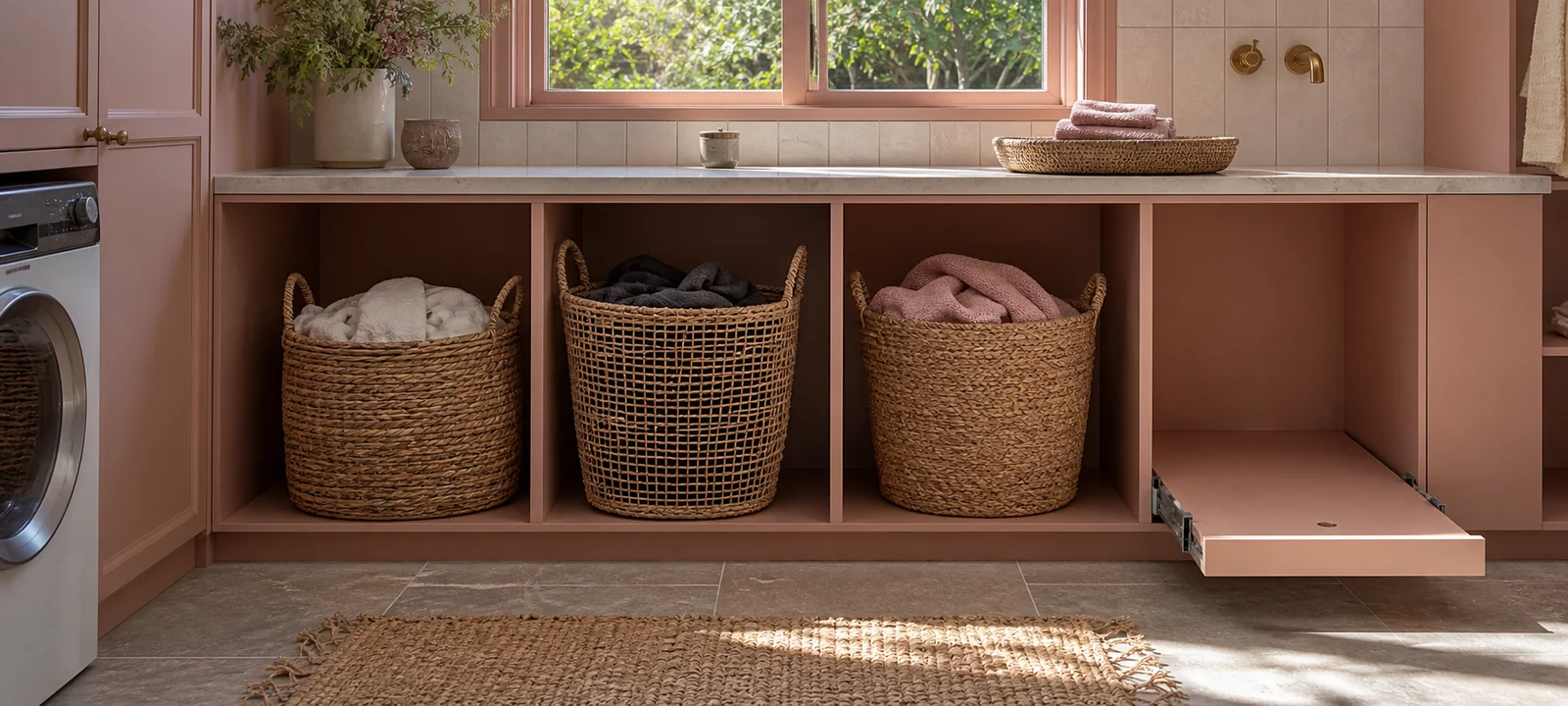
A divided hamper is only a sorting system if everyone uses the divisions. Otherwise it is a large piece of furniture full of mixed washing. The same is true of baskets left in bedrooms, bathrooms and hallways: their location matters as much as their capacity.
Follow the washing through the home. Notice where clothes are dropped, whether towels are damp, when loads are separated and who carries them to the machine or line. A household that sorts at the machine needs a different setup from one that washes each bedroom separately.
Choose the fewest baskets that support that routine. They should be comfortable to lift when full, allow damp items some airflow and have a place to sit without narrowing a walkway.
For broader laundry planning, see our main guide: Laundry Storage That Keeps Everyday Items Within Reach.
Trace the trip from bedroom to line
Start where clothes come off, not where baskets are sold. If dirty clothes remain in bedrooms, a single hamper beside the machine may be too far from the habit. If damp towels collect in the bathroom, they may need somewhere to air before joining the wash.
Follow one complete load and note each hand-off: collection, sorting, carrying, washing, drying, folding and putting away. A basket can support several of those steps, but it should not become long-term storage for clean clothes.
Use as few categories as the household will follow
A single hamper often suits one person, a couple with a simple routine or a household that sorts beside the machine. Several baskets or a divided sorter can earn their footprint when loads are already separated by colour, fabric or purpose.
Common recurring groups include:
- everyday clothing
- towels and linen
- uniforms or workwear
- activewear and swimwear
- baby clothes
- pet towels or washable bedding
Do not build a category for every possible load. If one section constantly overflows while two remain empty, the sorter reflects an imagined routine rather than the real one.
Measure the parked basket and the route
The basket needs a permanent position when empty, filling and full. Measure its footprint with the machine, dryer, tub, cupboard and room doors open. Leave the walkway and the loading position in front of the appliance clear.
Then rehearse the journey. Check:
- the narrowest doorway and hallway turn
- stairs, thresholds, rugs and uneven floor transitions
- handle width and grip position
- the basket's empty weight and likely full weight
- whether it can be carried without blocking the view of the floor
- where it waits near the clothesline or drying rack
A larger basket may reduce trips but become unpleasant to carry. Wheels help only on a clear, mainly level route. Where space is tight, the guide to small laundry storage covers the competing clearances in more detail.
Balance footprint, height and access
Tall hampers use less floor area, but clothes at the bottom can be awkward to reach. A low basket is easy to unload but occupies more room. If the hamper has a lid, include its full opening height and make sure it does not strike a shelf, wall or door.
Slim hampers need a second check for stability. They should lift out of the gap when full without catching on skirting, hoses or door hardware. Collapsible baskets save space only if the household actually empties and folds them.
Do not seal damp washing away
Towels, activewear, swimwear and cleaning cloths may enter the system damp. An open or ventilated basket can allow more air movement than a closed decorative hamper, but the better answer may be to air wet items before adding them to the wash pile.
Notice how long washing typically sits. A lidded hamper may be perfectly reasonable for dry clothes collected daily and less suitable for damp towels left through the week. For the wider wet-weather routine, see the guide to laundry drying space.
Choose the type by what it must do
Open carry basket
Useful for moving one load and easy to wipe clean. Check the handles with weight inside and decide where the basket will live between trips.
Lidded hamper
Hides dry washing in a visible bedroom or bathroom. Check ventilation, lid clearance and whether the contents are likely to be forgotten.
Divided sorter
Supports repeat wash groups that already exist. Compare individual compartment capacity, frame stability and whether each bag can be removed independently.
Rolling or collapsible basket
Wheels suit a clear level route; a collapsible frame suits a basket that is often empty. Neither feature adds value when the basket remains full and stationary all week.
Separate the clean-laundry problem
A home can have enough capacity for dirty clothes and still be crowded with clean washing. Decide where clothes wait to be folded and how they return to bedrooms. Using the same basket for both stages can work when it moves promptly; it becomes confusing when clean and dirty loads wait side by side.
Before buying another hamper, empty the existing baskets and check what they contain. If clean clothes have become permanent residents, the useful change may be a simpler folding routine rather than more collection capacity.
Keep shared systems obvious
Families and shared homes benefit from categories that can be understood at a glance. Two or three clearly named sections usually ask less of the household than a detailed set of rules. Place children's baskets where they can be used without climbing, lifting a heavy container or narrowing a route.
Renters and small-space households can favour lightweight, freestanding options that move between rooms and future homes. A highly specific built-in sorter is difficult to justify if a portable basket already follows the routine.
Spot a basket system that is doing too much
- compartments do not match the loads people actually wash
- the full basket is too heavy or wide to carry comfortably
- a hamper blocks an appliance, doorway or main walkway
- damp items disappear into a closed container
- clean and dirty washing have no clear hand-off
- slim or tall baskets become unstable when loaded
- extra baskets are holding clothes that need to be put away
Moving a basket to the room where clothes are dropped can achieve more than adding another one. The system is successful when washing keeps moving, not when every category owns a bin.
Laundry basket and sorter types to compare
Compare the basket against the whole trip from collection to washing, drying and putting away. Capacity matters, but so do carrying, parking the basket and whether the household will use the sorting system.
Open carry baskets
- May help with
- Moving one load between bedrooms, the washing machine and the drying area.
- Measure first
- The basket footprint, handle width and the route through doors, hallways and around appliances.
- Check before buying
- Grip comfort, basket weight when full and whether the shape can be cleaned and stored easily.
- Avoid if
- The basket will become permanent floor storage or is too wide to carry through the normal route.
Collapsible baskets
- May help with
- Homes that need a carry basket but have very little space to store it empty.
- Measure first
- Open capacity and dimensions, plus the folded thickness and intended storage gap.
- Check before buying
- How the sides lock open, whether folding areas trap lint and how the handles feel when loaded.
- Avoid if
- The basket will stay full most of the week or repeated folding adds effort without saving usable space.
Divided laundry sorters
- May help with
- Households that already separate repeat wash groups before laundry day.
- Measure first
- The complete footprint and height, compartment capacity and clearance for lifting bags or opening lids.
- Check before buying
- Whether labels match the real routine and whether each section can be emptied without moving the whole unit.
- Avoid if
- The household does not sort in advance or one compartment will overflow while the others remain empty.
Rolling baskets or sorters
- May help with
- Moving heavier loads across one level where a clear, hard-floor route already exists.
- Measure first
- Total width, wheel clearance and the route past thresholds, rugs, doors and appliance corners.
- Check before buying
- Whether wheels remain controlled when loading and whether the basket has a parking place outside the walkway.
- Avoid if
- The route includes stairs, uneven thresholds or soft flooring that makes carrying simpler than rolling.
Basket options for the routine that remains
First remove unused sorting categories and walk one real load from collection to washing, drying and putting away. If carrying, parking or separation is still the problem, compare these divided, collapsible and stackable options against the route, loaded weight and damp-airflow needs.
Some links below are affiliate links. If you buy through one, we may earn a commission at no extra cost to you. Learn more.
Two-compartment laundry separation basket
Joseph Joseph Tota 90L Laundry Separation Basket
A lidded, two-compartment 90 L hamper with removable carry bags for households that already separate regular wash groups and have room for its full footprint.
Research-supported option
View at Amazon AustraliaMay suit: households that consistently separate two repeat wash groups before laundry day; bedrooms, bathrooms or laundries with room for a 71 x 56 x 39.5 cm footprint.
May not suit: small routes where a large lidded basket would obstruct a door or appliance; households that do not sort washing before it reaches the machine.
Drawbacks to consider:
- At 90 L it needs a deliberate, clear place rather than a narrow walkway or appliance gap.
- It is assembled from a flat pack and the fabric exterior needs wipe-clean care.
- The lid is better for dry washing; damp clothes should be aired rather than sealed away.
Evidence confidence: moderate. Last reviewed 4 August 2026. Research-based assessment; we have not tested this product firsthand.
Collapsible 55 L carry basket
Joseph Joseph Hold-All Max 55L Collapsible Laundry Basket
A collapsible fabric carry basket for a household that needs to move a single load but can store the basket flat between uses.
Research-supported option
View at Amazon AustraliaMay suit: homes that carry one load between rooms and need the basket to store flat when empty; households with a dry, accessible gap for folded storage.
May not suit: households needing pre-sort compartments before laundry day; a basket that is normally kept full or used for damp clothes.
Drawbacks to consider:
- Its collapsible benefit disappears when it remains full and parked in one place.
- A fabric basket needs to be dried and cleaned appropriately after damp or dirty loads.
- It does not pre-sort washing into separate compartments.
Evidence confidence: moderate. Last reviewed 4 August 2026. Research-based assessment; we have not tested this product firsthand.
Stackable 35 L laundry sorter
Brabantia Stackable Laundry Box 35L
A stackable, front-loading 35 L sorter for homes that separate smaller loads and have vertical clearance for the boxes to be safely stacked.
Research-supported option
View at Amazon AustraliaMay suit: households separating compact repeat loads in a laundry with usable vertical space; a system that benefits from front loading and flat storage when a box is empty.
May not suit: large mixed loads or households that do not sort before washing; spaces where stacked boxes would obstruct a bench, appliance or walkway.
Drawbacks to consider:
- One 35 L box may be too small for a large household's usual wash load.
- Stacking adds vertical clearance and can make the upper opening less convenient.
- It helps only when the household actually uses the separate loads rather than letting them accumulate.
Evidence confidence: moderate. Last reviewed 4 August 2026. Research-based assessment; we have not tested this product firsthand.
Test the trip before choosing
- follow one load from collection to putting away
- use only the sorting categories the household already follows
- measure the basket's permanent position and every tight point on the route
- judge carrying comfort at a realistic full weight
- allow damp items to air rather than disappear into a closed hamper
- keep appliance doors, the tub and walkways clear
- give clean washing a separate, temporary hand-off
- check whether moving or removing a basket solves the problem first
The best basket system is rarely the largest. It is the smallest one that makes clothes easier to collect, carry, sort and return to the wardrobe.
Common Questions
What is the difference between a laundry basket and a hamper?
A hamper usually collects worn clothing in one place, while a basket carries a load between the bedroom, machine, line and folding area. One product can perform both jobs if its size, handles and location suit the whole route. Check it full, because a convenient bedroom hamper may be awkward to carry through doors.
Is a divided laundry sorter worth buying?
A divided sorter helps only when its categories match how the household actually washes and everyone follows them. Each section should hold a useful load without becoming permanent floor storage. If clothing still needs to be re-sorted at the machine, fewer clearly labelled categories or separate carry baskets may create a simpler routine.
Can damp clothes be left in a closed laundry hamper?
No. Give wet towels, sports clothes and other damp items a ventilated place until they can be washed instead of burying them beneath dry clothes in a closed hamper. Position the collection point around the household's real routine so separating damp washing is an easy step rather than an extra chore.