
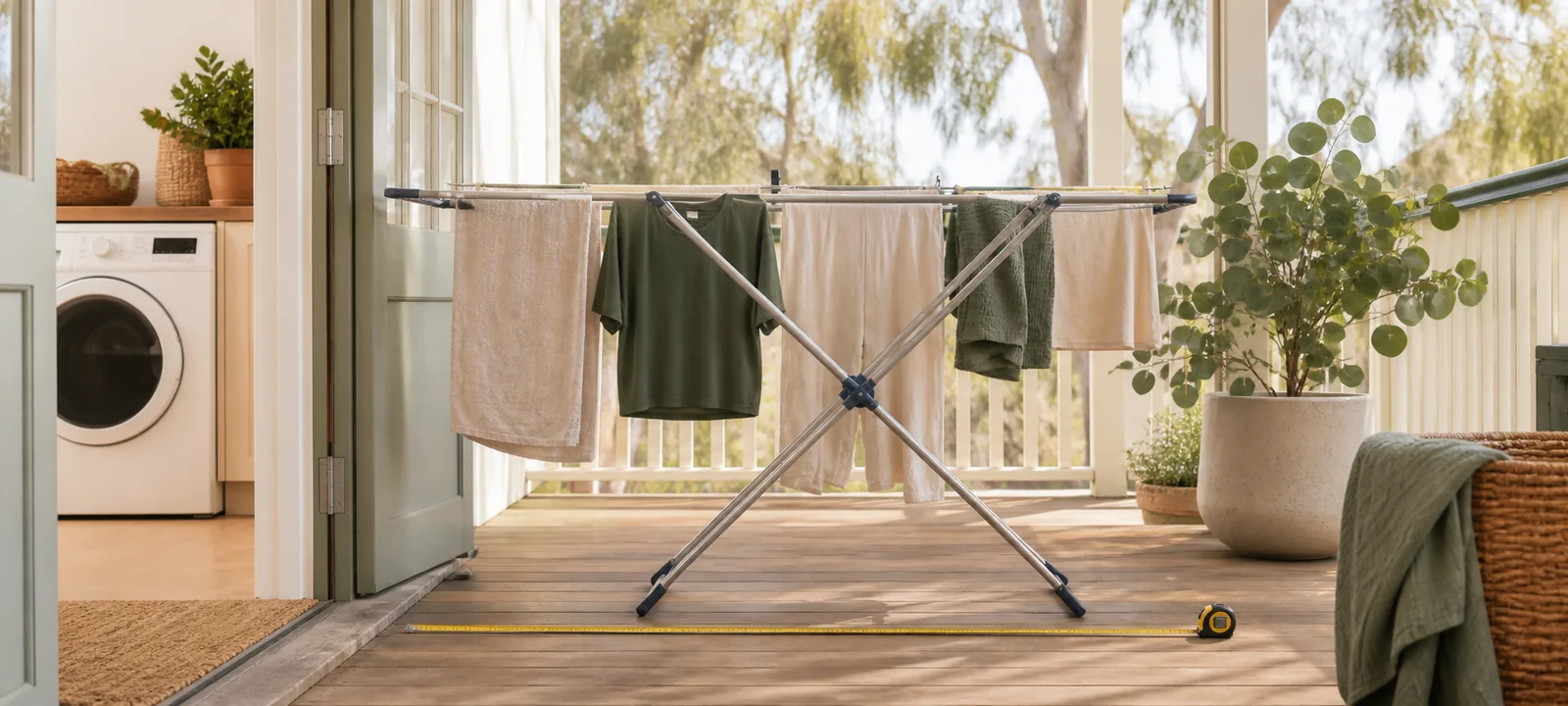
Drying space tends to disappear on the day it is needed most: rain has settled in, towels are piling up and the rack still holds yesterday's load. A product photo taken in an empty room does not show that pressure.
Picture a full wet-weather load. The airer needs enough rail length for those clothes, open space around it and airflow through the room. It also needs a home once folded. Without all four, it is likely to block a door, collect clean clothes or live permanently in the hallway.
Outdoor lines, covered patios, balconies and indoor racks each suit different homes. The best arrangement is the one the household can set up quickly without ignoring rental rules, body corporate requirements or signs of trapped moisture.
For broader laundry planning, see our main guide: Laundry Storage That Keeps Everyday Items Within Reach.
If a tumble dryer is part of the wet-weather plan, compare heat pump, condenser and vented dryers before setting aside space for ventilation, drainage, door clearance and routine maintenance.
Start with the loads that miss out
A household that needs five school shirts dry overnight has a different problem from one trying to handle sheets during a wet week. List the items that regularly wait for space: towels, uniforms, workwear, activewear, baby clothes, delicates or bedding.
Then look at why they are waiting. There may be too little outdoor line, no covered area, poor indoor airflow, an undersized rack or simply nowhere to leave an airer open. Buying the largest rack does not solve all of those problems.
Measure the rack in both states
Open dimensions determine whether the rack can be used; folded dimensions determine whether the household will put it away. Record the full width, depth and height with wings raised or shelves extended, then find a realistic folded position.
In the proposed drying spot, check:
- room, cupboard and appliance door clearance
- the main walkway and the route used by a full basket
- access to the tub, controls, taps and power points
- the space needed to hang garments without touching the floor
- whether the rack can remain there for an entire drying cycle
- the floor surface and where any drips will land
A rack that has to be folded every time someone enters the bathroom is too large for that position. In a very small laundry, a portable airer used in another suitable room may be more workable. The guide to small laundry storage explains how to protect those shared clearances.
Allow space for air, not just rails
More rails do not guarantee useful capacity. Garments packed tightly together dry slowly, particularly in a closed room with little air movement. Consider the room as part of the drying setup: available ventilation, open space around the rack and enough separation between wet items all matter.
Pay attention to a room that already smells musty, shows persistent condensation or has damp surfaces. Adding another full load indoors can compound the moisture problem. Use available ventilation in line with the room and appliance instructions, and address an ongoing damp problem rather than treating a larger rack as the answer.
Drips need planning too. Tiles or another water-tolerant surface are usually easier to manage than carpet or timber. Keep wet washing away from electrical equipment, power points, cabinetry and stored items that can be damaged by moisture.
Compare capacity with an actual load
Count garments rather than relying only on a broad capacity claim. Lay out the contents of a typical load and note long pieces, small items and heavier wet towels. Rail length, spacing and frame stability can matter more than the rack's overall footprint.
Folding and winged airers
These suit mixed loads and are easy to move, but raised wings add width. Check the frame on the intended floor and picture it carrying towels, not sitting empty in a showroom.
Tower airers
A tower uses less floor width, although long garments can overlap several levels and restrict airflow. Check total height, reach, shelf spacing and stability.
Over-door racks
These can hold lighter items where floor area is scarce. Measure the door thickness and hinge clearance, confirm the door can still close and protect the door and wall finishes.
Wall and ceiling systems
Fixed racks require checks for wall or ceiling construction, load, services, clearances and installation requirements. Renters should obtain approval before drilling or making permanent changes.
Treat heated airers as electrical equipment
A heated airer is not simply a warmer version of a folding rack. Check the manufacturer's instructions, intended use, ventilation, cord route and power point position. Keep the unit away from water and do not use it if the casing, plug or lead is damaged.
Do not run a cord through a wet area or across a walkway. If the proposed position cannot keep water, electricity and household traffic safely separated, choose a non-powered option or a different location.
Keep rental choices reversible
Folding airers, peg hangers and portable racks can move between rooms and homes without altering the property. Over-door products can also be useful, provided they clear the hinges and do not mark the surface.
Wall-mounted racks, ceiling airers and screw-in rails need more scrutiny. Check the lease or body corporate requirements and obtain any necessary approval. Adhesive fixings are not automatically damage-free, particularly on older paint, laminate or tiles.
Recognise when the current rack is not the problem
Before replacing it, check whether the airer is overloaded, badly positioned or being used in a room with poor airflow. Towels may need their own approach, small items may be consuming long rails, or clutter may be occupying the best drying spot.
Better spacing, a second spin where suitable for the garments and machine, or using outdoor drying when conditions allow may improve the routine without a larger product. A new rack is justified when it solves a measured capacity or access problem, not simply because the old one looks crowded.
Portable drying products to compare
Use a real wet-weather load and the fully open dimensions when comparing portable drying products. Heated products and fixed wall systems need separate electrical, installation and manufacturer checks and are not covered by this comparison.
Folding winged airers
- May help with
- Mixed everyday loads that need a combination of long rails and smaller hanging spaces.
- Measure first
- The full open width and depth, the height of raised wings and the storage size when folded.
- Check before buying
- Whether doors and machines remain accessible and whether the loaded frame stays stable on the intended floor.
- Avoid if
- The open airer would consume the only walkway or the folded frame has no realistic storage position.
Vertical or tower airers
- May help with
- Using height where floor width is limited and the household dries many smaller items.
- Measure first
- The full footprint, total height, shelf spacing and clearance from cupboards or door swings.
- Check before buying
- Whether garments can hang without crowding and whether every level can be loaded without awkward reaching.
- Avoid if
- Long items will overlap several levels, airflow is restricted or the tall frame would be unstable in the chosen spot.
Flat drying racks
- May help with
- A small number of items that are intended to dry flat rather than hang from rails.
- Measure first
- The rack surface, supporting footprint and the thickness of the folded rack.
- Check before buying
- Where drips will go, how air can move around the item and whether the rack can be cleaned and stored.
- Avoid if
- The household rarely dries items flat or the rack would occupy a bench, bath or floor needed for another routine.
Peg hangers for small items
- May help with
- Keeping socks and other small pieces together while freeing longer rails for larger garments.
- Measure first
- The hanger width and hanging height, including the longest item clipped underneath.
- Check before buying
- Clip spacing, total loaded weight and whether the hanger can sit where air circulates without dripping onto unsuitable surfaces.
- Avoid if
- The hanger will crowd a doorway, overload one rail or create more handling than placing small items directly on the airer.
Airer options for the loads that still miss out
First adjust wash timing, use the existing line fully and mark clear floor, wall and door space during a wet-weather load. If drying capacity is still short, compare these freestanding and foldable racks by open footprint, rail spacing, loaded stability and where the empty frame will be stored.
Some links below are affiliate links. If you buy through one, we may earn a commission at no extra cost to you. Learn more.
Freestanding clothes airer
L.T. Williams Large Aluminium Collapsible Clothes Airer, Black
A large fold-flat aluminium airer measuring about 178 x 81.5 cm when open and 108 cm high, so the full floor footprint and storage path need checking.
Research-supported option
View at Amazon AustraliaMay suit: households with room for a wide winged airer and a flat storage position.
May not suit: narrow laundries, shared walkways or homes needing a compact tower footprint.
Drawbacks to consider:
- Its 178 cm open width needs substantially more floor space than a compact tower or concertina airer.
- The light aluminium frame still needs stable, level placement and should be folded away before it obstructs a laundry route.
Evidence confidence: moderate. Last reviewed 22 August 2026. Research-based assessment; we have not tested this product firsthand.
Foldable drying rack
Brabantia HangOn Drying Rack 20m, Matt Black
A broad foldable rack with hanging bars and accessory space for households comparing usable line length rather than rail count alone.
Research-supported option
View at Amazon AustraliaMay suit: larger mixed loads and homes with a dedicated drying zone.
May not suit: narrow passages or homes without folded storage space.
Drawbacks to consider:
- The open footprint is substantial and needs a stable, ventilated position.
- Current dimensions, variant, price, stock and seller details should be rechecked before ordering.
Evidence confidence: moderate. Last reviewed 22 August 2026. Research-based assessment; we have not tested this product firsthand.
Rehearse a wet-weather day
- identify the garments and loads that regularly need indoor space
- measure the rack fully open, loaded and folded
- keep doors, appliances, walkways and exits clear
- allow useful airflow around and between garments
- choose a surface that can cope with drips
- check stability with the heaviest normal items
- find a folded storage position before buying
- confirm rental, fixing and electrical requirements where relevant
The useful drying setup is not the one with the most rails. It is the one that can stay in place long enough to dry a real load, then disappear without becoming the next household obstacle.
Common Questions
What size clothes airer do I need?
Use a real wet-weather load as the capacity test, including long garments and items that need to lie flat. Measure the airer fully open, not just folded, and include room to walk around it and space between hanging items. Also confirm the folded unit fits its intended storage position and can reach it easily.
Is a tower airer better than a winged clothes airer?
A tower uses a smaller floor footprint and can suit many shorter items, while a winged airer offers long rails and mixed hanging heights. The better shape depends on the usual loads, available floor area and where the rack parks when folded. Compare capacity with actual washing rather than the rail count alone.
Where should an indoor clothes airer be placed?
Choose a position with useful airflow that does not block a doorway, appliance, heater or the household's main path. Leave space around the washing instead of pressing the rack against furniture. The best wet-weather position also has a practical route from the machine and somewhere nearby for the empty airer to be stored.