
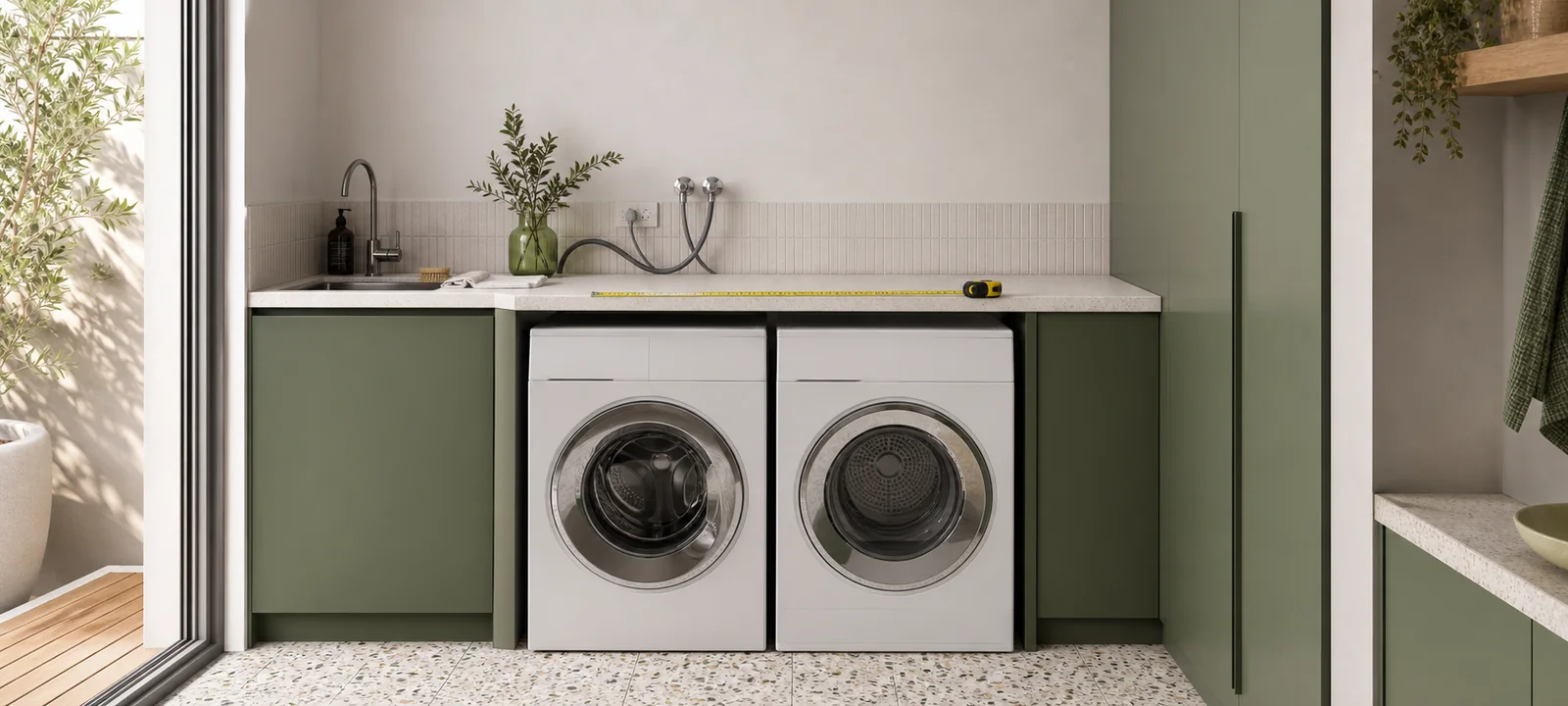
Australian laundries come in many shapes and sizes. A cupboard laundry has different space needs from a room with a top loader or a washer and dryer placed next to each other. Start with the appliances, then allow for doors, hoses and enough room to use them comfortably.
For a quick planning answer, many front-loading washing machines sold in Australia are about 600 mm wide and 850 mm high. Depth varies much more between makes and models, and the installed depth can increase once the door, hoses, taps and other connections are included.
Treat those figures as a common front-loader pattern, not a standard opening size. An individual machine can be slightly narrower than 600 mm, exactly 600 mm or a little wider. Record the exact width, height and depth of the model, then follow its installation instructions for hoses, taps, door opening, ventilation, required clearances and service access.
Washing machine dimensions in Australia at a glance
Swipe sideways to compare the full table.
| Measurement | Common planning pattern | How to use it |
|---|---|---|
| Width | About 600 mm is common, but the exact body width can sit slightly below, at or above that nominal figure. | Use 600 mm as a common nominal width, then confirm the selected model before building the opening. |
| Height | About 850 mm is a common height for a front loader. | Use 850 mm as the common nominal height, then check levelling adjustment and any required space above. |
| Depth | Depth varies substantially and the published figure may not include every projecting part or connection. | Check how the maker measures depth and allow for hoses, taps, plugs and anything projecting at the front. |
| Door open | The open door can take the total working depth well beyond one metre. | Keep enough clear floor area for the door, a laundry basket and the person loading the machine. |
| Installation space | Clearance and service requirements depend on the model and the way it is installed. | Use the selected machine's installation instructions rather than adding one generic allowance to every opening. |
Treat these as planning patterns only. The exact product sheet and installation instructions for the machine being considered remain the source for its dimensions and clearances.
Is there a standard laundry size in Australia?
There is no single useful room width or length for every Australian laundry. A cupboard laundry, apartment laundry and separate utility room all need to be planned around the appliances, tub, services, doors and the way the household uses the space.
For a new installation or a change to services, check the selected appliances' instructions and confirm the installation, ventilation, drainage and electrical requirements with the relevant qualified installer or tradesperson. Renters should also check proposed changes with their property manager before buying or altering fittings.
Compare water and energy use after checking fit
Once a washing machine fits the available space and suits the household's load size, use the Australian Government's Water Rating Label guide to compare litres per wash, capacity and the cycle used for testing. A higher WELS star rating is useful only when the machine's capacity and program also suit the way you wash.
The Energy Rating Label guide explains the annual kilowatt-hour figure and its usage assumptions. Compare machines of a similar capacity, then consider features, purchase cost, installation and likely use rather than treating the star count as the whole decision.
Observe a full cycle before measuring
Include every action, not only the appliance footprint. A person needs to approach with a basket, open the door or lid, load the machine, reach the controls and remove washing. The dryer may need its filter cleaned and both appliances need reasonable access for inspection and servicing.
If baskets are the obstruction, start with the basket routine. If wet clothes are waiting for space, address drying capacity. Storage built around the appliances will not solve a problem at a different stage of the wash.
Record the installed dimensions
Measure the machine itself and the opening around it. Handles, doors, hoses and connections can make an appliance effectively deeper than the cabinet or body suggests. Record:
- appliance width, depth and height
- the narrowest gaps at the front, middle and back
- space behind for hoses, vents and connections
- tap, drain, power point and filter positions
- the full swing of the loading door or the open lid height
- controls, service panels and cleaning access
- any movement or vibration observed during use
Compare these measurements with the manufacturer's installation and operating instructions. The visible gap is not storage capacity if the appliance requires it for connection, movement, ventilation or maintenance.
Treat the common 600 mm by 850 mm figure as the appliance footprint, not a universal installation rule. An opening that is exactly the same size as the machine leaves no room for differences between models or for any clearance the manufacturer requires. Depth is the measurement most likely to change, especially once the door, hoses and connections are included.
Front-loader vs top-loader dimensions and opening space
Top loader
Cabinet width, depth and closed height vary with the model and capacity, so the common 600 mm by 850 mm front-loader pattern should not be applied to a top loader. Open the lid fully and measure its highest and furthest points, then keep shelves and storage out of that loading space.
Front loader
About 600 mm wide and 850 mm high is a useful starting pattern, but depth and exact body dimensions still need model-specific checks. Mark the door swing on the floor, include the person unloading it and keep any lower filter or access panel reachable.
Dryer
Check door swing, controls, filters, vents and the manufacturer's clearance and ventilation requirements. Storage should not restrict airflow or routine cleaning. If the dryer type is still undecided, compare the installation, energy and maintenance differences between heat pump, condenser and vented dryers.
For a particularly tight cupboard or a laundry within a bathroom, use the guide to small laundry storage to protect the shared walkway and door clearances.
Treat stacking as an appliance installation decision
Do not assume any dryer can sit on any washing machine. Check both manufacturers' instructions, model compatibility, the need for a specified stacking kit and the completed height. Controls and filters must remain reachable without unsafe stretching.
Storage around a stacked pair should come later. It must not compromise ventilation, stability, connections or service access. If installation requirements are unclear, seek appropriate advice rather than using shelves or cabinetry to improvise support.
Test a trolley in the side gap from floor to handle
Measure the narrowest point of the gap at several heights. Skirting, taps and bowed walls can reduce a space that looks generous near the front. Then check whether the trolley can roll straight out past the room door, machine handle and basket position.
Load the proposed trolley on paper. Tall detergent bottles increase the centre of gravity, and a very narrow unit can become unstable or difficult to steer. Leave hoses and fittings uncompressed and accessible; a trolley that must be emptied to reach a tap is not a good use of the gap.
Use the space above conservatively
Storage above the machine can suit light cloths, pegs or modest supplies where the lid, ventilation and controls remain clear. Check comfortable reach height, wall construction, rated loads, fixing instructions and the consequences of anything falling.
Keep heavy liquid bottles below shoulder height where practical. Renters should confirm permission before drilling or installing fixed racks; the guide to rental laundry storage offers portable alternatives.
Keep water, power and maintenance access visible
Do not conceal taps, hoses, drains, plugs or power points behind fixed storage. Appliances and leads showing damage, overheating or water exposure should not be used. The Queensland Electrical Safety Office advises following manufacturer instructions and checking electrical equipment for damage before use.
Storage is not a workaround for a damaged connection, leaking hose or inadequate power point position. Electrical and plumbing work should be handled by appropriately qualified people where required.
Give detergent a safe home away from the machine top
Bottles left on an appliance can vibrate, leak or obstruct controls. Measure the tallest products and store them upright in a stable position that follows their labels and accounts for children or pets. Avoid placing heavy liquids high above a person loading the machine.
A removable caddy or nearby cupboard may be more useful than forcing another shelf into the appliance zone. See the guides to cleaning product storage and storage under the laundry tub before filling the side or overhead gaps.
Know which clearances should remain empty
- a top loader lid or front loader door cannot open fully
- dryer vents, filters or manufacturer clearances would be restricted
- taps, hoses, drains or power points would be hidden
- the appliance moves into the proposed storage zone
- a trolley cannot roll out without disturbing connections
- cleaning or service access would require dismantling the setup
- the real problem is basket placement, drying or excess products
Clear the appliance area before buying. Empty containers, unused cloths and misplaced baskets can make it seem as though another organiser is needed when the better result is an unobstructed machine.
Check access before filling a gap
- watch one complete wash and dry cycle
- measure the installed appliance, connections and full opening zones
- follow manufacturer placement, stacking and ventilation instructions
- keep taps, hoses, filters, drains and power accessible
- test any trolley at its realistic loaded weight
- keep heavy products at a comfortable height
- preserve cleaning, inspection and service access
- leave functional clearance empty when the machine needs it
Storage around the appliances succeeds when it quietly supports the next load. If it competes with a door, connection, vent or person using the machine, the gap was never spare capacity.
Common Questions
Are there standard laundry dimensions in Australia?
There is no single useful standard room width or length for every Australian laundry. Plan from the selected washer, dryer or tub, their installed dimensions and service needs, then add the door, lid, loading and movement space your layout requires. Check installation requirements with the manufacturer and an appropriately qualified installer or tradesperson.
What washing machine dimensions should I measure?
Record the installed width, height and depth, including hoses, taps, plugs and anything that projects at the back, rather than using the cabinet body alone. Allow for the front door or top lid to open fully, along with the controls, loading position and service access. Use the exact manufacturer's specifications because machines with a similar stated capacity can have different depths.
Can any dryer be stacked on a front loader?
Do not treat stacking as a general storage shortcut. Confirm that the specific washer, dryer and stacking kit are compatible in the manufacturers' instructions, and account for services, controls, ventilation and installation access. The combined arrangement also needs a stable, suitable position and a practical way to load and maintain both appliances.