
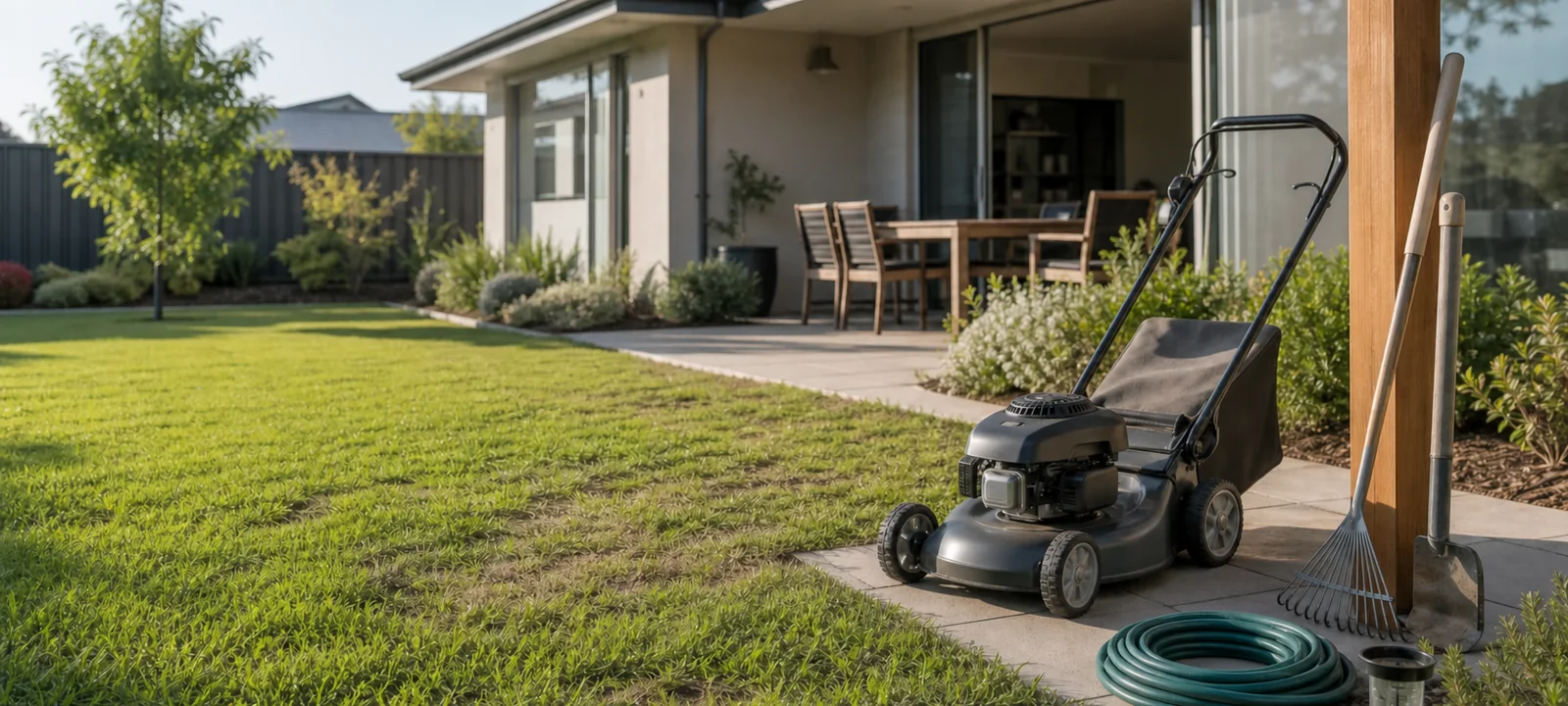
A struggling lawn can quickly produce a shed full of attempted solutions.
Fertiliser is added because the grass looks pale. A wetting agent follows when water pools on the surface. Weed treatment is applied to plants that have not been identified, and another sprinkler is bought because one area remains dry.
Sometimes one of those products is appropriate. Sometimes the real problem is shade, compacted soil, poor drainage, the wrong grass for the climate or a mowing routine that repeatedly stresses the lawn.
Lawn care begins with understanding the site.
Before buying another treatment or piece of equipment, check what type of grass is growing, how much sun it receives, what the soil does with water and whether the area genuinely needs to remain lawn.
Our Take
A lawn should serve the household, not become a permanent repair project.
Keep lawn where it provides a useful surface for play, access, pets, entertaining or visual openness. Where grass repeatedly fails because of deep shade, heavy traffic, poor drainage or limited water, another ground treatment may not be the answer.
Identify the cause before treating the symptom.
Healthy lawn care is usually a combination of suitable grass, appropriate mowing, water used only when needed and restrained feeding during active growth. It is rarely achieved by applying every product marketed for spring.
Start with how the lawn is used
The expected use changes what “healthy” needs to mean.
A lawn may provide:
- a play surface
- an area for pets
- access between the home and garden
- a visual break around garden beds
- space for outdoor seating
- erosion control
- a cooler permeable surface
- a verge or nature strip
- an area used only occasionally
A heavily used family lawn may never look like decorative turf that is rarely walked on.
Before planning improvements, ask:
- How much of the lawn is actually used?
- Where does foot traffic concentrate?
- Do pets repeatedly use one area?
- Does furniture sit on the grass?
- Is the lawn expected to remain green year-round?
- Is that expectation realistic for the climate and grass type?
- Are narrow or shaded sections serving any useful purpose?
- Would another permeable surface work better in a problem area?
The answer may be to improve the lawn, reduce it or accept seasonal changes rather than forcing constant growth.
Lawn problems at a glance
Swipe sideways to compare the full table.
| What you notice | Possible causes to investigate | Do not assume |
|---|---|---|
| Pale or yellow grass | Seasonal dormancy, low nutrients, excess water, poor drainage, disease, shade or unsuitable soil conditions | It automatically needs fertiliser |
| Dry-looking patches | Uneven irrigation, compacted soil, water-repellent soil, shallow roots, pet activity or local heat exposure | The whole lawn needs more water |
| Weeds increasing | Bare soil, mowing too short, disturbed ground, compaction or unsuitable grass | One weed product will prevent recurrence |
| Grass thinning in shade | Insufficient light, tree-root competition, dampness or unsuitable turf type | Extra fertiliser will replace missing sunlight |
| Water pooling | Compaction, clay soil, low points, blocked drainage or excessive irrigation | A wetting agent solves drainage |
| Water running off | Dry or compacted surface, slope, excessive sprinkler rate or water-repellent soil | Longer watering is always better |
| Brown lawn in cool weather | Dormancy, frost, low growth or genuine damage | Brown grass is necessarily dead |
| Ragged leaf tips | Dull or damaged mower blades | The lawn needs chemical treatment |
| Soft, very green growth | Excess water or fertiliser | Darker green always means healthier |
| Mushrooms or moss | Persistent moisture, shade or organic material | The lawn needs more watering |
These signs are starting points, not remote diagnoses.
Several problems can occur together, and the same symptom can have different causes.
Know what grass you have
Different turf types vary in:
- climate suitability
- shade tolerance
- drought response
- mowing height
- growth rate
- repair ability
- winter dormancy
- traffic tolerance
- salt tolerance
- water demand
Broadly, many warm-season grasses grow strongly during warmer conditions and slow down or become dormant during cool weather. Cool-season grasses may remain active in cooler regions but can struggle during hot Australian summers without suitable care and water.
Do not identify grass solely from a colour or an online photograph.
Useful clues include:
- leaf width
- growth habit
- runners above or below the soil
- seed-head shape
- response to winter
- where the turf was originally sourced
- old landscaping invoices
- neighbouring lawns established at the same time
A local turf specialist, nursery, horticultural adviser or council resource may help with identification, but avoid buying a treatment until the grass and problem are reasonably clear.
A mowing height that suits one turf type may damage another.
Australia does not have one lawn season
“Spring lawn care” means different things across the country.
In cool southern regions, spring may mark the return of active growth after cold, wet or frosty conditions.
In tropical and subtropical regions, grass may already be growing strongly, with the more important shift being towards heat, humidity, storms or the wet season.
In hot-arid and Mediterranean climates, spring may be the final preparation period before prolonged summer heat and watering restrictions become more important.
The lawn’s condition should be judged against:
- local temperature
- recent rainfall
- frost
- humidity
- soil moisture
- the grass type
- current water restrictions
- whether active growth has actually resumed
Do not fertilise or renovate merely because the calendar says September.
Check sunlight across the day
Grass needs enough light to maintain leaf growth and density.
An area described as “partly shaded” may receive:
- gentle morning sun
- intense afternoon sun
- filtered light through a tree
- almost no direct light
- strong summer sun but deep winter shade
Observe the lawn at several times of day.
Pay particular attention to:
- southern sides of buildings
- beneath dense tree canopies
- narrow side passages
- areas behind fences
- spaces shaded by new structures
- lawn beneath outdoor furniture
- areas affected by neighbouring development
Signs that shade is central to the problem may include:
- thin, stretched growth
- damp soil that remains wet
- moss
- slow recovery after traffic
- repeated weed invasion
- better growth only at the edge of the shaded zone
More water and fertiliser cannot replace insufficient light.
Possible responses include:
- pruning only where appropriate and permitted
- choosing a more shade-tolerant turf during a planned replacement
- reducing traffic
- converting the area to a suitable garden bed
- using a permeable path or groundcover
- accepting a less dense appearance
Do not damage significant trees or roots to preserve a small area of lawn.
Understand the soil before treating it
Soil influences how water, air and nutrients reach the roots.
The main practical differences include:
Sandy soil
Sandy soil generally drains quickly and may hold less water and nutrients.
A dry-looking lawn on sand may need improved water penetration and organic matter, but the response should still suit the turf and local conditions.
Clay soil
Clay can hold substantial water but drain slowly when compacted or poorly structured.
Adding more irrigation to a waterlogged clay lawn can make the problem worse.
Loam
Loam contains a useful balance of particle sizes and organic matter, but it can still become compacted, depleted or poorly drained.
Imported or construction soil
Newer homes may have shallow turf soil over compacted fill, rubble or heavy subsoil.
A lawn can appear acceptable after installation but struggle once the shallow surface layer dries or roots reach the compacted material.
Before applying a product, check:
- how easily a screwdriver or soil probe enters the ground
- whether water soaks in or runs off
- whether the soil remains saturated
- the approximate depth of usable topsoil
- whether the problem occurs across the lawn or only in one area
- whether building debris is present
- whether the soil surface has formed a hard crust
Do not excavate near underground services, irrigation, drainage or tree roots without understanding what is below.
Drainage and watering are different problems
A lawn that stays wet does not need a stronger watering routine.
Persistent pooling can result from:
- low points
- compacted soil
- heavy clay
- blocked surface drainage
- damaged irrigation
- roof or downpipe discharge
- water moving from a neighbouring property
- leaking plumbing
- excessive watering
- poor grading
Wetting agents are intended to improve water penetration in suitable water-repellent soils. They do not create an outlet for trapped water or repair a drainage fault.
Before applying one, determine whether water is:
- beading and running off a dry surface
- soaking into one area but not another
- pooling because the ground is already saturated
- being delivered faster than the soil can absorb it
- arriving from another source
Recurring waterlogging, erosion or water moving towards the building may require assessment by an appropriate drainage, plumbing or landscaping professional.
Do not reshape levels or divert water onto neighbouring land without checking applicable requirements.
Water only when the lawn needs it
Frequent light watering can encourage shallow roots and waste water through evaporation or runoff.
Queensland Government waterwise guidance recommends watering less frequently and more deeply, while watching for signs that the grass actually needs irrigation.
Possible signs include:
- a change in colour
- leaves folding or losing firmness
- footprints remaining visible
- soil becoming difficult to penetrate
- slow recovery after being walked on
Possible signs of excessive watering include:
- persistently soft soil
- runoff
- moss
- fungal growth
- mushrooms
- very lush weak growth
- water remaining on the surface
The correct frequency depends on:
- grass type
- soil
- root depth
- temperature
- humidity
- rainfall
- wind
- shade
- slope
- irrigation output
- local restrictions
Do not copy a watering schedule from another city or state.
Check water restrictions before irrigating
Watering rules can vary between:
- states and territories
- councils
- water providers
- towns
- drought-response levels
- scheme and bore water
- established and newly laid turf
Rules can also change.
Before using sprinklers or installing new turf, check the current requirements from the relevant local council or water authority.
Possible restrictions may cover:
- allocated watering days
- permitted hours
- sprinkler use
- hose requirements
- irrigation controllers
- new-lawn exemptions
- bore use
- rain sensors
Do not assume a new lawn can be watered without approval.
Keep the seasonal guide general and direct readers to their current local rules rather than embedding a national schedule that will become inaccurate.
Water early where practical
Watering during cooler, calmer conditions generally reduces evaporation.
Early morning is often practical because:
- wind may be lower
- temperatures are cooler
- water has time to soak into the root zone
- leaves and surfaces can dry as the day warms
- irrigation can be checked before daytime use of the lawn
Evening watering may be permitted or necessary in some locations, but prolonged leaf wetness and local humidity should be considered.
The timing must still comply with local restrictions.
Avoid watering during:
- strong wind
- the hottest part of the day
- rainfall
- active mowing
- outdoor play
- conditions that create substantial runoff
Test irrigation rather than trusting the timer
An irrigation system can run on schedule while watering the lawn unevenly.
Check for:
- blocked nozzles
- tilted or buried sprinklers
- broken heads
- overspray onto paving
- water hitting fences or walls
- one area receiving overlapping coverage
- dry gaps between sprinkler patterns
- leaks
- pressure changes
- zones running for the wrong duration
- a controller that has not been adjusted seasonally
Place several identical straight-sided containers across a zone and run the system for a measured period to observe distribution. Do not treat this as a substitute for professional irrigation assessment where the system is complex or defective.
Switch irrigation off when useful rain is expected.
Automatic scheduling should respond to actual conditions rather than operating unchanged throughout the year.
Mow for the grass and season
Mowing removes leaf area the plant uses for photosynthesis.
Cutting too low can:
- expose soil
- increase moisture loss
- weaken roots
- reduce shade over weed seeds
- increase heat stress
- slow recovery
- create bare patches
- scalp uneven areas
The suitable cutting height depends on:
- turf type
- season
- shade
- irrigation
- mower type
- desired use
- how level the ground is
Use the mower and turf guidance that applies to the actual lawn.
Avoid removing a large amount of growth in one pass after the lawn has become overgrown. Gradually returning it to the intended height can reduce stress.
Avoid mowing during the hottest part of a very hot day or when the lawn is waterlogged.
Sharp blades matter
A sharp mower blade cuts the leaf cleanly.
Dull, bent or damaged blades can tear the grass, leaving ragged tips that lose moisture and may make the lawn look grey or brown.
Before mowing:
- switch the equipment off
- isolate its power source as instructed
- wait for moving parts to stop
- follow the manufacturer’s maintenance procedure
- do not handle blades casually
- arrange servicing when blade removal or sharpening is outside your capability
Do not tilt, open or repair a mower while it is running, connected to power or hot.
Petrol equipment must cool before refuelling or maintenance.
Prepare the mowing area
Before starting, walk the full lawn and remove:
- stones
- sticks
- wire
- toys
- hose fittings
- sprinkler attachments
- pet items
- fruit or hard seed pods
- loose edging
- garden tools
- hidden debris
Mowers and line trimmers can propel objects at high speed.
Keep children, pets and bystanders away from the working area.
Use the protective equipment specified by the manufacturer, which may include:
- enclosed slip-resistant footwear
- eye protection
- hearing protection
- long trousers
- suitable gloves for handling or maintenance
Do not remove guards, deflectors or safety controls.
Petrol, corded or battery equipment
The mower should match the property and storage arrangements.
Petrol equipment
Consider:
- fuel storage
- noise
- exhaust
- servicing
- starting effort
- transport
- cooling before refuelling
- safe storage away from ignition sources
Corded electric equipment
Consider:
- outdoor-rated electrical supply
- residual-current protection
- cord length
- cable visibility
- keeping the cord behind the cutting path
- weather
- storage without cable damage
Never mow in wet conditions with electrical equipment unless the manufacturer explicitly permits that use and all electrical requirements are met.
Battery equipment
Consider:
- lawn size
- runtime
- charge time
- battery compatibility
- battery condition
- storage temperature
- charger location
- replacement availability
- safe charging away from heat, moisture and combustible clutter
A larger mower is not automatically easier to use. Check weight, handle position, storage size, turning room and whether the operator can control it safely.
Leave or collect grass clippings?
Fine, dry clippings can sometimes remain on a lawn where the mower and turf-management method are designed for mulching.
They can return organic material to the surface.
Collection may be more appropriate when:
- growth is long or wet
- clippings form heavy piles
- weeds have set seed
- disease is suspected
- the surface is used immediately for play or entertaining
- the mower is not designed to mulch effectively
Do not leave thick clumps that block light and airflow.
Avoid placing treated clippings in garden beds or compost if the chemical label restricts that use.
Local green-waste and composting rules should be checked.
Fertilise only during suitable growth
Fertiliser is not a general cure for every colour change.
Before applying it, consider:
- grass type
- season
- whether the lawn is actively growing
- soil condition
- recent fertiliser use
- irrigation availability
- rainfall forecast
- local waterway risks
- whether deficiency has been identified
Applying fertiliser when grass is dormant, severely stressed, waterlogged or unable to use the nutrients can waste product and increase runoff.
Use the label rate. More is not better.
Excess fertiliser may:
- scorch the lawn
- promote weak growth
- require more mowing
- increase water demand
- wash into drains and waterways
- worsen some pest or disease problems
Avoid spreading fertiliser onto hard surfaces. Sweep accidental granules back onto the lawn rather than hosing them into stormwater.
Soil testing before repeated feeding
A soil test may be useful where:
- the lawn repeatedly fails despite reasonable maintenance
- pH is suspected to be unsuitable
- new soil has been imported
- the lawn is part of a larger renovation
- fertiliser has been applied repeatedly without improvement
- deficiency symptoms are unclear
A basic pH kit provides limited information. A laboratory or professional test can provide more detail about:
- pH
- nutrients
- salinity
- organic matter
- soil texture
- amendment needs
Do not apply lime, gypsum, iron or other amendments merely because they are commonly associated with lawn care.
Each addresses a different condition and can be unnecessary or harmful when used without evidence.
Wetting agents are not routine fertiliser
Some Australian soils, especially dry sandy soils, can become water repellent.
A suitable wetting agent may help water enter those soils more evenly.
It will not correct:
- a broken irrigation system
- heavy clay drainage
- a leaking pipe
- low spots
- severe compaction
- insufficient sunlight
- dead turf
- excessive watering
Check whether the product:
- is intended for home lawns
- suits the soil and turf
- has clear application instructions
- requires watering in
- has restrictions around drains, ponds or pets
- needs reapplication
- is compatible with other products
Do not combine lawn treatments unless the labels explicitly permit it.
Identify weeds before treating them
A weed is a plant growing where it is not wanted, but identification still matters.
Different weeds may be:
- annual or perennial
- grasses, broadleaf plants or sedges
- spread by seed, runners, bulbs or underground structures
- controlled by mowing and improved lawn density
- resistant to a product intended for another weed type
- regulated under state or territory biosecurity laws
Before using a herbicide:
- identify the plant
- confirm the lawn species
- check the product is registered for that weed and turf
- read the full label
- follow application timing and weather directions
- protect people, pets, neighbouring plants and waterways
- observe re-entry or withholding instructions where stated
A product described as “lawn safe” may not be safe for every turf type.
Do not use a pesticide if the APVMA or former NRA registration number cannot be found on the label, or if the directions cannot be understood.
Why weeds return
Weeds often occupy space created by an underlying lawn problem.
Recurring invasion may be encouraged by:
- bare soil
- mowing too short
- thin growth
- compaction
- poor drainage
- excess water
- low fertility
- disturbed edges
- imported soil
- weed seed moving from nearby areas
Killing existing weeds does not automatically correct the conditions that allowed them to establish.
After control, consider how the lawn will recover and cover the exposed soil.
Do not create a large bare area without a plan for turf recovery, reseeding where suitable or another surface.
Pests and disease
Discolouration, holes, loose turf, dead patches or fungal growth may indicate pests or disease, but they can also result from:
- drought
- waterlogging
- fertiliser burn
- chemical damage
- pet urine
- scalping
- compaction
- shade
- heat reflected from paving
- leaking irrigation
Before applying an insecticide or fungicide:
- inspect the pattern
- review recent watering and treatments
- check the soil
- identify the organism or condition where possible
- confirm the product is registered for the exact use
- follow the label
- consider qualified diagnosis if the problem is substantial or recurring
Preventive chemical treatment without a recognised risk can add cost and exposure without solving the actual issue.
If pesticide poisoning or exposure is suspected, contact the Poisons Information Centre on 13 11 26. Call Triple Zero (000) in an emergency.
Store lawn chemicals safely
Keep fertilisers, herbicides, pesticides and wetting agents:
- in original containers
- correctly labelled
- closed
- upright
- away from food and animal feed
- inaccessible to children
- inaccessible to pets
- protected from extreme heat and moisture
- stored according to label directions
Do not transfer garden chemicals into drink bottles, food containers or unlabelled sprayers.
Do not combine leftover products.
A dedicated sprayer should be clearly identified and used only as permitted. Residue from a previous product can damage turf, garden plants or create unintended exposure.
Dispose of unwanted chemicals through the program specified by the relevant council or environmental authority. Do not pour them into sinks, toilets, stormwater drains or onto the ground.
Compaction and aeration
Compacted soil can reduce:
- water infiltration
- air movement
- root growth
- drainage
- turf recovery
Compaction is common in:
- walkways
- pet routes
- play areas
- parking edges
- heavy clay
- construction-affected soil
- areas used while wet
Possible signs include:
- water running off
- hard ground
- shallow roots
- thin grass in traffic zones
- repeated bare patches
Aeration may help suitable compacted lawns, but the method depends on the soil and site.
Before using powered aeration equipment, identify:
- irrigation pipes
- electrical services
- drainage
- communication cables
- lighting cables
- shallow tree roots
- hidden edging
Do not drive spikes or hollow tines into the ground without considering underground services.
Severe construction compaction may require more than a small domestic aerator.
Thatch and dethatching
Thatch is an accumulated layer of stems, roots and organic material between green leaves and the soil surface.
A thin layer can be normal.
An excessive layer may affect:
- water penetration
- rooting
- mowing quality
- pest habitat
- disease conditions
Do not mistake ordinary clippings lying on the surface for established thatch.
Aggressive dethatching can temporarily damage the lawn and generate substantial waste. It should be timed for active recovery, not dormancy or extreme weather.
Before hiring or buying equipment, confirm:
- that excess thatch is actually present
- the grass can tolerate the process
- the season supports recovery
- irrigation is available within local rules
- the equipment depth can be controlled
- underground irrigation and edging are protected
Bare patches
Bare areas need a cause and a recovery plan.
Possible causes include:
- pets
- foot traffic
- shade
- drainage
- mower scalping
- chemical spill
- insects or disease
- heat from paving
- poor soil
- building work
- furniture left in place
Repair may involve:
- removing the cause
- loosening suitable compacted soil
- improving the soil layer
- replacing turf
- encouraging surrounding runners
- sowing suitable seed where appropriate
- changing the surface use
Do not patch repeatedly while leaving the same table, pet route, leak or drainage problem in place.
Match replacement turf to the existing lawn where practical. A visually similar grass may grow, spread and respond differently.
Pets and lawns
Pets can affect lawns through:
- concentrated urine
- repeated paths
- digging
- compacted resting areas
- toys left in the mowing zone
- damage to irrigation
- exposure to lawn chemicals
Before using any treatment, check the label instructions for animal access and re-entry.
Do not assume a product is safe for pets because it is described as natural or organic.
Keep pets away during mowing and equipment operation.
For recurring pet-wear areas, consider whether a more durable surface or designated path would work better than repeated lawn repair.
New turf requires planning
Laying turf should not begin with selecting the colour or texture.
Confirm:
- local climate
- sun and shade
- soil depth
- drainage
- irrigation
- water restrictions
- new-lawn exemptions
- intended use
- access for delivery
- ground preparation
- establishment timing
- ongoing mowing height
- long-term water demand
New turf may require frequent watering while establishing, which can conflict with restrictions unless an exemption applies.
Check the current local rules before ordering.
Do not lay turf over compacted rubble, active weeds or unresolved drainage and expect establishment watering to correct the base.
Consider reducing lawn area
Lawn can be useful, but not every outdoor surface needs to be turf.
Reducing lawn may make sense where areas are:
- too shaded
- too narrow to mow
- rarely used
- difficult to irrigate
- repeatedly compacted
- steep
- beside reflective paving
- expensive to maintain
- needed for garden biodiversity or shade
Alternatives may include:
- suitable garden beds
- locally appropriate groundcovers
- coarse mulch
- permeable paths
- stepping stones
- a defined play surface
- outdoor seating on a suitable hardstand
- waterwise planting
Avoid replacing lawn with large areas of dark, impermeable paving without considering heat, runoff and drainage.
The replacement should solve the original problem rather than create another one.
Verge and nature-strip responsibilities
Rules for verges and nature strips vary by council.
They may regulate:
- mowing responsibility
- planting
- irrigation
- structures
- rocks and edging
- sight lines
- access to utilities
- street trees
- parking
- chemical use
Do not treat the verge as private garden space without checking local requirements.
Street-tree pruning may remain the council’s responsibility.
Maintain safe pedestrian access and avoid placing irrigation, tools or materials where they create a hazard.
A practical spring lawn reset
First session: inspect
- identify the grass if possible
- map sun and shade
- note traffic and pet areas
- look for pooling and runoff
- check irrigation coverage
- inspect mower condition
- identify weeds before treatment
- review previous products used
- check local water restrictions
Second session: correct basics
- remove mowing debris
- repair obvious irrigation faults
- sharpen or service mower blades
- adjust mowing height appropriately
- reduce unnecessary watering
- clear hard-surface fertiliser residue
- remove isolated weeds using a suitable method
- separate lawn problems from drainage or landscaping work
Later sessions: treat only what remains
- soil test where justified
- aerate proven compaction
- fertilise during suitable active growth
- apply a suitable registered treatment only when the problem is identified
- repair bare areas after removing their cause
- convert repeatedly failing lawn where another surface is more suitable
Before You Buy Checklist
Before buying lawn-care products or equipment, check:
- What purpose does the lawn serve?
- Does the entire existing lawn area need to remain turf?
- What grass type is growing?
- Is it actively growing or seasonally dormant?
- Does the turf suit the local climate?
- How much direct sunlight reaches each area?
- Are thin areas caused by shade?
- What soil type is present?
- Is usable topsoil deep enough?
- Is the soil compacted?
- Does water soak in, run off or pool?
- Is irrigation coverage even?
- Are sprinklers watering paths or walls?
- Are current local watering restrictions understood?
- Is a new-lawn exemption required?
- Does the lawn genuinely need water?
- Is the mowing height suitable for the turf and season?
- Are mower blades sharp and undamaged?
- Does the mower suit the lawn size and operator?
- Can the mower and fuel or batteries be stored safely?
- Have stones, toys and hoses been removed from the mowing area?
- Can children, pets and bystanders remain away during mowing?
- Is a nutrient deficiency identified?
- Is the lawn actively growing enough to use fertiliser?
- Is the label rate clear?
- Can fertiliser be kept out of stormwater?
- Is a wetting agent addressing proven water repellence?
- Has the weed been identified?
- Is the product registered for the weed and turf type?
- Is an APVMA or NRA number visible on the pesticide label?
- Are all label directions understood?
- Can people and pets be kept away as directed?
- Is the problem actually pests, disease, watering or chemical damage?
- Are lawn chemicals stored in original containers?
- Is an appropriate disposal option available?
- Are underground services known before aerating?
- Is thatch genuinely excessive?
- Can the lawn recover after renovation?
- Has the cause of each bare area been removed?
- Would reducing the lawn solve a recurring problem more effectively?
Maintain the lawn you actually need
A useful lawn does not need to remain uniformly green in every Australian season.
It needs to suit the climate, receive enough light, drain appropriately and tolerate the way the household uses it.
Begin with those conditions. Water only when needed, mow at a height suited to the grass, keep blades sharp and feed during appropriate active growth rather than according to advertising.
Use chemicals only after identifying the problem and reading the complete label.
Where lawn repeatedly fails because the site is wrong for turf, buying another treatment may delay the better decision: changing the area to something that uses less water and is easier to maintain.
Official guidance
Queensland and Western Australian guidance below provides regional examples. Check current watering rules, restrictions and exemptions with your own local council or water authority.
- Queensland Government lawn-care guidance
- Queensland Government waterwise-gardening guidance
- Australian Government Your Home guidance on outdoor water use
- Water Corporation Western Australia guidance on maintaining a healthy lawn
- Australian Pesticides and Veterinary Medicines Authority guidance on understanding pesticide labels
- Healthdirect guidance on pesticide poisoning
- ACCC Product Safety guidance on garden and outdoor product safety
- ACCC Product Safety guidance on power-tool and mower safety
- ACCC Product Safety consumer product recalls search