
If a room is difficult to cool, the obvious response can be to buy a larger air conditioner.
Sometimes that is the right answer. But before increasing cooling capacity, look at why so much heat is entering the room in the first place.
Sun through windows, a hot roof, poor insulation, open adjoining spaces and hot outside air can all increase the cooling load.
Reducing some of that heat can improve comfort and help an existing air conditioner work more effectively. For the broader equipment and installation questions, start with our Air Conditioning Buying Guide.
If you are preparing the whole property before warmer weather, begin with the Spring Home Maintenance Checklist.
Stop the sun before it reaches the glass
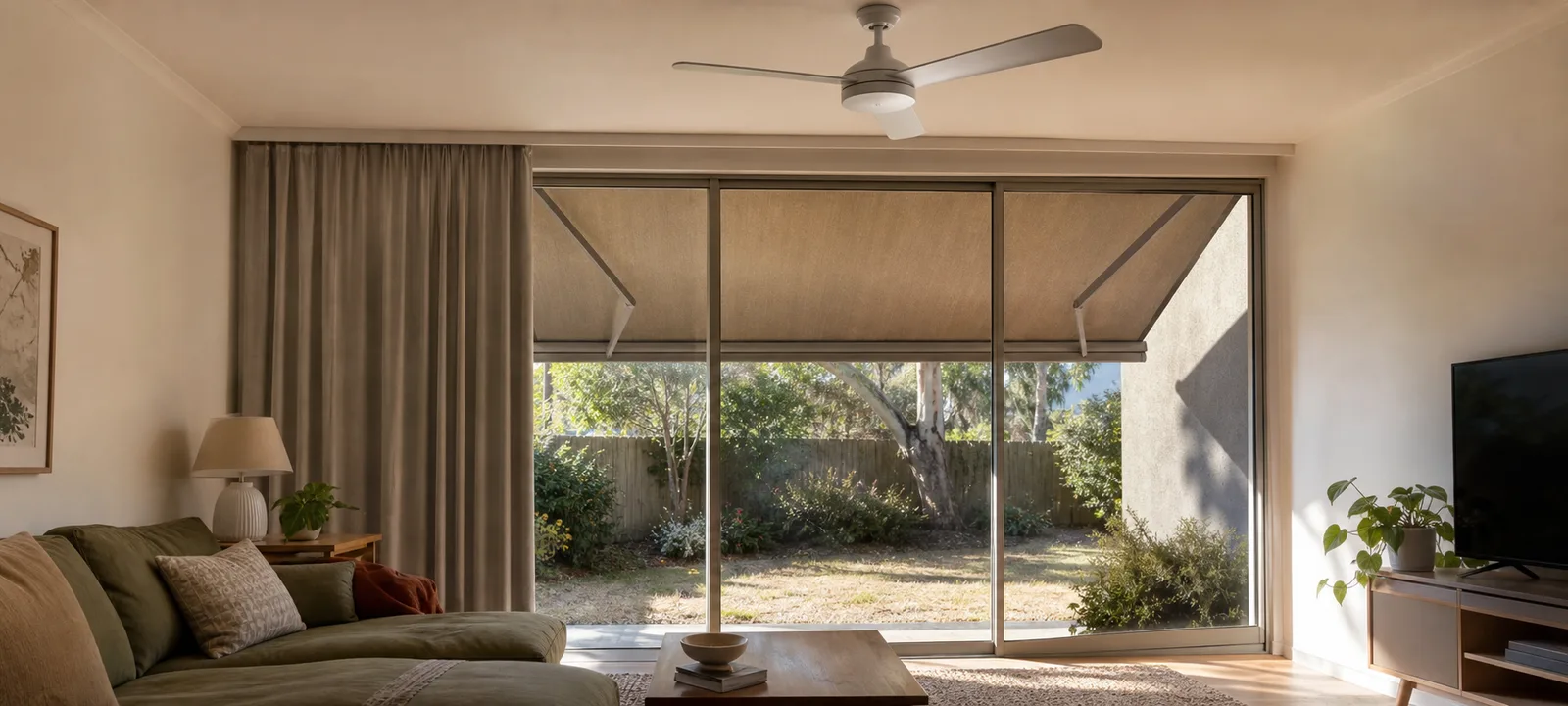
Direct sunlight through windows can add substantial heat to a room. External shading is usually more effective than dealing with that heat after it has passed through the glass.
Depending on the home, useful options can include:
- awnings or external blinds
- verandahs or appropriately positioned shade structures
- trees or vegetation where they suit the site.
East- and west-facing windows deserve particular attention because low-angle morning and afternoon sun is difficult to shade. For north-facing glazing, correctly sized eaves or adjustable shade can block high summer sun while allowing useful winter sun where the climate calls for it.
Use curtains and blinds strategically
Internal curtains and blinds can still help, particularly when direct sun is hitting the window. Close them before the room becomes excessively hot rather than after heat has built up.
Blockout curtains, close-fitting blinds and pelmets can perform better than lightweight decorative coverings, but their effectiveness depends on the window and installation. Treat them as a secondary measure rather than a complete substitute for external shade where strong sun is the main problem.
Check the ceiling and roof insulation
Rooms directly below a hot roof can gain substantial heat from above. Ceiling or roof insulation helps slow that heat transfer.
This deserves attention in upstairs rooms, top-floor apartments and spaces beneath highly exposed roofs. If one room is dramatically hotter than others of similar size, investigate the insulation above it before simply adding more cooling capacity.
Our Home Insulation Basics guide explains what to check before planning an upgrade.
Open the house when outside is cooler
Ventilation can help when outdoor conditions are more comfortable than indoor conditions. Opening suitable windows and doors in the evening may release heat that accumulated during the day, especially where air has a clear path through the home.
Ventilation is not always beneficial. If the air outside is hotter or much more humid than the air indoors, leaving everything open can increase the load on the home and any air conditioner that is running.
Use outdoor conditions as the guide rather than following a fixed rule that windows should always be open or always be closed. Evaporative systems use airflow differently; our evaporative and refrigerated cooling comparison explains that distinction.
Close the house when the heat arrives
Once outside conditions become hotter than indoors, closing windows and doors can limit hot-air entry. Combine this with shading before direct sun reaches exposed windows.
If refrigerated air conditioning is running, keep the conditioned space reasonably closed unless the system or building is designed to operate differently. Continuously replacing cooled air with hot outdoor air adds to the load.
Use fans to improve comfort
Fans do not lower the room’s air temperature in the same way as refrigerated air conditioning. Moving air across the skin can, however, make people feel cooler.
Ceiling and pedestal fans can improve comfort without compressor-based cooling in milder conditions, help distribute conditioned air and reduce the temptation to set the air conditioner excessively cold. Our ceiling-fan guide covers placement, clearances and controls.
Turn fans off when the room is unoccupied unless they serve a specific ventilation purpose. Fans cool people, not empty rooms.
Close off areas you are not cooling
A split system in a living room should not automatically be expected to cool every adjoining room and hallway. If the layout allows it, close doors to unused areas while air conditioning is operating.
For open-plan areas that cannot be closed off, capacity should be assessed for the connected space rather than one nominal room. See What Size Air Conditioner Do I Need? for the full sizing checks.
Reduce heat created inside the house
Cooking, clothes dryers, large appliances and electronics can add heat indoors. On very hot days, consider using outdoor cooking where practical and safe, running heat-producing appliances during cooler parts of the day and avoiding unnecessary appliance use during the hottest afternoon period.
The objective is not to stop using the house. It is to avoid creating extra heat at the same time the cooling system is working hardest.
Check draughts and uncontrolled air leakage
Draught sealing is often discussed as a winter measure, but gaps around doors and windows can also admit hot outdoor air into a conditioned room.
Check obvious gaps and worn seals, particularly around frequently used external doors and older windows. Do not block intentional ventilation openings or building systems designed for safe airflow. Our guide to reducing uncontrolled draughts explains that boundary.
Simple checks for outdoor conditions and small air leaks
First compare the actual indoor and shaded outdoor conditions, then identify a specific unintended gap rather than sealing by guesswork. If those checks reveal a useful ventilation window or a small non-opening crack around a conditioned room, compare these options while preserving intentional ventilation, window operation where needed and a sound painted surface.
Some links below are affiliate links. If you buy through one, we may earn a commission at no extra cost to you. Learn more.
Wireless indoor and outdoor condition monitor
TempPro TP60B Indoor/Outdoor Thermometer and Hygrometer
A base display and remote sensor for comparing indoor conditions with a representative shaded outdoor location before deciding when to open or close the home.
Research-supported option
View at Amazon AustraliaMay suit: households wanting an at-a-glance indoor versus outdoor comparison to support a ventilation routine.
May not suit: homes without a suitable sheltered sensor position or people needing alerts, forecasts or long-term data logging.
Drawbacks to consider:
- The display has no backlight or app history, and the stated wireless range is an unobstructed maximum rather than a promise through every wall.
- The remote sensor needs a sheltered, shaded and representative position; direct sun, rain or a hot wall can distort the comparison.
- Temperature and humidity readings do not account for smoke, outdoor air quality, security or other reasons to keep windows closed.
Evidence confidence: moderate. Last reviewed 24 August 2026. Research-based assessment; we have not tested this product firsthand.
Temporary interior tape for small window and door cracks
3M 2110NA Indoor Transparent Weather Sealing Tape
A clear indoor tape for a confirmed small crack around a conditioned room where temporarily covering the seam will not block required ventilation or access.
Research-supported option
View at Amazon AustraliaMay suit: a small confirmed interior crack around a conditioned room that can remain temporarily closed.
May not suit: large gaps, frequently opened windows or doors, fragile finishes, intentional vents or any opening needed for safety.
Drawbacks to consider:
- It covers a seam rather than repairing worn hardware or filling a large, moving or irregular gap.
- An operable window or door cannot be used normally while its opening seam is taped, so it is unsuitable for required ventilation, access or an escape route.
- Removal can affect weak paint or leave residue; clean, dry and test an inconspicuous sound surface first.
Evidence confidence: moderate. Last reviewed 24 August 2026. Research-based assessment; we have not tested this product firsthand.
Do not just turn the thermostat lower
A very low setting does not stop heat entering through an unshaded window or poorly insulated roof. Australian Energy Rating guidance suggests considering around 25–27°C for summer cooling.
Use the thermostat for comfortable conditions rather than trying to compensate for excessive heat gain with an extreme setting. Keep filters clean according to the manufacturer’s instructions and make sure furniture or other obstructions do not block indoor airflow.
Is the air conditioner actually too small?
It may be, but check the room first. A system can appear undersized because of strong afternoon sun, exposed glazing, poor ceiling insulation, a large open-plan area, open doors or windows, dirty filters, restricted airflow or unusually high internal heat loads.
If those issues have been addressed and the system still cannot maintain reasonable comfort, have the room and air-conditioner capacity assessed. Simply buying a larger unit does not guarantee a good result.
The practical order
Shade the glass → reduce heat transfer → manage ventilation → use air movement → limit unnecessary internal heat → use the existing air conditioner effectively → then reassess the cooling load.
A larger air conditioner can compensate for some heat gain. A cooler, better-managed room gives it less heat to fight in the first place.
Sources and guidance
- YourHome guidance on passive cooling, heat gain, shading and cooling breezes
- YourHome guidance on seasonal, north-facing and east–west shading
- YourHome guidance on glazing, curtains, blinds, pelmets and window seals
- YourHome guidance on controlled ventilation, airtightness and unintended air leakage
- Australian Government guidance on ventilation, fans, cooling zones and roof insulation
- Australian Energy Rating guidance on thermostat settings, filters and airflow