
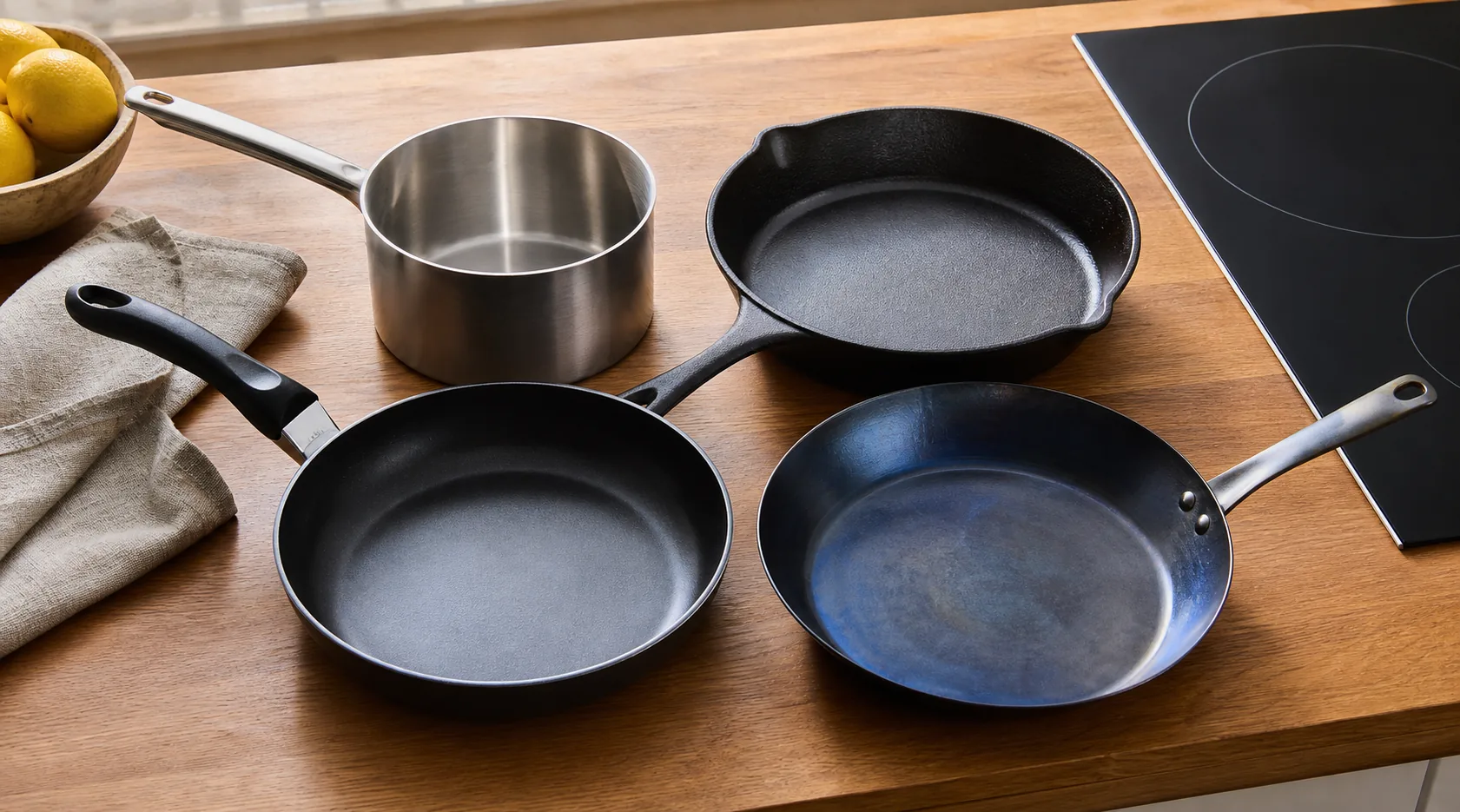
Cookware material affects heat control, browning, weight, cleaning and how much attention a pan needs after dinner. A matching ten piece set can look convenient, but one material rarely does every kitchen job equally well.
A more practical starting point is the food cooked most often, the cooktop and the care routine the household will actually follow. The comparison below is a planning guide, not a performance ranking: construction and instructions vary within every material category.
The technical sources used here are direct material or manufacturer guidance: the Australian Stainless Steel Development Association's thermal-property note, Electrolux Australia's induction cookware guidance, Tefal Australia's cookware care instructions, and the Lodge cast-iron and carbon-steel care guides. Manufacturer guidance applies to that maker's products; the instructions supplied with the exact pan and cooktop take priority.
Cookware materials at a glance
Swipe sideways to compare the full table.
| Material | Useful for | Main strengths | Main trade offs |
|---|---|---|---|
| Stainless steel | General stovetop tasks, subject to the pan's construction | Available with bonded or clad conductive layers | Thermal behaviour and oven, utensil and induction limits vary by product |
| Coated nonstick | Tasks where the household wants an easy-release coated surface | Can reduce sticking when used as the maker directs | Heat, utensil, stacking and cleaning limits are coating-specific |
| Cast iron | Tasks suited to the exact seasoned pan and heat-source instructions | A seasoned iron surface can be maintained with use and oil | Weight and wash, dry and oil care must suit the user |
| Carbon steel | Frying tasks suited to a thinner seasoned steel pan | Lodge's construction note describes its carbon steel as thinner and lighter than its cast iron | Prompt drying and a light oil film are part of the cited maker's care routine |
| Enamelled cast iron | Tasks permitted by the enamelled product's instructions | A porcelain-enamel surface separates food from exposed iron | Weight, heat, utensil and impact care remain product-specific |
Stainless steel quality is more than the steel grade
ASSDA's published comparison shows lower thermal conductivity for stainless steel than for aluminium or copper. Cookware makers address this in different ways, including conductive layers in the base or body. Do not infer the construction from the words stainless steel alone; check the cross-section or specification for the exact range.
Check whether the base sits flat, whether it is magnetic for induction and how the handles are attached. A heavy pan that feels reassuring when empty may become awkward when full of pasta water.
Nonstick earns its place through the tasks it makes easier
A coated pan can be selected for tasks where easy release matters to the household. That does not make the same coating necessary for every saucepan and stockpot. Buy only the pieces whose care limits and intended tasks fit the kitchen.
- Use the heat range recommended by the manufacturer.
- Do not preheat an empty coated pan for an extended period.
- Use utensils permitted for that exact coating.
- Let the pan cool before washing to reduce thermal shock.
- Protect the surface from other pans when stacked.
Cast iron and carbon steel reward a regular routine
Lodge describes seasoning as oil baked onto iron and tells owners of its cast iron to wash, dry and oil it. Its carbon-steel care guide gives the same three-part routine and says its carbon steel is formed thinner and lighter than its cast iron. Those statements describe Lodge's products; use the supplied instructions for another maker.
Wash according to the maker, dry as directed and refresh the oil film only when the instructions call for it. Check the exact manual before cooking acidic foods or using an oven, barbecue, dishwasher or metal utensil; material-category shorthand is not a substitute for those limits.
Enamel is useful when seasoning is not
Enamelled cast iron places a porcelain surface over iron. The Lodge cast-iron product guide describes its enamel surface as suitable for acidic and alkaline foods, while its care details remain product-specific. Check the exact maker's heating, cooling, utensil, oven and cleaning instructions before assuming another enamelled product has the same limits.
Check the interior colour and condition in store. A pale enamel makes browning easier to see, while a dark interior may show staining less. Neither changes the need to follow the maker's heating and utensil instructions.
Check the cooktop before the cookware
Cooktop requirements differ. Electrolux Australia's cited support guidance says induction compatibility can be checked by the maker's mark or whether a magnet pulls to the base, and says the permitted base diameter depends on the cooktop model. Use the cookware and cooktop instructions together.
The word stainless does not guarantee induction compatibility, and a small magnetic insert may perform differently from a full induction base. Use the cooktop and cookware instructions together, particularly for boost settings and maximum heat.
Build a small set around actual meals
Start with current meals
List the pots and pans used across a normal week, including their filled weight. Replace a missing task rather than buying a fixed piece count.
Measure capacity and storage
Check the capacity needed for household portions, then measure cooktop contact, handle reach, drawer height and the space needed to protect coated surfaces.
For induction
Confirm every base, including pieces inside a set. Match base diameter to the cooktop zones and avoid assuming that a larger rim means a larger magnetic contact area.
Cookware options for the meals you actually make
First keep any sound pan that already handles the household's regular meals and identify the one missing task. If a gap remains, compare these stainless-steel and cast-iron options by cooktop compatibility, filled weight, care and storage rather than replacing the whole cupboard by default.
Some links below are affiliate links. If you buy through one, we may earn a commission at no extra cost to you. Learn more.
Stainless-steel cookware set
Scanpan Impact 6-Piece Cookware Set
A broad stainless-steel set for cooks who need several saucepan sizes, a frypan and a steamer and have checked hob compatibility.
Research-supported option
View at Amazon AustraliaMay suit: households building a coordinated stainless-steel set.
May not suit: small kitchens or cooks who only need one replacement pan.
Drawbacks to consider:
- A six-piece set consumes substantial cupboard space and may duplicate pans already owned.
- Current dimensions, variant, price, stock and seller details should be rechecked before ordering.
Evidence confidence: moderate. Last reviewed 18 August 2026. Research-based assessment; we have not tested this product firsthand.
Pre-seasoned cast-iron skillet
Lodge 12-Inch Cast Iron Skillet
A large pre-seasoned cast-iron skillet for high-heat cooking where weight, handle heat and seasoning care are acceptable.
Research-supported option
View at Amazon AustraliaMay suit: cooks wanting durable high-heat cast iron.
May not suit: users with lifting limitations or wanting dishwasher cleaning.
Drawbacks to consider:
- It is heavy, the handles become hot and the seasoned surface needs appropriate drying and care.
- Current dimensions, variant, price, stock and seller details should be rechecked before ordering.
Evidence confidence: moderate. Last reviewed 18 August 2026. Research-based assessment; we have not tested this product firsthand.
Cookware buying checklist
- List the five meals and techniques used most often.
- Choose pan sizes that match the cooktop zones and household portions.
- Lift the pan with a realistic amount of water in mind.
- Confirm induction and oven compatibility for every component.
- Check lid material, handle heat, utensil limits and cleaning instructions.
- Buy coated cookware only for tasks that benefit from it.
- Leave room to store pans without scraping their cooking surfaces.
- Verify origin claims against the exact product, not the brand story.
Common Questions
What cookware material is best for everyday cooking?
There is no single best material for every household or task. Start with the meals, cooktop, lifting weight and care routine, then compare the exact product instructions. A mixed set can be more practical than assuming one construction has to handle every job.
Does stainless steel cookware work on induction?
Only when its base is magnetic and designed for induction. Many stainless steel sets are compatible, but the material name alone does not guarantee it. Check the maker's cooktop symbols or test an existing pan base with a magnet.
When should a nonstick pan be replaced?
Follow the exact manufacturer's inspection, care and replacement advice. Do not apply one brand's temperature, utensil or damage guidance to another coating. If the instructions are missing or the pan is damaged, contact the manufacturer before further use.