
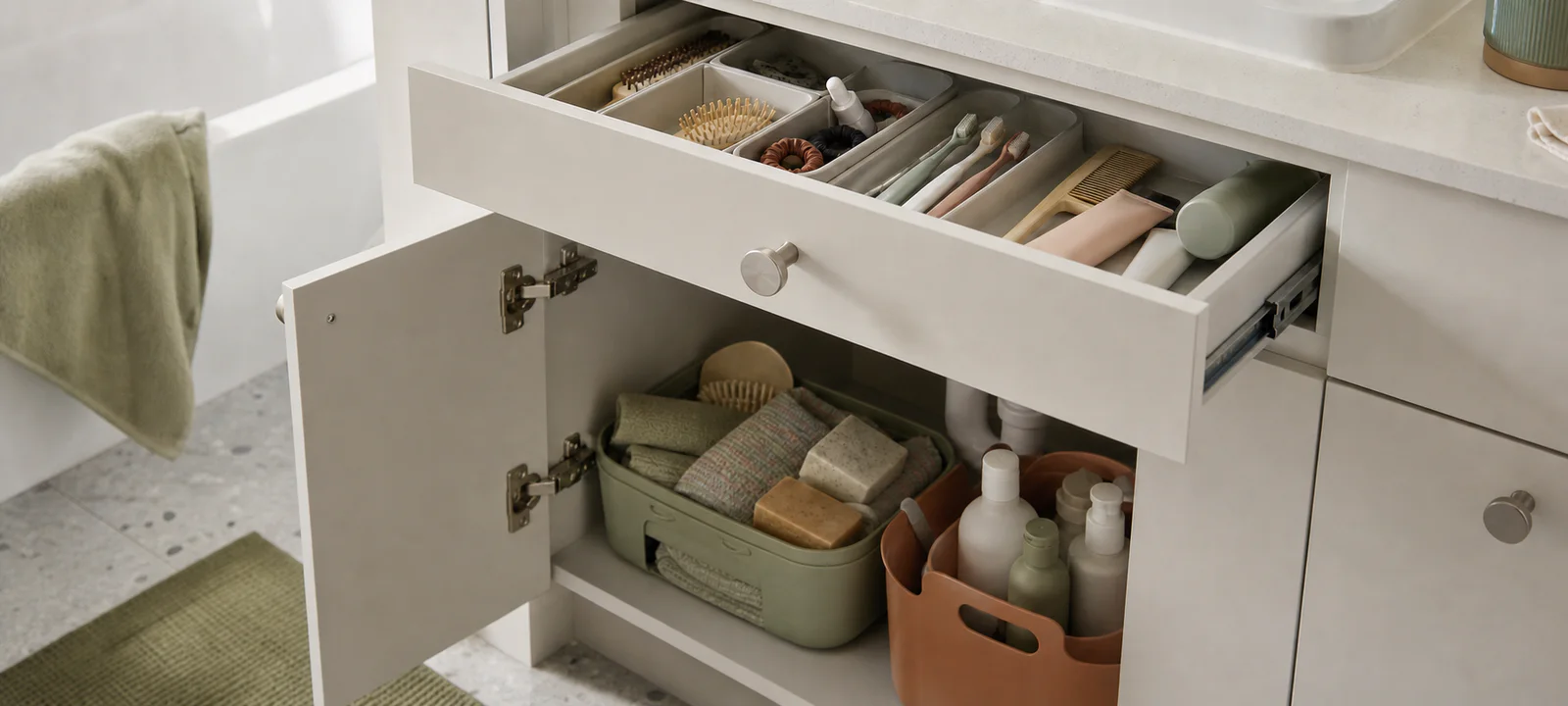
Bathroom products multiply quietly. A new tube joins the half-used one, samples disappear into a drawer and spare bottles crowd the cleanser somebody reaches for every morning. The active collection ends up buried inside an archive.
Bring similar items together before buying trays or baskets. Decide what is in use, what is a sensible backup and what should leave the room. Organisers then have a clear job: keep the remaining groups visible, upright and easy to clean around.
Separate the routine from the reserve
Daily products need to be reached without moving anything else. Backups only need to be found when the current product runs out. Keeping both groups in the same prime drawer makes the morning routine compete with unopened stock.
| Group | Examples | Storage priority |
|---|---|---|
| Daily routine | toothpaste, cleanser, deodorant, current skincare | front drawer or one small tray |
| Weekly or occasional | treatments, grooming tools and special cosmetics | separate from the daily reach zone |
| Backups | unopened soap, toothpaste and toiletries | one visible, labelled reserve |
| Guest or travel | small toiletries and travel containers | portable group outside prime storage |
| Controlled items | medicines, blades and household chemicals | storage chosen for safety and product directions |
In a shared bathroom, one routine basket per person may be easier to maintain than dozens of product-specific compartments. Keep genuinely shared basics together and give personal items a defined boundary.
Remove products before measuring storage
Check dates, packaging and condition. Empty bottles, unwanted samples, duplicates and products that have changed unexpectedly should not determine the size of an organiser. Follow the label or relevant professional guidance when a product needs special disposal.
Healthdirect advises following each medicine's packaging for storage and taking expired or unwanted medicines to a pharmacy rather than putting them in household rubbish or flushing them. See its medicine storage and disposal guidance.
Track duplicates for a few weeks. If the household repeatedly buys another product because the first cannot be seen, visibility—not more stock—is the problem.
Group products by the moment they are used
A morning tray, shower caddy, hair basket and backup bin are more intuitive than one large “toiletries” category. Each group should be small enough to lift or slide out without shifting its neighbours.
- Keep morning and evening routines distinct where that helps.
- Put dental care near the basin, without crowding the tap.
- Keep only active wash products in the shower.
- Store hair tools according to their electrical, heat and manufacturer guidance.
- Separate cleaning supplies from personal care products and clean linen.
The bathroom vanity guide shows how to position these groups around drawers, cupboards and the benchtop.
Measure products as carefully as the cupboard
Record the internal drawer or shelf dimensions, but also measure the tallest pump, longest brush and widest package in each group. Include room to grip and lift the item; a bottle that fits with a few millimetres to spare may still be awkward to remove.
Check:
- internal drawer width, depth and height
- usable shelf height beneath frames and hinges
- cabinet opening and basket removal clearance
- the positions of pipes, traps and shelf openings
- whether bottles remain upright and labels face the user
- the loaded weight of deep or handled baskets
In an under-sink cupboard, use the under-sink measuring guide before choosing a pull-out or tiered system.
Limit the vanity tray to one routine
A tray can keep the benchtop orderly when it holds the few products used at the basin. It should leave the tap, plug and mirror clear and lift away easily when the surface is wiped.
Check whether splashes collect under or inside it and whether toothbrushes or razors can dry appropriately. If the tray becomes a landing place for unopened products and occasional treatments, return those to their categories rather than buying a larger one.
Keep drawer inserts flexible
Small compartments suit hair ties, makeup and dental accessories; longer open sections suit brushes, razors and tubes. Leave enough finger space to remove items and enough flexibility for a product to change size when it is replaced.
An insert should lift out for cleaning. Avoid a fixed grid that forces unrelated products together or leaves half the drawer unusable. Sharp items and medicines require their own access decisions rather than an ordinary open divider.
Keep chemical products in their own controlled zone
Cleaning sprays and toilet products should not sit loosely beside toiletries, towels or toothbrush heads. Follow each label, keep the product in its original container and make sure leaks would be visible.
Product Safety Australia recommends storing household chemicals securely out of children's reach and sight and using a child-resistant lock if a low cupboard is accessible. Its chemical and poison guide also stresses closing products after use. If the vanity cannot provide suitable storage, move the chemicals rather than disguising them in a decorative basket.
Keep the shower collection deliberately small
Wet-zone storage should contain the products currently used while washing, not their replacements. Extra bottles make shelves heavier, restrict drainage and add more surfaces to clean.
Check bottle height, full weight, shelf drainage and surface suitability with the shower storage guide. Store razors deliberately and keep spare blades in suitable dry, controlled storage.
Move bulk stock out of a humid room
A bathroom may need one spare toothpaste or soap, not the entire multipack. A nearby linen, hallway or laundry cupboard can keep bulk toilet paper, unopened toiletries and clean spare towels out of steam and prime vanity space, provided that location suits the products.
Set a maximum for each backup category. When the basket is full, use what is there before purchasing more. This makes stock visible and prevents the bathroom from becoming a general household storeroom.
Choose containers that reveal drips and dates
Bathroom products leak, shed powder and collect residue. Smooth removable trays and baskets are easier to wipe than deep woven or fabric containers. Avoid organisers that hide the cabinet floor, trap water or require every neighbouring item to be removed first.
Put labels where they can be read from the doorway. In a deep cupboard, a handled basket can bring one category forward, but it should not become so heavy that nobody uses it or so deep that products disappear in several rows.
Run a final check of the products and space
- Which items are used every day, weekly and occasionally?
- Which backups are genuinely needed in this room?
- Have expired, empty and unwanted products been handled appropriately?
- Can bottles stand upright with pumps and caps clear?
- Do trays and baskets fit through the opening and lift out for cleaning?
- Will leaks, dates and labels remain visible?
- Are medicines, blades and chemicals stored according to their requirements?
- Could bulk stock live somewhere more suitable?
Bathroom product organiser types to compare
The active collection should stay visible and easy to clean around. Compare organisers for ordinary toiletries only after expiry, backup quantities and items that should be stored elsewhere have been resolved.
Daily-use trays
- May help with
- Keeping a small morning or evening routine together in a drawer or dry cabinet area.
- Measure first
- The tray footprint, product heights and the clearance needed to lift each item out.
- Check before buying
- Whether the tray can be removed for cleaning and whether every item genuinely belongs in the daily group.
- Avoid if
- The tray will sit in a wet splash zone or become a place for products used only occasionally.
Open backup baskets
- May help with
- Grouping unopened replacement toiletries so the household can see what is already available.
- Measure first
- Shelf depth, opening width and the height of the largest package kept as a backup.
- Check before buying
- Label visibility, loaded weight and whether the basket remains separate from cleaning products.
- Avoid if
- The bathroom is being used for bulk stock that would stay drier and clearer elsewhere.
Tall bottle bins
- May help with
- Keeping a limited group of upright bottles together on a deep cabinet shelf.
- Measure first
- Bottle height and width, bin depth and clearance above the tallest pump or cap.
- Check before buying
- Whether bottles remain upright and whether spills can be seen and cleaned promptly.
- Avoid if
- The bin would conceal expiry dates, leaks or products behind several rows.
Divided drawer inserts
- May help with
- Separating small grooming items that otherwise roll or mix together.
- Measure first
- Internal drawer dimensions and the length, height and quantity of the items being separated.
- Check before buying
- Compartment size, cleaning access and whether items can be returned without rearranging neighbours.
- Avoid if
- The insert is being used for medicines, blades or other items that require more controlled access.
Keep the active collection visible
Useful bathroom product storage makes the daily routine obvious. Products in daily use stay close, backups are limited and separate, and anything hazardous or sensitive is stored for its own requirements rather than the convenience of an empty shelf.
If an organiser hides expiry dates, encourages another row of backups or makes the cabinet harder to clean, it has contained the collection without improving it.
Fit product storage into the whole bathroom
Product categories are only one part of the room. Use the main bathroom storage guide for the complete layout, or the small bathroom guide when floor and wall space are tight. The towel storage guide covers the other high-use category. Renters can continue with the renter-friendly guide, while Bathroom collects the full series.
Common Questions
How do you organise toiletries in a bathroom?
Remove everything first, discard products that no longer belong, then group what remains by when it is used. Keep the small morning and evening collection easy to reach, occasional products together in a drawer or cabinet, and unopened replacements in one visible reserve zone instead of mixing every bottle together.
Where should backup toiletries be stored?
Keep unopened replacements together in one labelled basket or cabinet zone where quantities and expiry information remain visible. If the bathroom is crowded or humid, move bulk stock to a suitable cupboard elsewhere and bring in one replacement at a time. This prevents the daily collection from becoming buried behind spare bottles.
Which bathroom products should be stored separately?
Cleaning chemicals should have their own controlled area rather than sharing a tray with skincare or dental products. Medicines, blades and any product with special storage directions also need a position suited to their labels and household. Separating these groups makes daily toiletries easier to find and leaks or damaged packaging easier to notice.