
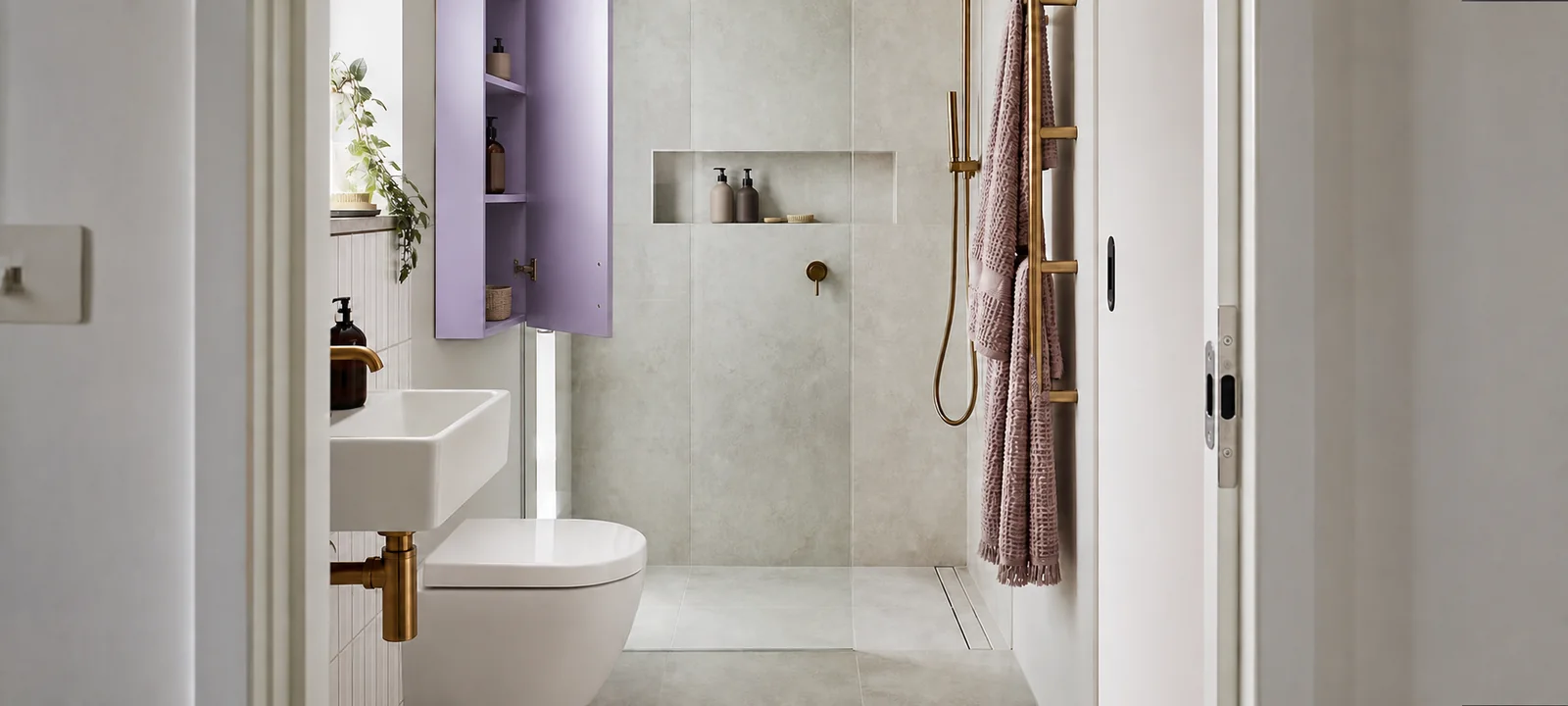
Small bathrooms expose bad storage quickly. A narrow trolley can take the only comfortable standing space, an over-door rack can stop the door opening and an oversized caddy can make the shower feel smaller every day.
The answer is rarely to fill every gap. Keep the products needed for the current routine, move bulk backups elsewhere and choose the shallowest organiser that solves a specific problem. Empty space is useful when it lets a person turn, dry off or clean the floor.
Decide what earns a place in the room
Give prime space to the toothbrushes, toiletries and grooming items used every day. Keep only the shower products currently open and enough towels for the household routine. Samples, travel toiletries, duplicates and large refill packs can usually live in a linen cupboard or laundry.
| Priority | Examples | Small-space response |
|---|---|---|
| Daily | toothbrush, cleanser, deodorant, hairbrush | keep within one easy reach |
| Shower | open shampoo, conditioner and body wash | use draining wet-zone storage |
| Backup | unopened toiletries and spare toilet paper | limit or relocate |
| Controlled | medicines, blades and cleaning products | store securely in a suitable place |
| Remove | expired, empty and unused products | do not buy storage for them |
This first edit often creates more usable room than another shelf. For the broader method, see how to plan bathroom storage around real routines.
Draw the room with everything open
A product can fit its footprint and still stop the bathroom working. Measure with the main door, shower screen, vanity doors and drawers in their open positions. Include the space a person needs at the basin, beside the toilet and when stepping out of the shower.
- Mark every door and drawer arc.
- Measure the narrowest part of the walking route.
- Allow room to reach the toilet, taps and shower controls.
- Keep enough floor access to mop around the vanity and toilet.
- Note switches, power points, mirrors and existing towel rails.
Test likely positions with a cardboard box or masking-tape outline. Living with that shape for a day can reveal collisions a tape measure misses.
Use the vanity before adding furniture
Internal vanity storage does not consume walking room, but it needs accurate measurements. Record drawer width, depth and height; cabinet opening width; shelf spacing; pipe and trap positions; and the space lost to hinges.
Match trays to the few items used at the basin. Fit baskets around the plumbing rather than forcing in a full-width unit. Keep the benchtop mostly clear: one small, washable tray is often more useful than a tiered organiser that crowds the tap and collects splashes.
Keep the shower load small
A compact shower does not need storage for the household's entire product collection. Put the current bottles together, weigh them if the fixing has a rated load and measure the tallest pump bottle.
Then check whether the proposed caddy:
- clears the shower head, hose, screen and curtain
- leaves shoulders and elbows room to move
- drains rather than holding water beneath bottles
- keeps razors out of children's reach where necessary
- can be removed or reached easily for cleaning
The shower storage guide covers surface, bottle and drainage checks in more detail.
Treat suction and adhesive as surface-specific
Removable storage can be useful, particularly in a rental, but the product instructions determine where it belongs. Glossy tile, textured tile, grout, painted wall and glass do not behave the same way. Heat, steam and direct spray can also affect performance.
Check the approved surface, preparation method, wet-area suitability and rated load. Do not entrust heavy, sharp, glass or breakable items to a fixing that is not explicitly intended for that use. Removal can still mark a surface, so renters should check their agreement before installing anything.
Be selective with vertical storage
A high shelf can free a drawer, but a deep shelf at shoulder height creates a new obstacle. Check its projection from the wall and stand where people normally use the basin or toilet. Leave the mirror, switches and power points clear.
Over-toilet units need room around the cistern, flush button, seat and cleaning area. Avoid heavy, sharp, glass or spill-prone items above the toilet. If the unit requires wall fixing, confirm the wall or tile is suitable and follow the manufacturer's installation guidance.
Give each used towel somewhere to dry
The smallest storage option is not necessarily the most practical. Hooks use little wall width, but a bunched towel may dry slowly in a poorly ventilated room. Rails spread towels out but require a longer clear wall. Over-door rails only work if the door still opens and the towels do not drag or clash with fittings.
Count the towels in daily use and plan for those first. Folded spares can be stored outside the bathroom; damp towels do not belong in closed baskets.
Keep risky items out of the convenient low zone
Small bathrooms place almost everything within reach. Razors, spare blades, hot styling tools, medicines, fragrances and cleaning products may need secure storage rather than an open basket under the basin.
Follow each medicine's packaging or pharmacist advice because heat and moisture can affect storage requirements. Keep household chemicals in their original labelled containers and follow their directions. Product Safety Australia advises storing chemical products out of children's reach and sight, using a child-resistant lock if a low cupboard is accessible. Its chemical and poison guide explains the precautions.
Choose materials for a damp, busy room
In a small bathroom, every organiser is close to steam, splashes or cleaning products. Prefer pieces that can be lifted, wiped and dried. Be cautious with cardboard, fabric baskets, untreated timber, rust-prone metal and deep containers that hide leaks.
Persistent condensation, musty smells, swollen cabinetry, water damage or recurring mould need attention to their cause. Storage should leave those areas visible, not cover them.
Match the product to one job
| Option | Useful when | Likely problem |
|---|---|---|
| Drawer tray | small daily products need separation | too tall for a shallow drawer |
| Under-sink basket | backups fit around plumbing | blocks pipes or hides dampness |
| Shower caddy | a few current bottles need drainage | crowds movement or overloads the fixing |
| Wall shelf | there is safe, dry clearance | projects into head or shoulder space |
| Towel hook or rail | used towels have room to dry | blocks a door or bunches fabric |
| Over-toilet unit | the toilet area has measured clearance | feels crowded or restricts cleaning |
Storage options for the one unsolved zone
First move reserves out of the room and test whether the vanity, an existing hook or a smaller shower load can do the job. If one defined problem remains, compare these over-toilet and adhesive caddy formats against door swings, wall and tile surfaces, ventilation and clear movement space.
Some links below are affiliate links. If you buy through one, we may earn a commission at no extra cost to you. Learn more.
Freestanding over-toilet shelf
SONGMICS 3-Tier Bamboo Over-Toilet Organiser
A roughly 26 x 63 x 170 cm bamboo unit with an adjustable middle shelf and anti-tip kit, once cistern, seat, wall-fixing and walkway clearances have been checked.
Research-supported option
View at Amazon AustraliaMay suit: small bathrooms with measured vertical space and a suitable anti-tip fixing point.
May not suit: renters unable to secure furniture or toilets with tight side and cistern clearances.
Drawbacks to consider:
- The bamboo finish is not waterproof, so splashes and persistent bathroom moisture need prompt drying.
- It requires assembly and the supplied anti-tip restraint; the 63 cm width and rear bar will not clear every toilet or plumbing layout.
Evidence confidence: moderate. Last reviewed 22 August 2026. Research-based assessment; we have not tested this product firsthand.
Adhesive shower caddy
Command BATH11-ES Shower Caddy
An adhesive-mounted caddy for smooth suitable surfaces where drilling is undesirable and the rated load is sufficient.
Research-supported option
View at Amazon AustraliaMay suit: renters with smooth compatible tiles and modest storage needs.
May not suit: porous, uneven or repeatedly wet mounting surfaces.
Drawbacks to consider:
- Adhesive performance depends on surface preparation, cure time, texture and load.
- Current dimensions, variant, price, stock and seller details should be rechecked before ordering.
Evidence confidence: moderate. Last reviewed 18 August 2026. Research-based assessment; we have not tested this product firsthand.
Take a small-bathroom buying list
- items that genuinely need to stay in the room
- internal vanity and drawer measurements
- pipe, trap, hinge and shelf positions
- door, drawer and shower-screen clearances
- shower dimensions, surface and loaded bottle weight
- usable wall width and shelf projection
- toilet and cistern clearance
- the number of towels drying each day
- items needing secure or moisture-appropriate storage
- rental, strata or body corporate restrictions
Leave enough room for the bathroom to work
A well-planned small bathroom may have fewer organisers than expected. The daily products are close, the shower holds only what is being used, towels have room to dry and bulk supplies live elsewhere.
If storage narrows the path, blocks a fitting or makes cleaning more awkward, the fact that it technically fits is not enough.
Common Questions
How do you create more storage in a small bathroom?
First remove backups and rarely used products that do not need to live in the room. Make the existing vanity work harder with measured, removable organisers, keep shower products to the active set and add vertical storage only for a defined job. Every addition should preserve door travel, towel drying and cleaning space.
What storage should you avoid in a very small bathroom?
Avoid any trolley, shelf or over-door rack that occupies the room's only comfortable standing area or stops a door opening fully. Oversized shower caddies and deep wall units can also make movement harder. Test the proposed footprint with cupboards, shower screens and towels in use before committing to the product.
Are shelves or caddies better for a small bathroom?
Neither is automatically better. A shelf may suit dry products or folded towels when it has safe clearance, while a draining caddy suits a small active shower collection. Choose the option that solves one measured problem, fits the relevant surface and can be cleaned without requiring other items to be moved first.