
A home desk often becomes the filing cabinet for the whole household. Current work competes with school notices, bills, spare leads, manuals and receipts until the surface has no clear owner.
Empty it and separate active work from household administration, occasional supplies and genuine archive material. Each group has a different access pattern; treating them as one office category is what makes a small filing cabinet feel full.
Keep current work closest, give essential records an appropriate home and move surplus tech or bulk supplies off the desktop. Storage should follow that hierarchy rather than preserve every paper pile beside the laptop.
Let the Desk Belong to Current Work
Home office storage should start with access, not furniture. The daily items need a close home; the occasional items need a findable home; the old paperwork usually does not need to sit beside the laptop.
A clear surface, one home for daily supplies, labelled tech storage and a separate paperwork system will often outperform a large unit that mixes every category together.
Empty the Desk and Name Each Category
Before buying storage, sort the home office items into practical groups. This avoids buying a product that looks useful but does not match the clutter you actually have.
Common home office storage categories include:
- Current paperwork.
- Archive paperwork.
- Notebooks and stationery.
- Laptop accessories.
- Chargers and spare cables.
- Printer paper and ink.
- Headphones, webcams and microphones.
- External drives and USB accessories.
- Product manuals and warranty paperwork.
- Receipts and household documents.
- Cleaning cloths and small desk supplies.
Each group needs different access. A pen used daily should not be stored the same way as old paperwork. A spare HDMI cable does not need the same position as a laptop charger. If your broader workspace is still being planned, the home office setup guide for small spaces is a useful starting point before choosing storage furniture.
Use Frequency to Set the Storage Distance
- Daily: current papers, notebook, pen, charger and headphones within easy reach.
- Occasional: spare leads, printer supplies, extra notebooks and call accessories in a nearby drawer, shelf or labelled box.
- Archive: completed files, old receipts and retained records away from the active desk when appropriate.
This hierarchy is more useful than treating every item as urgent. It also reveals whether the workspace needs furniture or simply a better location for the archive.
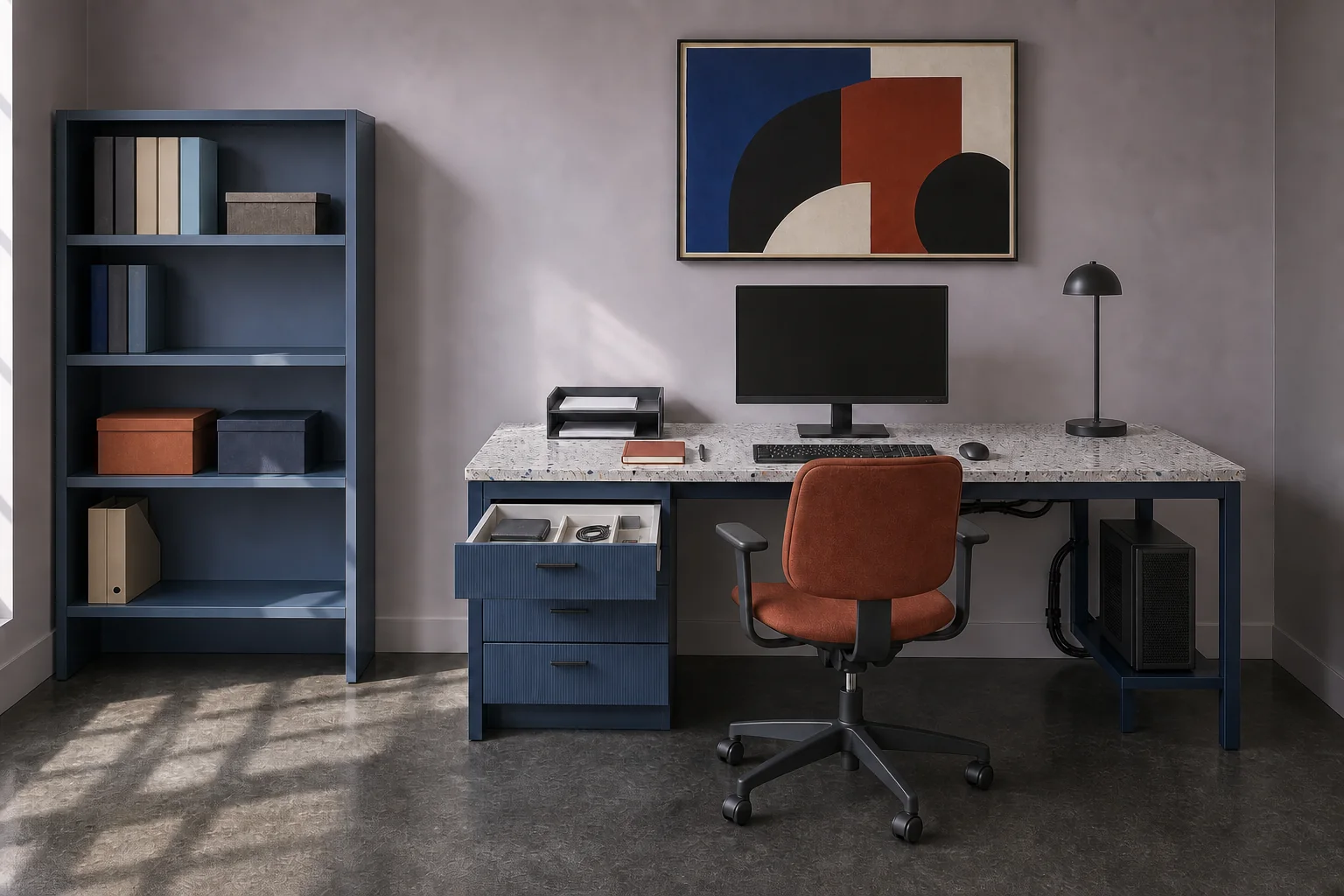
Measure the Space Before Choosing Storage
Home office storage often fails because the product fits the items but not the room. Before buying, measure the width beside the desk, the depth under or beside the desk, the height available under the desktop and the walkway around the work zone.
Also check the distance from the chair to nearby drawers or shelves, the clearance needed for chair movement, wall space for shelving and floor area for freestanding storage. A drawer unit may look compact online but still block a chair, doorway or cupboard.
This is especially important in small bedrooms, apartments and shared living areas. If the desk still needs adjustment, check the home office desk setup guide before committing to storage that depends on the current desk position.
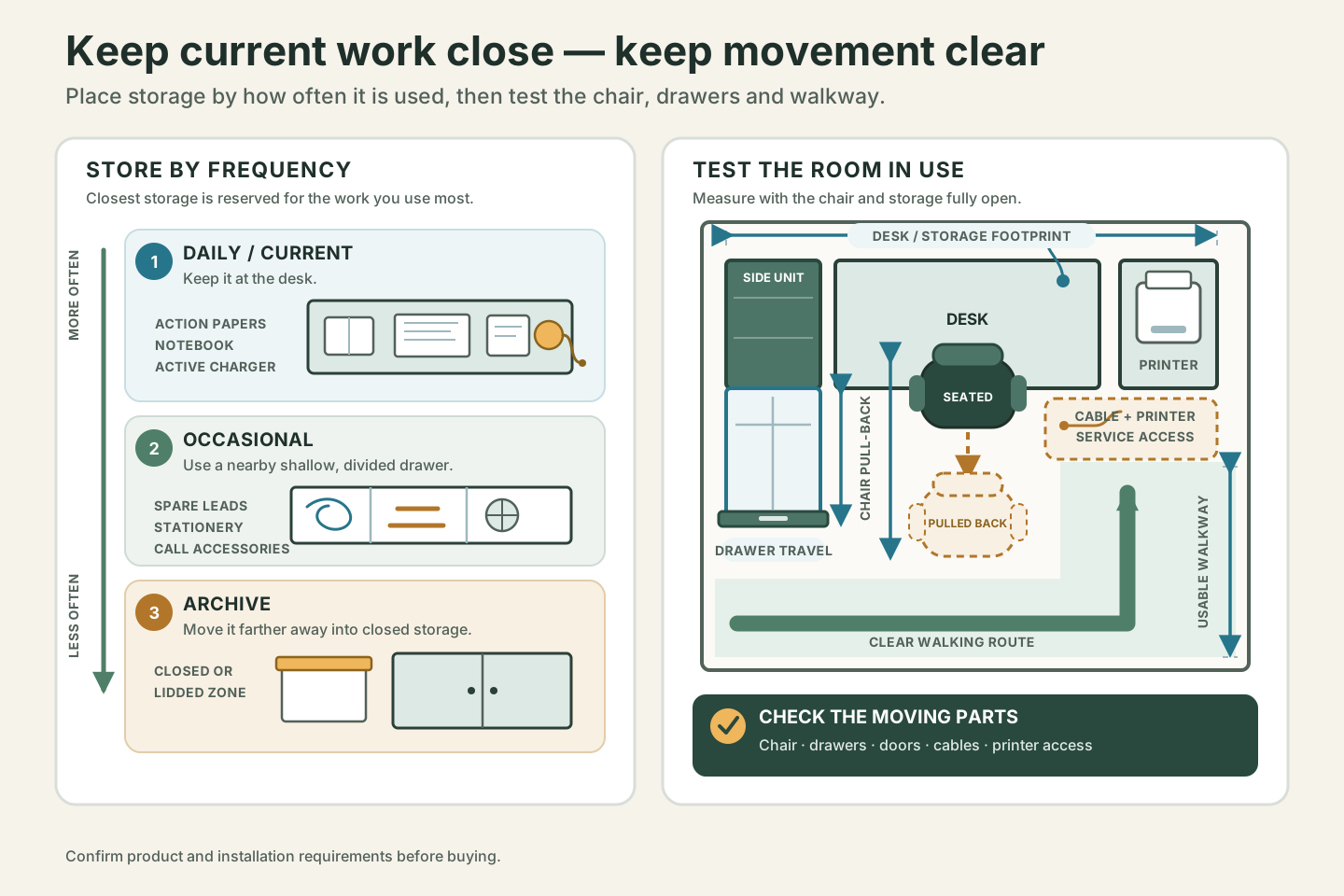
Choose Access Before Capacity
More capacity does not automatically make a home office easier to use. Useful storage matches how often items need to be reached.
Shallow trays suit small daily items because their contents remain visible. Drawers can contain occasional supplies when divided by category. Labelled boxes suit less frequent material, while closed cabinets can calm a shared room. Large capacity can preserve backlog as easily as it stores useful work.
Separate Action, Reference and Archive Papers
Paperwork is one of the easiest home office categories to underestimate. A small pile of forms, receipts and notes can quickly become a drawer full of mixed documents.
Give papers awaiting action a small, visible limit. Keep reference material findable but outside the immediate working surface, and move genuine archives farther away. Before choosing a filing cabinet, confirm how much paper remains after duplicates, expired material and items that do not need to be retained have been dealt with appropriately.
Tech Accessory Storage
Tech accessories are often small, similar-looking and easy to misplace. USB-C cables, HDMI cables, charging bricks, adapters, memory cards, external drives, laptop stands, headphones and mouse accessories can all disappear into deep drawers.
For tech storage, look for compartments that are easy to see and adjust. Shallow drawers, divided trays, zip pouches and labelled containers can work better than deep boxes for small accessories.
If your setup has several chargers or leads, connect this storage plan with the home office cable management guide so connected cables and spare cables do not become the same problem.
Storage options for the papers that still need a home
First action each loose paper: scan, archive or discard it, then return occasional tech away from the desk. If a defined reference or document group remains, compare these lidded and lockable boxes by paper size, access frequency, carrying weight and the level of control the contents require.
Some links below are affiliate links. If you buy through one, we may earn a commission at no extra cost to you. Learn more.
Lidded office storage box
Really Useful Box 19L Clear
A rigid clear box for archived supplies or technology accessories that need a visible, stackable home away from the active desk.
Research-supported option
View at Amazon AustraliaMay suit: archived stationery, cables and infrequently used supplies.
May not suit: daily files that need rapid labelled access.
Drawbacks to consider:
- It is too bulky for everyday paperwork access and does not provide document-specific filing.
- Current dimensions, variant, price, stock and seller details should be rechecked before ordering.
Evidence confidence: moderate. Last reviewed 22 August 2026. Research-based assessment; we have not tested this product firsthand.
Lockable document box
Cathedral A4 Steel Filing Box
A compact steel A4 box for selected household or office papers where portability and basic keyed closure are useful.
Research-supported option
View at Amazon AustraliaMay suit: a modest set of important A4 documents.
May not suit: large archives or documents needing certified fire protection.
Drawbacks to consider:
- A small portable lockbox has limited capacity and is not equivalent to a fire-rated safe.
- Current dimensions, variant, price, stock and seller details should be rechecked before ordering.
Evidence confidence: moderate. Last reviewed 18 August 2026. Research-based assessment; we have not tested this product firsthand.
Limit Stationery to What the Desk Uses
Stationery storage should match the amount of stationery actually used. Many home offices have too many pens, sticky notes, clips, spare notebooks and envelopes because these items are easy to keep just in case.
Keep weekly supplies close and move bulk packs or duplicates elsewhere. A small holder is useful only when it leaves enough working surface. On a compact desk, a divided drawer may contain the same items without creating another object to work around.
Give the Printer a Complete Zone
Not every home office needs a printer zone, but if it does, printer supplies need their own plan. Consider printer paper, ink or toner, envelopes, labels, scanning documents, manuals, cables and replacement accessories.
Paper is bulky, and access is needed for loading, scanning and replacing consumables. A shelf or drawer near a regularly used printer may be enough. A printer used rarely can sit away from the desk, provided it can be moved or used according to its instructions without awkward lifting or blocked ventilation.
Compare Storage by What It Makes Visible
- Open shelf: quick to scan and reach, but every folder and box remains part of the room.
- Drawer: useful for small items when divided; otherwise prone to mixed clutter.
- Closed cabinet: visually calm in a shared room, with a larger footprint and another door clearance to measure.
- Labelled box: flexible for archives and occasional items, but slower to search if categories are mixed.
- Portable caddy: supports a pack-down office when it has a cupboard or shelf to return to.
Storage for Shared Home Office Spaces
A shared home office needs more deliberate storage because different people may use the same desk, room or supplies. Separate drawers or boxes, shared stationery in one visible place and labelled tech accessories can reduce confusion.
Also plan a common charging zone, a place for paperwork that should not be mixed and storage that can be closed when the room is used for something else. In a shared living area, visual clutter matters more.
This topic connects closely with broader shared-space planning, but the key storage principle is simple: avoid storage that assumes only one person uses the room. The shared home office spaces guide covers the wider room planning questions.
Protect Chair and Walkway Space
In smaller homes, storage needs to work harder without making the room feel crowded. Slim drawer units, wall-mounted shelves where suitable, under-desk drawers with enough leg clearance, stackable document boxes and compact desktop organisers can all help in the right room.
Consider What Should Not Stay in the Office
Sometimes the most useful storage decision is removing items from the home office entirely. Household paperwork that does not need desk access, old manuals, duplicate cables, broken chargers, empty boxes, excess stationery and unrelated books may belong elsewhere.
This is not about creating a bare office. It is about avoiding unnecessary storage purchases for items that do not need to be kept in the workspace.
Home Office Storage Checklist
- List what items currently have no proper home.
- Separate daily items from occasional and archive items.
- Check which paperwork needs to stay near the desk.
- Decide whether archive paperwork can be stored elsewhere.
- Measure beside, under and near the desk.
- Check whether chair movement will be affected.
- Open drawers and cabinet doors inside the measured space.
- Check whether dividers or labels will make categories clear.
- Check whether tech accessories need small compartments.
- Keep connected cables separate from spare cable storage.
- Plan a printer supply zone if the printer is used regularly.
- Decide whether closed storage would suit the room better than open storage.
- Use labels where they would make the system easier to maintain.
- Remove duplicates before buying more storage.
- Avoid buying storage for items that should leave the workspace.
Let the Wider Workspace Settle First
Storage works better when it follows the rest of the workspace. A drawer unit, shelf or document box should match the desk footprint, the light in the room and where chargers naturally land during the workday.
Keep Current Work Closest
Good office storage keeps current work close, occasional supplies findable and archives out of the working surface. A smaller system with clear categories will usually serve the room better than more furniture built around an unsorted backlog.
Common Questions
How should I organise paperwork in a home office?
Separate papers that require action from reference material and genuine archives. Keep current work closest to the desk, move less-used records farther away and remove documents that belong elsewhere in the household. This prevents a large filing unit from mixing urgent tasks with material that is rarely opened.
What is the best way to store home office tech accessories?
Group chargers, adaptors, drives and spare leads by the device or job they support, then keep active items within reach and occasional items in labelled storage. Avoid one deep mixed box. Check every unidentified cable before discarding it, and give frequently connected equipment a route that remains easy to access.
How can I add office storage without crowding a small room?
Measure the chair and walkway first, then choose storage for the categories that remain after sorting. A shallow drawer, defined shelf or mobile unit may provide better access than a large cabinet. Include open drawers and doors in the footprint, and keep the desk surface reserved for current work rather than permanent overflow.