
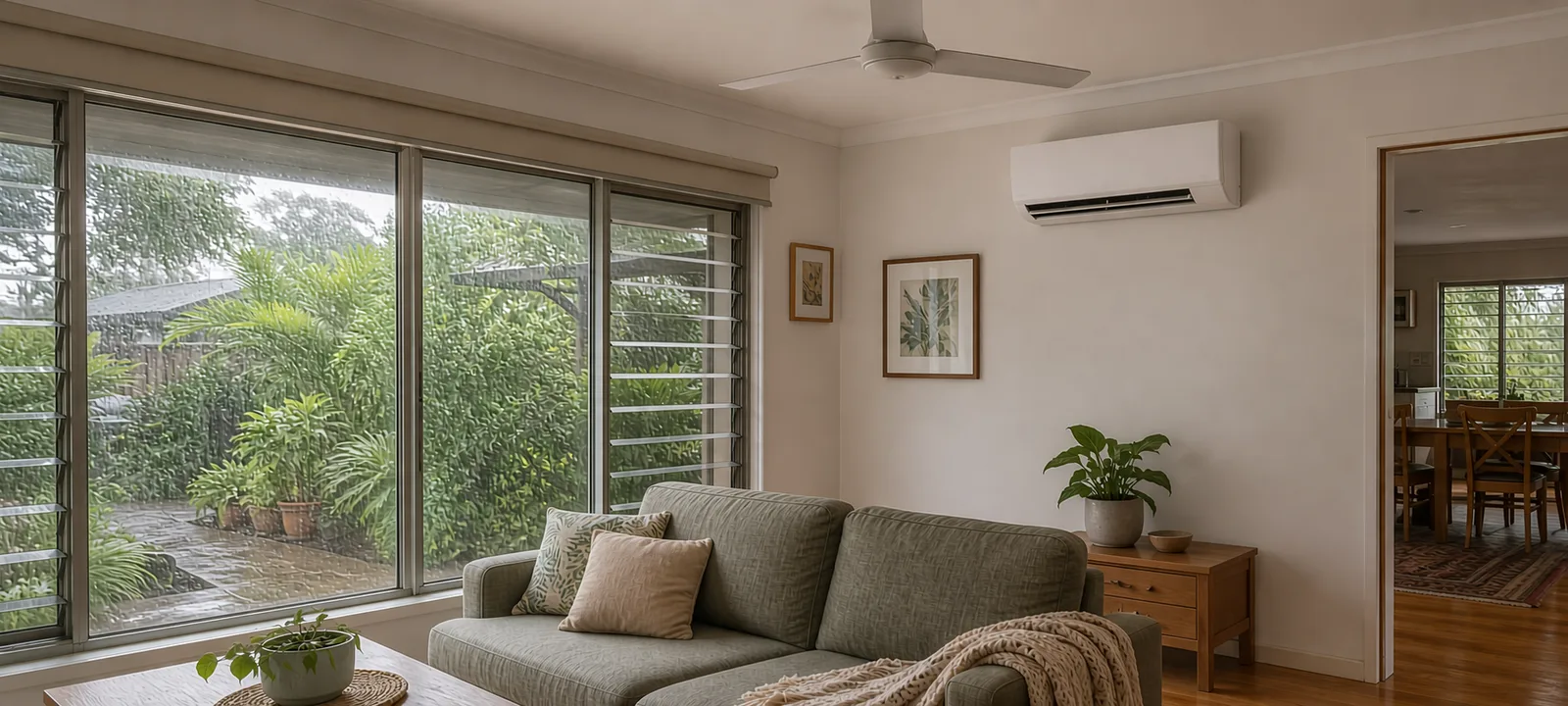
The dry, dehumidify or water-drop symbol on an air-conditioner remote can be confusing.
Dry mode is not simply a weaker version of cooling mode, and it is not exactly the same as running a dedicated dehumidifier.
Its main purpose is to reduce indoor moisture while providing some cooling, which can be useful in humid parts of Australia when the room feels sticky but is not extremely hot.
For the broader system, sizing and climate questions, start with the Air Conditioning Buying Guide.
Why humidity affects comfort
Humidity changes how effectively sweat evaporates from your skin.
When the air already contains a lot of moisture, evaporation becomes less effective, which can make warm conditions feel more uncomfortable.
That is why a humid 27°C room can feel very different from a dry room at the same temperature.
In tropical and subtropical Australian conditions, reducing moisture can therefore be an important part of indoor comfort rather than simply lowering the thermostat.
Air conditioners already remove moisture
A refrigerated air conditioner cools indoor air by passing it across a cold evaporator coil.
As the air cools, some of its moisture can condense on the coil and drain away as water.
This moisture removal happens during normal cooling operation as well as in systems with a dedicated dry mode.
Dry mode changes how the air conditioner operates so that moisture removal becomes a greater priority than rapid temperature reduction.
Exactly how it does this varies between manufacturers and models.
When dry mode can be useful
Dry mode generally makes the most sense when the room feels humid or clammy but is not excessively hot.
Examples might include:
- a muggy afternoon after rain
- humid evenings
- wet-season weather
- mild but sticky coastal conditions
- a room that feels uncomfortable even though the temperature is already close to comfortable.
CHOICE describes dry mode as a mild cooling mode that focuses on dehumidification and notes that it can be useful when conditions are humid but not particularly hot.
If the room is genuinely hot, normal cooling mode will usually be the more appropriate choice.
Dry mode versus cooling mode
The two modes overlap because both can remove moisture from indoor air, but their priorities differ.
Cooling mode primarily aims to bring the room towards the selected temperature.
Dry mode primarily aims to reduce moisture while avoiding unnecessary heavy cooling.
The exact behaviour is model-specific. Some systems may vary compressor operation, fan speed or temperature control automatically.
Check the manual for your air conditioner rather than assuming every brand uses dry mode in exactly the same way.
Is dry mode cheaper to run?
Dry mode is not always the cheaper setting.
Electricity use depends on the air conditioner, indoor and outdoor conditions, the selected settings and how the manufacturer has programmed dry mode.
If the room is very hot, using dry mode instead of normal cooling may also leave you uncomfortable without addressing the actual cooling load.
Choose the mode that matches the conditions rather than treating dry mode as an automatic energy-saving setting.
Portable air conditioners and condensate
Condensate is especially worth checking if you use a portable refrigerated air conditioner.
Depending on the design, a portable unit may:
- evaporate some moisture through the exhaust
- collect water in an internal tank
- require periodic emptying
- support continuous drainage.
Dry mode may also require a particular drainage arrangement.
In humid conditions, more moisture can mean more water for the unit to manage.
Check the manufacturer’s instructions before relying on dry mode overnight or for long periods.
For other portable-unit considerations, see our Portable Air Conditioners Australia guide.
Dry mode is not the same as a dedicated dehumidifier
A dedicated dehumidifier is designed specifically to remove moisture, while an air conditioner primarily controls temperature even when it includes a dry function.
Dry mode may be enough for occasional muggy weather in an air-conditioned room.
A dedicated dehumidifier may make more sense when:
- moisture is a persistent problem
- rooms needing treatment are not air conditioned
- significant dehumidification is required without substantial cooling
- damp conditions continue during cooler weather.
CHOICE notes that persistent damp problems may require a separate dehumidifier, particularly in rooms that are not air conditioned.
Ways to measure humidity before changing the equipment
First track the room's temperature and humidity and investigate ventilation, leaks and other moisture sources. If occasional muggy conditions are the only issue, a simple monitor may be enough; if a persistent problem remains and substantial moisture removal is needed without cooling, compare a dedicated dehumidifier only after checking room size, noise and drainage.
Some links below are affiliate links. If you buy through one, we may earn a commission at no extra cost to you. Learn more.
Compact temperature and humidity monitor
TempPro TP49 Indoor Thermometer and Hygrometer
A small battery-powered display for checking whether a room is mainly warm, humid or both before choosing dry mode, normal cooling or another response.
Research-supported option
View at Amazon AustraliaMay suit: households wanting a simple local temperature and relative-humidity reading before changing operating mode.
May not suit: people needing alerts, room-to-room monitoring, calibrated records or investigation of a persistent moisture problem.
Drawbacks to consider:
- It has no backlight, app, remote sensor or logged history, so it shows current conditions rather than the cause of moisture.
- A reading near supply air, a window, bathroom door or damp surface may not represent the wider room.
- It does not identify leaks, ventilation faults, hidden damp or mould risk by itself.
Evidence confidence: moderate. Last reviewed 19 August 2026. Research-based assessment; we have not tested this product firsthand.
Dedicated compressor dehumidifier for smaller rooms
Breville the Smart Dry Connect Dehumidifier LAD208WHT
A dedicated dehumidifier with a 2.5 L tank and continuous-drain option for persistent moisture in a measured room up to the maker's stated 30 m² limit.
Research-supported option
View at Amazon AustraliaMay suit: smaller rooms with a confirmed persistent humidity problem that needs moisture removal without relying on air-conditioner cooling.
May not suit: occasional muggy weather, larger connected areas, unresolved leaks or households without a practical tank-emptying or drain routine.
Drawbacks to consider:
- Its quoted extraction capacity is measured under specified warm, humid test conditions and will vary in the home.
- The 2.5 L tank needs emptying unless a safe continuous-drain route is available, and the 9.5 kg unit still needs floor space.
- Noise tolerance varies in owner feedback, and app or voice control does not remove the need to investigate ventilation, leaks or building moisture.
Evidence confidence: moderate. Last reviewed 19 August 2026. Research-based assessment; we have not tested this product firsthand.
Don’t use dry mode to hide a moisture problem
Persistent condensation, dampness or mould can have causes that an air-conditioner setting will not fix.
Possible contributors include:
- poor ventilation
- moisture from bathrooms or kitchens
- indoor clothes drying
- water leaks
- building moisture
- inadequate exhaust fans.
Australian Government guidance for tropical and subtropical homes recommends ventilation, air circulation and effective bathroom and kitchen exhaust systems as part of managing high humidity.
If damp or mould repeatedly returns, investigate the moisture source rather than simply running dry mode for longer. Our condensation and mould guide explains the broader checks.
Fans can still help
Air movement can make humid conditions feel more comfortable even when it does not remove moisture from the air.
A ceiling or pedestal fan can therefore complement air conditioning by improving air circulation and perceived comfort.
In some conditions, a fan may be enough. In others, refrigerated air conditioning or dehumidification is needed to actually reduce indoor moisture.
If a fixed fan is part of the plan, check room size, clearance, positioning and controls in our ceiling-fan guide.
When should you use dry mode?
Consider dry mode when:
- the room feels muggy rather than extremely hot
- humidity is the main source of discomfort
- you want some moisture removal without aggressive cooling
- the manufacturer’s instructions recommend it for the conditions.
Use normal cooling mode when substantial temperature reduction is required.
And if moisture is persistent regardless of temperature, consider whether ventilation, a dedicated dehumidifier or a building moisture problem needs to be addressed.
The practical takeaway
Dry mode can be genuinely useful in humid Australian conditions, particularly during muggy weather when the room does not need strong cooling.
But it is not a universal “better” air-conditioning setting.
Use it when moisture is the problem, use normal cooling when heat is the problem, and investigate persistent dampness rather than expecting an air conditioner to solve every source of indoor moisture.