
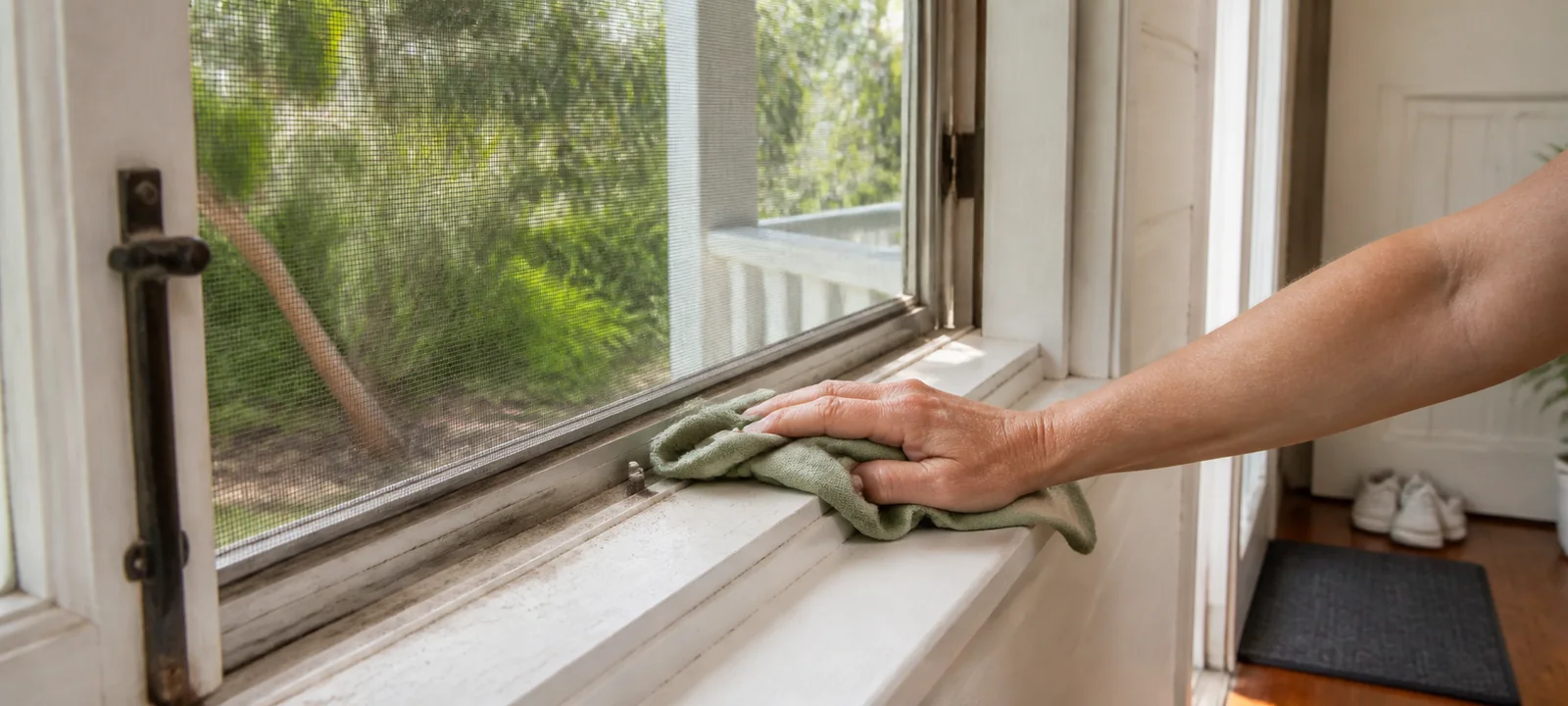
When dust returns soon after cleaning, doing the same job more often is not always the answer. Start by working out how material reaches the room.
Spring pollen and outdoor dust can enter through windows and doors or arrive on shoes, clothes, washing, pets and carried items. Household dust also develops indoors, so no single change will eliminate it completely.
The practical goal is to slow down what comes inside and remove what settles without spreading it through the room again.
Find the route before changing everything
Clean one test area, such as a windowsill or the floor inside the busiest door, then check it over the next few days.
| Where material returns | Check first |
|---|---|
| One open windowsill | Outdoor conditions, wind direction and how long the window remains open |
| Around a closed window | Screen fit, seals, frame gaps and dust trapped in the track |
| Just inside an external door | The entrance mat, footwear, pets and items carried inside |
| On a bed or bedroom furniture | Open windows, outdoor clothes, exposed washing and cleaning order |
| Evenly across a closed room | Indoor fibres, disturbed dust, vents or unintended air leakage |
| After sweeping or dusting | Whether the cleaning method is redistributing fine material |
| Beside recurring condensation or a musty patch | A moisture or mould problem rather than ordinary spring dust |
Pollen, road dust, smoke and mould are not interchangeable. A visible moisture problem belongs with the condensation and mould guide, while smoke requires current air-quality and health advice.
Make the busiest entrance do more of the work
Concentrate on the door the household actually uses.
Use a stable, cleanable mat with enough clearance for the door. Clean it before accumulated grit becomes another source of material tracked through the home.
Create a convenient place for shoes, school bags, work gear and other outdoor items without blocking the doorway.
Useful habits include:
- removing visibly muddy or dusty footwear
- keeping outdoor bags off beds and upholstered furniture
- wiping visibly dusty pet paws with a clean, animal-safe towel
- placing gardening or work clothes directly in the laundry
- closing the door between repeated trips
The aim is to catch the most obvious material before it travels further.
Use windows according to the day
Windows provide ventilation, but they also connect the room to current outdoor conditions.
On windy, dusty or high-pollen days, temporarily close the openings most exposed to those conditions. Check a reliable pollen forecast and local air-quality information rather than treating every spring day the same.
Ventilate when outdoor conditions improve, using a less-exposed opening where practical. Keep kitchen, bathroom and laundry exhaust working as intended.
Do not seal intentional vents, drainage points or weep holes. Recirculating air conditioning also does not provide fresh outdoor air unless the system is designed to do so.
Clean in an order that collects material
Window tracks, sills, screen frames, door tracks and floors inside entrances often collect outdoor material first.
A useful order is:
- clear items preventing the surface being reached
- remove loose grit with an appropriate vacuum attachment or soft brush
- wipe suitable higher surfaces, sills and frames
- clean upholstery with an appropriate attachment where needed
- vacuum or clean the floor last
- empty the vacuum without releasing its contents back into the room
A well-wrung cloth can collect fine residue on moisture-tolerant hard surfaces. Use another suitable method on delicate screens, timber finishes or surfaces that should not be dampened.
Fast sweeping and feather dusters can redistribute fine material. If dust quickly returns around a closed window, inspect the screen, seals and frame instead of cleaning the sill indefinitely.
The cordless vacuum guide explains floor heads, filtration, seals and bin handling. The robot vacuum guide covers regular floor maintenance and the areas robots still miss.
Decide whether filtration would add anything
For a vacuum, look for a well-sealed airflow path and a clearly specified exhaust filter. A filter described only as “HEPA-like,” “allergy friendly” or “high performance” provides little useful information. Also consider whether emptying an open bin will release captured material again.
A portable air purifier may reduce some airborne particles in the room where it operates. It does not remove settled dust, stop material arriving on shoes or fix an entry gap.
Before buying one, check:
| Question | Why it matters |
|---|---|
| What room will it serve? | A unit sized for one bedroom may not suit an open-plan area |
| What is its CADR? | Clean Air Delivery Rate indicates how quickly filtered air is delivered |
| Is the filter clearly specified? | Vague purification language cannot replace a meaningful specification |
| Where will it stand? | Blocked air inlets and outlets reduce useful airflow |
| How loud is it at a usable speed? | A quiet low setting may deliver less filtered air |
| What do replacement filters cost? | Ongoing ownership matters more than the initial price |
| Are filters readily available? | The unit cannot perform as intended with an overdue filter |
Compare the stated capacity with the room
| Option | Manufacturer's capacity basis | Filter, noise and size | Best fit and limitation |
|---|---|---|---|
| Philips AC1715/70 | 300 m³/h CADR; stated coverage up to 78 m² | Pre-filter, activated carbon and NanoProtect HEPA; 15 dB on sleep mode; 27.3 × 27.3 × 48.6 cm | A higher-airflow option for a defined medium room. The area claim does not account for every ceiling height, air-change target or open-plan connection. |
| Levoit Core 300 | 187 m³/h CADR; stated as 80 m² once an hour or 40 m² twice an hour | Pre-filter, activated carbon and HEPA filter; 24 dB on sleep mode; 22 × 22 × 36 cm | A smaller-footprint option for a measured bedroom or compact room. It has no particle sensor or automatic mode, and its lowest noise figure applies only to sleep mode. |
Coverage figures use different air-change assumptions. Treat CADR, the actual room volume and the speed you will run as the useful comparison, and allow the clearances stated in the manual.
Two portable purifiers to compare after source control
Only compare a purifier when a defined room still has an airborne-particle problem after entry control and cleaning. Match the CADR and coverage basis to the room, leave airflow clearance, and confirm the exact replacement filter; neither unit removes settled dust or stops pollen entering.
Some links below are affiliate links. If you buy through one, we may earn a commission at no extra cost to you. Learn more.
Portable air purifier for a defined medium room
Philips 1000i Series Air Purifier AC1715/70
A 300 m³/h CADR purifier with pre-filter, activated carbon and NanoProtect HEPA filtration, stated coverage up to 78 m² and a 27.3 × 27.3 cm footprint.
Research-supported option
View at Amazon AustraliaMay suit: a defined medium room needing more airflow than a compact purifier can deliver after pollen entry routes have been reduced.
May not suit: an open-plan area sized only from floor area, a room without clearance around the unit or a household unwilling to replace filters.
Drawbacks to consider:
- The 78 m² figure is a manufacturer coverage claim; useful sizing still depends on room volume, desired air changes and open-plan connections.
- The stated 15 dB noise level applies to sleep mode, while higher speeds needed for more airflow will be louder.
- It needs floor space, unobstructed airflow and the genuine FY1700/30 replacement filter as an ongoing ownership cost.
Evidence confidence: moderate. Last reviewed 24 August 2026. Research-based assessment; we have not tested this product firsthand.
Compact portable air purifier for a measured room
Levoit Core 300 Air Purifier
A compact 187 m³/h CADR purifier with pre-filter, activated carbon and HEPA filtration, stated at 80 m² for one air change an hour or 40 m² for two.
Research-supported option
View at Amazon AustraliaMay suit: a measured bedroom or compact closed room where its CADR and manual controls match the intended routine.
May not suit: a large open-plan zone, anyone expecting automatic particle sensing or a household unwilling to replace filters.
Drawbacks to consider:
- The area figures represent one or two air changes per hour; a smaller room may be needed where a higher air-change target is appropriate.
- The 24 dB figure applies to sleep mode, and this model has no particle sensor or automatic mode.
- It needs 22 × 22 cm of floor space, clear airflow and the genuine Core 300-RF replacement filter as an ongoing cost.
Evidence confidence: moderate. Last reviewed 24 August 2026. Research-based assessment; we have not tested this product firsthand.
If entry control and ordinary cleaning keep the problem manageable, another appliance may add noise, power use and replacement-filter costs without solving a remaining need.
Keep outdoor pollen away from the bed
Washing, clothes and bedding can carry pollen indoors after time outside.
National Asthma Council Australia and healthdirect recommend avoiding outdoor clothesline drying on high-pollen days for people affected by pollen. Use a suitable indoor drying arrangement when necessary and manage the resulting moisture with ventilation or exhaust.
After extended outdoor activity during high-pollen conditions, put exposed clothes in the laundry or another contained location rather than on the bed or bedroom chair.
Wash bedding and removable covers according to their care labels. If the household is not affected by pollen, there is no reason to treat every load of outdoor washing as contaminated.
Use a daily and weekly spring routine
| When | Practical action |
|---|---|
| When coming inside | Contain shoes, outdoor gear and visibly dusty items near the entrance |
| After gardening or extended outdoor activity | Change heavily exposed clothing before using the bedroom or sofa |
| On high-pollen or dusty days | Close the most exposed openings temporarily and reconsider outdoor drying |
| After conditions improve | Ventilate deliberately rather than leaving every window open all day |
| Once or twice a week | Clean entry mats, sills, tracks and busy hard-floor routes |
| During a bedroom clean | Work from higher surfaces down and clean the floor last |
| When dust returns quickly | Recheck the entry route instead of increasing the cleaning frequency |
For a wider seasonal job, use the Spring Cleaning Checklist. For a shorter reset, the 20-Minute Spring Reset keeps the work contained.
When household cleaning is not enough
This guide does not diagnose allergy, asthma or another medical condition. Speak with a doctor or pharmacist when symptoms persist, affect sleep or daily activities, or involve breathing changes.
Renovation dust, suspected asbestos, widespread mould and unexplained odours require advice suited to their source rather than a more intensive cleaning routine.
Start with the busiest entrance, the most exposed window and the room where material returns fastest. Those locations usually reveal where a manageable spring routine will make the greatest difference.