
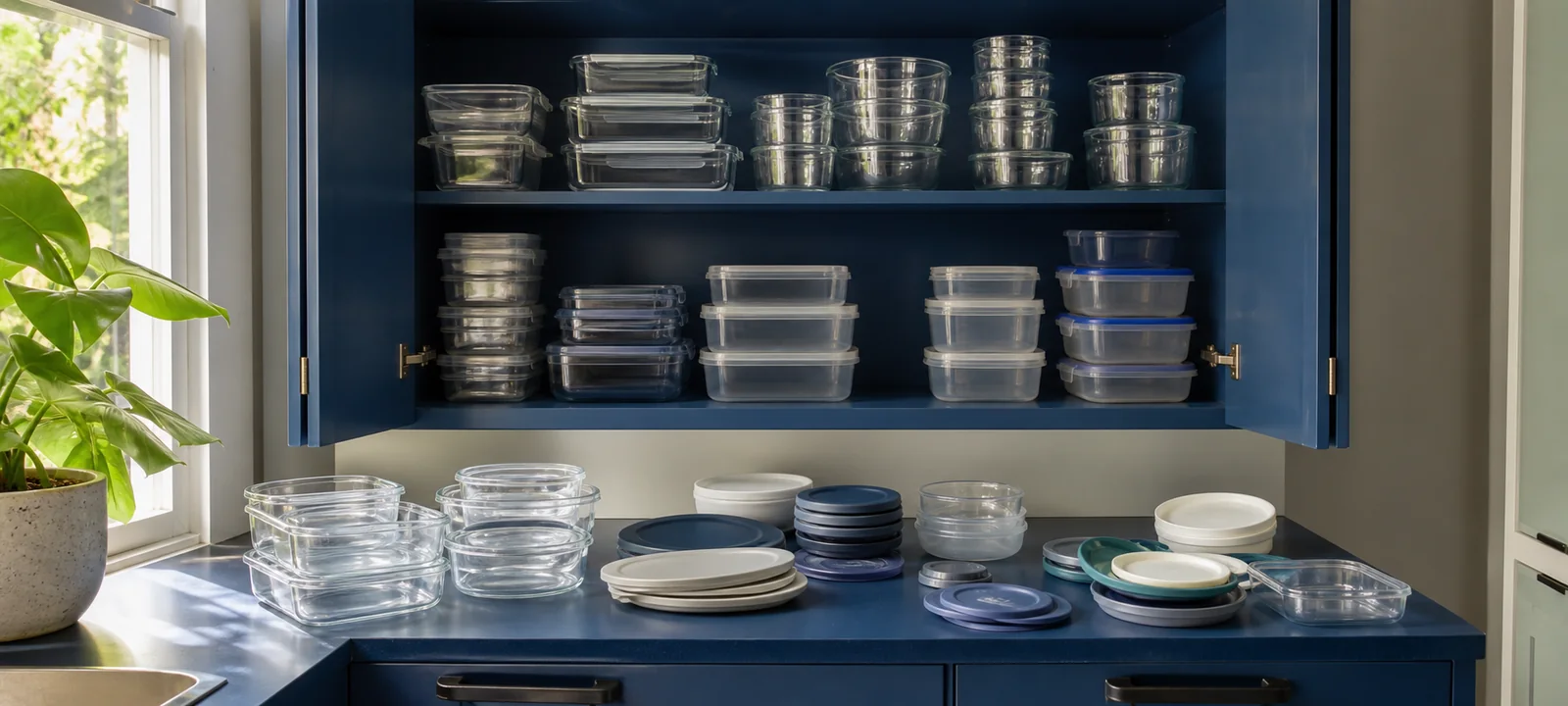
Food containers create two cupboards at once: one for bases and one for lids that might fit something. Add lunchboxes, drink-bottle parts and a few takeaway tubs, and a new matching set begins to look like the clean answer.
Empty the cupboard before replacing it. Match every lid, remove damaged pieces and identify the containers used for real leftovers, lunches and pantry staples. The useful gaps become clear only after the failed pieces leave.
For the broader kitchen plan, see Kitchen Storage That Makes Small Cupboards Easier to Use.
Put the whole collection in one place
Bring together bases, lids, lunchbox inserts, snack tubs, drink-bottle parts and pantry containers. Check the dishwasher, drying rack and school bags so the sort reflects the full collection rather than what happened to be in the cupboard.
Group by job before shape: leftovers, freezer use, lunches, pantry staples and occasional large batches. A container can stack beautifully and still have no role in the household.
Match every lid to a base
Pair each piece and test the closure. Set aside unmatched items briefly while the collection is checked, then remove those with no partner. Do not keep a deep lid pile indefinitely for a base that may reappear.
Multi-part lunchboxes need the same test. Confirm trays, seals, clips and bottle valves are present and fit the correct product.
Remove damage and failed seals
Follow the product's care and replacement guidance. Cracks, warping, damaged closures, deteriorated seals or surfaces that can no longer be cleaned properly are reasons to stop treating a piece as reliable food storage.
Check whether the container is intended for the proposed freezer, microwave, dishwasher or other use. Similar-looking plastics and glass products do not automatically share the same instructions.
Test stacking with lids included
Nesting bases saves space only when the matching lids remain easy to identify. Try the system the household will actually use: lids clipped on, stood vertically, or grouped beside each stack. Avoid a tower that must be completely removed to reach the common size.
Measure the final stack against shelf height, door opening and the hand space needed to lift it. A neat stack that catches the cupboard frame will not remain neat.
Separate lunches from leftovers
School and work lunch gear has a morning deadline. Keep complete lunchboxes, snack containers and relevant bottle parts together so packing does not begin with a lid search. Everyday leftover containers can occupy a separate, broader group.
Small inserts often disappear in utensil drawers. If a drawer is the right location, use the kitchen drawer guide before adding several tiny trays.
Treat pantry containers as a different system
Pantry containers remain full for longer and need labels, packet-volume checks and shelf clearance. Keep food names, dates and any cooking, allergen or storage information the household requires when decanting.
The pantry storage guide covers openings, hinges, risers and turntables as well as containers.
Keep enough for the actual cooking cycle
Count the leftovers normally stored after a busy cooking day, the lunches prepared at once and the few larger batches made regularly. Add a modest allowance for containers currently in the fridge or freezer; do not size the cupboard around a hypothetical maximum.
If every container is routinely in use, an additional compatible size may help. If many sit untouched, storage rather than quantity is the likely issue.
Be cautious with takeaway containers
Keep only items suitable for the reuse intended and follow any use or disposal information. Do not assume a takeaway package is designed for repeated heating, freezing or washing. When its purpose is uncertain, use an appropriate container instead.
Set a clear limit. A small group for a defined non-food or short-term task is different from a cupboard shelf that grows after every order.
Choose the storage method before the new set
Measure usable shelf width, depth, height and door clearance. Decide whether lids will stay on bases, stand in a rack or sit beside nested groups. Then compare any replacement shapes with that method.
A matching set can reduce variation, but may include tiny or oversized pieces the household never uses. Replacing only the failed common sizes can be the more useful choice.
Keep the drying rack from becoming storage
Containers need to dry fully before they are enclosed, but they should also have a cupboard they can return to. If clean pieces live on the bench for days, the cupboard is either too crowded or too difficult to reset. The bench space guide helps trace that overflow.
Use a rental kitchen without buying for one cabinet
Choose ordinary shapes and removable storage that can move between shelves or homes. Avoid custom racks or adhesives unless the lease, surface and instructions support them. The renter-friendly kitchen guide covers those checks.
Where container cupboards go wrong
- Unmatched lids and damaged pieces remain during the reorganisation.
- Lunchbox parts, leftovers and pantry decanting are treated as one category.
- Bases nest but lids become a second unsorted pile.
- A replacement set adds shapes the household does not use.
- Stacks fit the shelf but not the opening or lifting space.
- Takeaway containers accumulate without a defined, suitable purpose.
- Clean containers remain on the bench because cupboard return is too difficult.
A final check before replacing anything
- Every retained base has a working lid.
- Condition and intended-use instructions have been checked.
- Everyday leftovers and lunch routines have enough suitable sizes.
- The stack, lids and hand clearance fit the actual cupboard.
- New pieces will be compatible with the storage method.
A container cupboard does not need to match. It needs complete, suitable pieces that can be found, dried and returned. Sort first; replace only the gap the household can name.
Common Questions
What is the easiest way to organise food containers and lids?
Put the whole collection together, match every lid to a base and remove pieces with damage or failed seals. Separate lunch containers from leftover and pantry systems, then choose one repeatable position for complete sets. Storing unmatched lids neatly does not solve the problem; confirm that every retained piece has a partner and purpose.
How many food storage containers does a household need?
Keep enough for the actual cycle of leftovers, packed lunches, freezing and washing rather than an imagined maximum. Watch which sizes are still in use at the busiest point of the week. If many containers remain untouched while preferred ones are unavailable, the mix of sizes may be the problem rather than the total quantity.
Should food containers be stacked with their lids on?
The best method depends on the cupboard, but test the collection as complete sets before deciding. Lids stored separately need a stable position where they are easy to match; lids kept on bases use more volume but keep pairs together. Whichever method you choose should let the household return dry containers without rebuilding a complicated stack.