
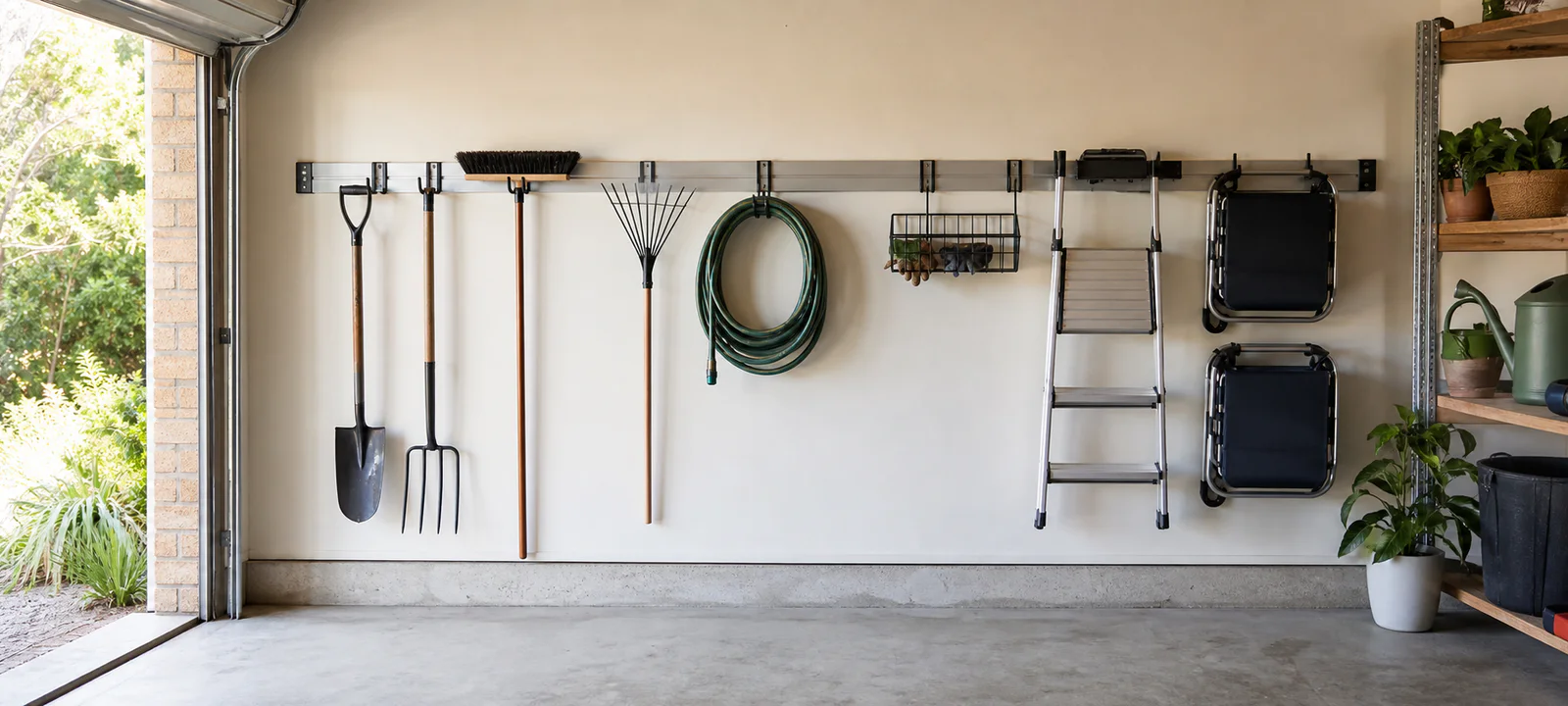
Wall storage earns its place when it removes an awkward item from the floor without moving the hazard to head or shoulder height. A bike, ladder or long-handled tool still occupies space after it is hung; that space now projects from the wall.
List the items first, including their weight and the person who will lift them. Then inspect the wall, choose fixings and a system rated for the load, and follow the installation instructions. Seek approval where rental or body corporate rules require it.
Measure protrusion with the car doors and walking route in use. Keep heavy equipment within sensible reach and leave services, switches and garage door mechanisms clear.
Start with the item on the floor
Bikes, ladders, long tools, folding chairs and sports equipment can be good wall-storage candidates. Ordinary tubs, heavy tool cases and products needing controlled conditions may be better elsewhere. The main garage guide helps decide whether wall storage is solving the room's real bottleneck.
For each candidate, record:
- weight, length, width and loaded depth
- how often it is used
- who needs to remove and return it
- where hands must grip during lifting
- whether it swings, rolls or has sharp edges
Identify the wall construction
A garage wall may be plasterboard, brick, concrete block, timber-framed, steel-framed, partly lined or shared with another property. Pipes, wiring and other services may sit behind the visible surface.
Match the product and its specified fixings to the actual construction. Do not substitute a generic anchor or assume a stud, cavity or masonry joint is where it appears to be. Heavy or awkward systems may call for qualified installation.
Read the whole load rating
Check the rated load for the hook, rail or panel, any rating per attachment point and the conditions under which the figure applies. The wall, fixing, system and stored item work as one chain; the lowest-capacity part determines the result.
Include accessories and anything carried on the item. A sports bag may be heavier when full, and a rail holding several garden tools carries their combined load. Follow installation and spacing instructions rather than concentrating weight wherever the wall looks convenient.
Mark the loaded projection on the floor
Measure from the wall to the furthest part of the stored item, not the empty hook. Open the car doors, walk the route indoors and operate the garage door. A tidy wall is not an improvement if handlebars, pedals or tool heads sit in the traffic zone.
Keep meters, fuse boxes, taps, power points, switches, door tracks, motors, lights and ventilation openings accessible. Leave enough surrounding space to inspect and service them.
Set the height by handling, not appearance
Frequently used gear should be reachable without climbing or lifting above a comfortable range. Heavy objects belong lower, but not where they create a trip or head-strike hazard. Light seasonal items may sit higher only when retrieval remains controlled.
Rehearse the full action with an empty mock position: approach, lift, align, secure and step away. If the user must twist beside the car or balance the load overhead, choose another height or storage method.
Give bikes and ladders their own test
For bikes, include handlebar and pedal projection, wheel size and the rider's ability to lift the frame. A floor stand may use more floor area but be far easier to reset after each ride.
For ladders, include full length and weight, the clearance needed to rotate them and a secure support method. Do not hang a ladder high simply because it is used infrequently; awkward removal can make that position unsuitable.
Match the system to the category
Single hooks
Useful for selected light items when each hook, fixing and wall position suits the load.
Rails
Allow a group of compatible hooks to be rearranged. Check the rail's total load and fixing spacing.
Pegboards or panels
Keep suitable hand tools visible near a bench. They need wall clearance and rated accessories as well as a sound fixing.
Specialised racks
May suit bikes, boards or ladders when the item, wall and user all meet the product requirements.
For tool-specific decisions, see Garage Tool Storage That Starts With Sorting.
Keep sharp and hazardous items controlled
Open wall storage is not suitable for every blade, powered tool, chemical or accessory. Consider access by children, pets and visitors, as well as the chance of an item falling or being grabbed without seeing a sharp edge.
Use cases, drawers or secure cabinets where controlled access is more important than visibility. Follow product labels and manufacturer guidance for hazardous products and batteries rather than treating wall storage as a universal answer.
Account for rentals and garage conditions
Renters and body corporate residents should confirm permission before drilling or changing a shared wall. Adhesive systems are not automatically damage-free and should not be stretched beyond their rated use.
Damp, heat, water entry and dust can also affect walls, fixings and stored equipment. Inspect the proposed area and keep sensitive tools elsewhere if garage conditions are unsuitable.
Tool-storage options when the wall is not the only answer
First group long-handled tools, mark their loaded projection and confirm whether the wall and lease permit the required fixing. If light items still need control, compare the adhesive gripper only on a compatible surface; where fixing is unsuitable, the freestanding rack provides a floor-based alternative.
Some links below are affiliate links. If you buy through one, we may earn a commission at no extra cost to you. Learn more.
Adhesive tool gripper
Command Broom Gripper, 2 Pack
A removable adhesive gripper for light handled tools on compatible smooth surfaces where drilling is not appropriate.
Research-supported option
View at Amazon AustraliaMay suit: light brooms and mops on smooth prepared surfaces.
May not suit: heavy garden tools or unsealed blockwork.
Drawbacks to consider:
- It is not suitable for heavy tools, dusty masonry or rough garage walls.
- Current dimensions, variant, price, stock and seller details should be rechecked before ordering.
Evidence confidence: moderate. Last reviewed 18 August 2026. Research-based assessment; we have not tested this product firsthand.
Freestanding long-tool rack
Traderight Garden Tool Storage Rack
A freestanding rack for consolidating long-handled tools without loading a wall, once the base footprint and tool count are checked.
Research-supported option
View at Amazon AustraliaMay suit: garages where wall fixings are unavailable.
May not suit: very narrow aisles or unusually heavy tools.
Drawbacks to consider:
- A freestanding rack consumes floor space and can become unstable if loaded unevenly.
- Current dimensions, variant, price, stock and seller details should be rechecked before ordering.
Evidence confidence: moderate. Last reviewed 18 August 2026. Research-based assessment; we have not tested this product firsthand.
Spot a wall system creating a new hazard
- the wall or fixing method has not been identified
- loaded gear projects into a car door or walking zone
- the user cannot comfortably return the item
- combined loads exceed a rail or panel rating
- services or garage door parts become obstructed
- sharp or hazardous items remain openly accessible
- drilling or surface changes lack required approval
Check the wall, fixing, load and reach together
- Choose only items that genuinely benefit from wall storage.
- Measure each item's weight, dimensions and loaded projection.
- Identify the wall and any hidden-service risk.
- Follow the complete fixing and load instructions.
- Mark vehicle, walkway and service clearances.
- Test whether the intended user can return the item.
- Obtain any rental or body corporate approval.
The useful wall is not the one holding the most gear. It is the one that frees the floor while keeping the load secure, the route clear and every item practical to return.
Common Questions
How do I know whether my garage wall can hold storage?
Identify the wall construction before choosing hooks, rails or panels, then follow the storage manufacturer's fixing and load instructions. Consider the combined weight of the system and gear, not just one item. If the wall or fixing method is uncertain, get appropriate installation advice rather than guessing from the surface.
Are hooks, rails or panels best for garage wall storage?
Single hooks suit a few stable items, rails make positions adjustable, and panels can support a changing group of lighter tools or accessories. Choose according to the category, loaded projection and return action. A flexible system is valuable only when every attachment remains compatible with its load and wall fixing.
Can bikes and ladders be stored safely on a garage wall?
They need their own handling test. Mark how far the loaded item projects, check the full weight and attachment rating, and set the height so one person can lift and return it without standing in a vehicle route. Keep sharp edges and moving parts away from heads, doors and walkways.