
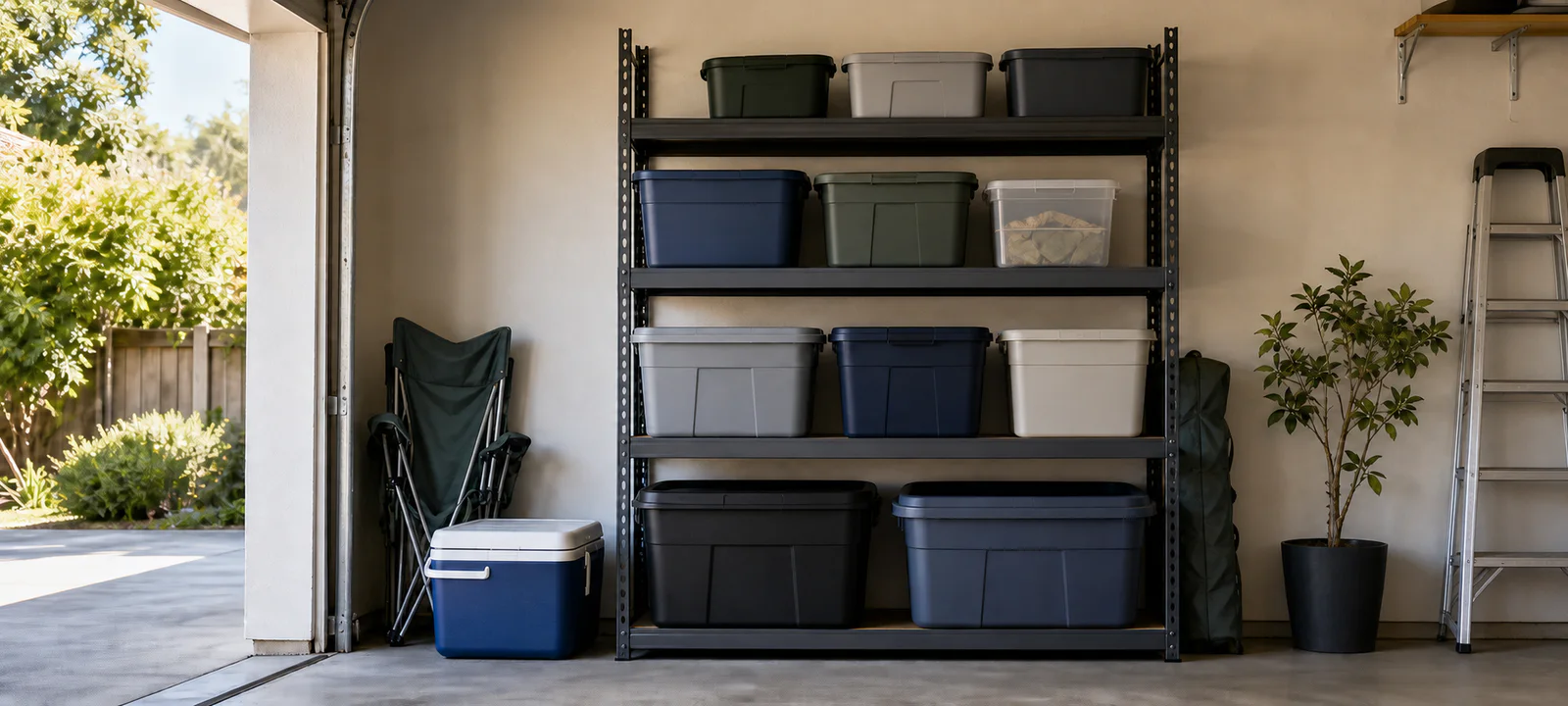
A wall of matching tubs can make a garage look finished while hiding years of postponed decisions. Outgrown sports gear, spare tiles, tangled cords and camping equipment are tidy only until somebody has to find one of them.
Open the existing containers and group their contents by when and how they return. Seasonal decorations can sit high and deep; tools used monthly cannot. Remove items that should not be in the garage before calculating how many tubs remain necessary.
Match each tub to its shelf and load. It needs a lid that closes, a label visible from the approach and a full weight somebody can lift safely. A new container is not progress if it simply gives an unsorted pile somewhere opaque to disappear.
Open every existing tub
Sort the contents into current, seasonal, duplicate, broken, unidentified and no longer needed groups. Match loose parts with the equipment they belong to, and follow appropriate disposal guidance for chemicals or questionable products.
Group what remains by use rather than broad type. A weekly soccer ball, summer beach games and an outgrown helmet should not share one container merely because they are all “sports”. The main garage guide can help assign access zones before new containers are chosen.
Decide whether a tub is the right tool
Tubs suit defined groups of clean, dry items that benefit from containment or dust protection. They are poor homes for bikes, ladders, long tools, daily balls, wet gear and anything too heavy to lift in a box.
Power tools may belong in their cases, sharp tools in controlled storage and hazardous products in arrangements that follow their labels. A container is not automatically safer because it has a lid.
Measure the shelf and the tub together
- external tub width, depth and height with the lid fitted
- handles, wheels or lips extending beyond the base
- clear shelf width, depth and bay height
- room to grasp, slide and lift the container out
- the shelf's load rating and the likely filled weight
- label visibility from the aisle
The guide to garage shelving covers car door clearance, floors and load distribution. A tub should sit fully supported; one that overhangs or scrapes the shelf above is the wrong size for that bay.
Choose visibility deliberately
Clear lidded box
Helps identify light, dry contents, but still needs a specific label. Check whether sun, heat and the garage conditions suit the plastic and the contents.
Opaque tub
Can make seasonal groups look calmer, but relies entirely on a visible, useful label. Avoid “miscellaneous” categories that invite unrelated items.
Open bin
Makes everyday light gear easy to return. It also exposes contents to dust and pests and should not become a catch-all in the walkway.
Small-parts case
Keeps a defined set of light fixings or accessories separated. Check latches, labels and whether compartments stay closed when the case is carried.
Let the full weight set the size
Very large tubs invite overloading. Tools, hardware, tiles, books, paint and bulk supplies can turn a manageable empty container into one that never leaves the floor. Use smaller boxes for dense items and keep them on lower, load-rated shelves.
Test the handles and carrying route with a realistic load. If the container must be dragged, tipped or unpacked before it can move, split the category.
Stack only as the product permits
Check the manufacturer's stacking and load guidance, lid fit and the level of the shelf or floor. Put lighter, less-used tubs above heavier ones and avoid a stack that must be dismantled every time the bottom box is needed.
Keep stacks away from car doors and main walkways, and consider whether children or pets can pull on them. “Stackable” describes a design feature, not an unlimited safe height.
Label the face, not only the lid
Use a specific label that can be read in the tub's storage position: “camping cooking gear” is more useful than “outdoor”. Labels should be easy to update and visible without moving the container above or beside it.
Large tubs can hold smaller labelled cases when one clear category contains many small parts. Do not use inner boxes to combine several unrelated groups under one vague heading.
Store only clean, dry contents
A lid can protect against dust while trapping moisture already inside. Dry towels, sports pads, beach gear, shoes and camping equipment before closing the tub. Check the garage for water entry, condensation, direct sun, heat and persistent damp before storing sensitive belongings there.
Containers also do not solve pest activity. Remove food residue and avoid casually storing food or pet treats in ordinary garage tubs. Deal with gaps and underlying pest problems rather than relying on plastic alone.
Keep hazardous products out of ordinary tub planning
Fuels, pesticides, pool chemicals, solvents, paints, oils, batteries, blades and other hazardous products require their own label and manufacturer guidance. Keep incompatible products separated where directed and restrict access by children and pets.
Avoid chemicals above head height or where a leak could damage other belongings. Do not decant products into unlabelled containers or assume an ordinary tub supplies the required ventilation or containment.
Recognise a neat stack hiding a backlog
- tubs are bought before the contents are sorted
- boxes overhang shelves or block the walkway
- labels are vague or visible only from above
- large tubs become too heavy to lift
- wet gear is sealed into closed storage
- stacks are unstable or hide frequently used items
- hazardous products are treated as ordinary contents
- every new container is full immediately
Garage container types to compare
Choose a container only after deciding whether the category needs visibility, a lid, airflow or smaller compartments. Hazardous products, fuels, batteries and chemicals are outside this ordinary container comparison and must follow their labels and specific storage guidance.
Clear lidded boxes
- May help with
- Light, dry categories that need visual identification before a box is pulled from the shelf.
- Measure first
- Shelf depth and height, box width and the extra clearance needed to remove the lid.
- Check before buying
- Loaded weight, handle access, label position and whether the plastic suits the garage conditions.
- Avoid if
- Sun or heat exposure is unsuitable, the contents are sensitive or visibility will replace proper labels.
Opaque lidded tubs
- May help with
- Clearly labelled seasonal groups that do not need to be seen every week.
- Measure first
- External tub and lid dimensions, shelf clearance and the weight of the full category.
- Check before buying
- Whether lids close without forcing, labels face the aisle and the tub can be lifted from its planned height.
- Avoid if
- The label will be vague, several unrelated categories will be mixed or the full tub will be too heavy.
Open bins
- May help with
- Frequently returned items such as balls, shoes or light outdoor gear that should not require opening a lid.
- Measure first
- The largest item, bin opening and the floor or shelf area available without narrowing access.
- Check before buying
- Whether contents need airflow, whether dust is acceptable and whether the bin is easy to empty and clean.
- Avoid if
- The items need protection from dust, moisture or pests, or the bin will become a mixed dumping zone.
Small-parts cases
- May help with
- Keeping a defined set of light fittings, fasteners or hobby parts separated inside a larger storage zone.
- Measure first
- The largest part, compartment depth and the shelf or drawer where the closed case will live.
- Check before buying
- Latch operation, label space and whether compartments remain separated when the case is carried.
- Avoid if
- The contents are heavy, sharp, hazardous or too varied for the compartment sizes.
Container options for a sorted category
First open the existing tubs, discard or relocate unsuitable contents and name the exact category that remains. If it genuinely needs containment, compare these clear and stackable boxes by shelf fit, full lifting weight, lid access and visibility; ordinary tubs are not a substitute for hazardous-product storage guidance.
Some links below are affiliate links. If you buy through one, we may earn a commission at no extra cost to you. Learn more.
Gasket-sealed storage tub
Sterilite 51L Gasket Box
A clear gasket-sealed tub measuring about 58.7 x 39.7 x 33 cm, suited to long-term garage storage once shelf depth and safe loaded lifting have been checked.
Research-supported option
View at Amazon AustraliaMay suit: bulkier lightweight items that need a clear, gasket-sealed garage container.
May not suit: dense hardware loads or shallow shelves where a smaller box is safer to handle.
Drawbacks to consider:
- A 51 L tub can become difficult to lift safely when filled with dense tools, hardware or liquids.
- The external dimensions and recessed lid must be checked against the shelf rather than relying on the nominal capacity.
Evidence confidence: moderate. Last reviewed 22 August 2026. Research-based assessment; we have not tested this product firsthand.
Stackable lidded storage box
Really Useful Box 19L Clear
A rigid clear box with clip handles for smaller garage categories that need visible, repeatable stack dimensions.
Research-supported option
View at Amazon AustraliaMay suit: small parts, cleaning refills and hobby supplies.
May not suit: bulky sporting gear or heavy power tools.
Drawbacks to consider:
- Nineteen litres is too small for bulky equipment and the tapered internal shape reduces usable space.
- Current dimensions, variant, price, stock and seller details should be rechecked before ordering.
Evidence confidence: moderate. Last reviewed 22 August 2026. Research-based assessment; we have not tested this product firsthand.
A container should make return easier
- keep only defined categories that genuinely need containment
- measure the shelf, lid, handles and lift-out room
- choose a size that remains manageable when full
- follow stacking and load guidance
- put a specific label on the visible face
- store clean, dry and suitable contents only
When a tub can be found, lifted and returned without opening three others, it is doing useful work. Otherwise it is simply a more uniform version of the garage pile.
Common Questions
What size storage tubs are best for garage shelves?
Measure the shelf opening, depth and spacing, then allow room to grip and remove each full tub. Choose a size that remains safe to lift when loaded rather than maximising empty volume. Several manageable containers are more useful than one oversized box that cannot be moved without unloading it.
Are clear or opaque tubs better for garage storage?
Clear tubs make contents visible, while opaque tubs reduce visual clutter and may better shield some items from light. Choose deliberately for the category, then label the front either way. Open bins suit frequently returned items; lidded tubs suit clean, dry contents that need more protection and are accessed less often.
Is it safe to stack garage storage tubs?
Stack only when the container maker allows it and the lids, bases and contents remain stable under the full load. Keep heavy tubs lower, preserve access to labels and avoid towers that must be dismantled for one item. A neat stack is not useful when the lower boxes are never opened.