
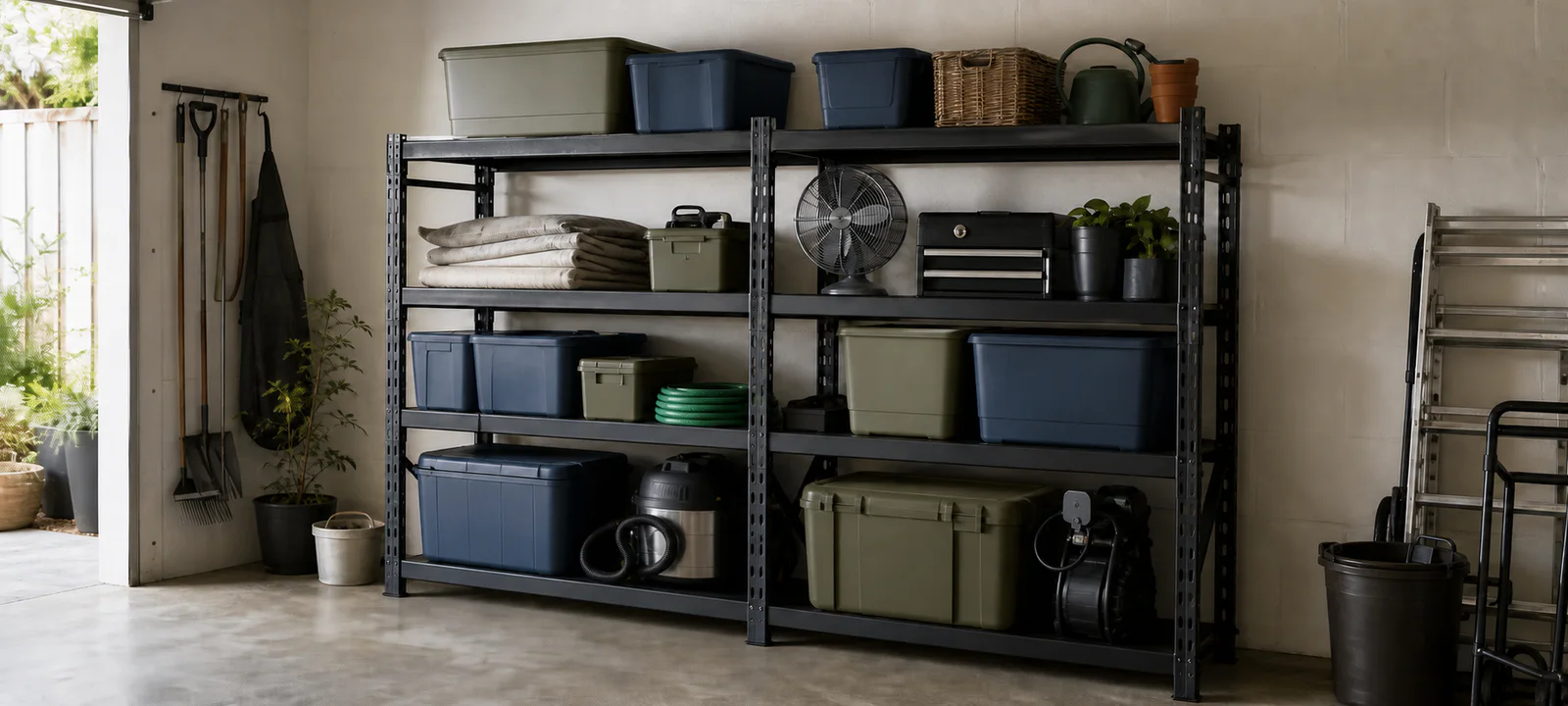
Garage shelving often fails in depth rather than width. A unit can fit neatly against the wall and still stop a car door opening, turn the walkway into a squeeze or leave tubs hanging over the shelf edge.
List what the shelves will carry and identify the heaviest load. Check the manufacturer's limits, the weight per shelf and any fixing requirements. Tall capacity is of little value if bulky boxes must be lifted down from an uncomfortable height.
Measure the wall, floor and approach with the garage in use. Uneven surfaces, moisture, roller-door tracks and nearby vehicles all belong in the decision, even when they are absent from the product dimensions.
Start with the load, not the wall
Make a rough inventory before comparing units. Light seasonal decorations have different needs from tools, paint tins, hardware, car care products and bulk supplies. Record the heaviest likely item and estimate how many will share each shelf.
Remove broken, duplicate and misplaced belongings first. The guide to sorting garage tubs can help separate real capacity needs from general overflow.
Set the maximum depth with the car parked
Open the vehicle doors, boot or tailgate and walk the route to the house. Measure from the wall to the boundary that storage must not cross, allowing a little tolerance for imperfect parking and bulky loads.
Check the proposed depth against:
- driver and passenger door clearance
- the main walkway and internal door
- bikes, bins, prams or a washing basket passing
- steps, drains and sloping floor sections
- power points, taps, switches, meters and fuse boxes
- garage door tracks and moving parts
The broader garage planning guide covers these room-wide zones. In many working garages, a shallower shelf offers more useful access than a deep rack with greater theoretical capacity.
Measure the containers as a system
Record each existing tub's width, depth and height with its lid fitted. Include handles, wheels and any lip that extends beyond the base. Work out how many fit side by side and how much vertical room is needed to lift or slide them out.
A tub should sit fully supported rather than overhang the shelf. Its label should remain visible from the aisle, and the loaded container should still be a manageable weight. Buying matching tubs later does not fix a bay that is the wrong height or depth now.
Read the load rating closely
Check maximum load per shelf and for the complete unit. Note whether the rating assumes an evenly distributed load, a level floor, a particular assembly method or anchoring to a wall. Do not infer capacity from thick uprights or a “heavy-duty” appearance.
Spread weight as instructed and keep the heaviest items on lower levels. Paint tins, hardware and bulk liquids become heavy quickly, particularly when several containers share one bay. A shelf that is safe in total can still be overloaded on one side or level.
Use height only where it remains usable
Check ceiling height, lights, door tracks, beams and pipes before choosing a tall unit. Then decide who will retrieve the contents and how. High shelves are best reserved for light, infrequently used items that can be handled without awkward climbing or reaching.
| Zone | Better suited to | Avoid |
|---|---|---|
| Top | light seasonal gear | heavy tubs, chemicals and blades |
| Knee to shoulder | frequent tools, pet and car care gear | items that protrude into the aisle |
| Lower | heavy tubs, hardware and bulk supplies | moisture-sensitive items near a damp floor |
Check the floor before the feet
Garage slabs may slope towards a door or drain, contain cracks or collect water. Inspect the exact position for unevenness, loose coatings and damp. Confirm what the manufacturer requires and whether the unit includes suitable levelling feet.
Do not improvise unstable packing under the legs. Avoid positions with regular water entry, and keep sensitive belongings away from the lowest shelf where garage conditions make that necessary.
Follow the anchoring instructions
A unit that looks freestanding may still require wall fixing, particularly when tall or heavily loaded. Check the instructions before buying, then identify the wall material, suitable fixing method and any hidden services.
Renters and body corporate residents should confirm permission before drilling. If the required anchoring cannot be installed correctly, choose a different unit rather than treating the instruction as optional.
Decide whether shelves are the right enclosure
Open shelving keeps labelled tubs and bulky gear visible. Cabinets may better suit tools, sharp objects or products needing controlled access, although doors add depth and require their own opening zone.
Chemicals, pesticides, fuels, batteries and other hazardous products should be stored in line with their labels and protected from inappropriate access. Avoid placing spill-prone or hazardous products above head height. A general shelf is not automatically suitable simply because the container fits.
Shelving options for the measured load
First remove items that do not belong in the garage and park the car while marking the maximum shelf depth and access aisle. If a defined load still needs open storage, compare these mobile and freestanding wire units by loaded rating, container fit, floor condition and anchoring instructions.
Some links below are affiliate links. If you buy through one, we may earn a commission at no extra cost to you. Learn more.
Mobile wire shelving unit
Amazon Basics 5-Shelf Shelving Unit on Castors
A five-tier wire unit on castors for dry garages where the floor is level and the loaded dimensions suit the planned aisle.
Research-supported option
View at Amazon AustraliaMay suit: dry garages needing adjustable mobile shelving.
May not suit: uneven floors or storage requiring enclosed dust protection.
Drawbacks to consider:
- Castors reduce static stability and the open wire shelves do not contain small items.
- Current dimensions, variant, price, stock and seller details should be rechecked before ordering.
Evidence confidence: moderate. Last reviewed 18 August 2026. Research-based assessment; we have not tested this product firsthand.
Freestanding wire shelving unit
Modular Chrome Wire Storage Shelf 1200 x 450 x 1800mm
A wide six-foot wire shelving format for measured garage walls where load distribution and floor levelling are planned.
Research-supported option
View at Amazon AustraliaMay suit: garages with a long clear wall and mixed tubs.
May not suit: tight corners or floors with a strong fall.
Drawbacks to consider:
- The 1200mm width needs a clear wall run and safe anchoring may still be appropriate.
- Current dimensions, variant, price, stock and seller details should be rechecked before ordering.
Evidence confidence: moderate. Last reviewed 18 August 2026. Research-based assessment; we have not tested this product firsthand.
Leave capacity for the routine
A unit packed tight on the first day has no working space. Leave enough room to slide out a tub, place down an incoming item and rotate seasonal gear without building a second stack on the floor.
If new shelving fills immediately, revisit what belongs in the garage. Capacity should make the stored collection easier to use, not guarantee that every item with no other home can remain.
Spot a unit that fits the wall but not the garage
- the depth narrows a car door zone or walkway
- tubs overhang or cannot be lifted from their bays
- load ratings or weight distribution are unclear
- the top shelves require awkward handling
- services or door tracks become obstructed
- the floor cannot support the unit as instructed
- required wall fixing is unsuitable or not permitted
- hazardous items would remain open or too high
Take the real load shopping
- maximum usable width, depth and height
- vehicle, door, walkway and service clearances
- dimensions and loaded weight of existing tubs
- heaviest item and expected weight per shelf
- manufacturer anchoring and floor requirements
- wall type and tenancy restrictions
- damp, dust and pest conditions
- which items need low, frequent or controlled storage
The best unit is not the tallest rack or the one with the boldest load claim. It is the shelf that carries the real collection without stealing the space needed to park, walk and reach the room's essential services.
Common Questions
How deep should garage shelving be?
Set the maximum depth with the car parked and its doors opening normally. Include the route to the house, bins, switches and anything else that must remain accessible. Then compare that limit with the containers or equipment to be stored. Extra-deep shelving is wasted when it steals safe movement space.
How do I know how much weight garage shelves can hold?
Read the manufacturer's load rating, whether it applies per shelf or to the complete unit, and any conditions for evenly distributed loads. Estimate the weight of full tubs and heavy equipment rather than empty containers. Do not mix ratings from different configurations, and keep the heaviest usable loads on lower shelves.
Do freestanding garage shelves need to be anchored?
Follow the shelving manufacturer's assembly and anchoring instructions for the exact unit. Check the wall construction, fixing method and floor before installation, especially where the surface slopes or is uneven. Do not treat a heavily loaded shelf as self-stabilising; incorrect loading can make a poorly set unit more hazardous.