
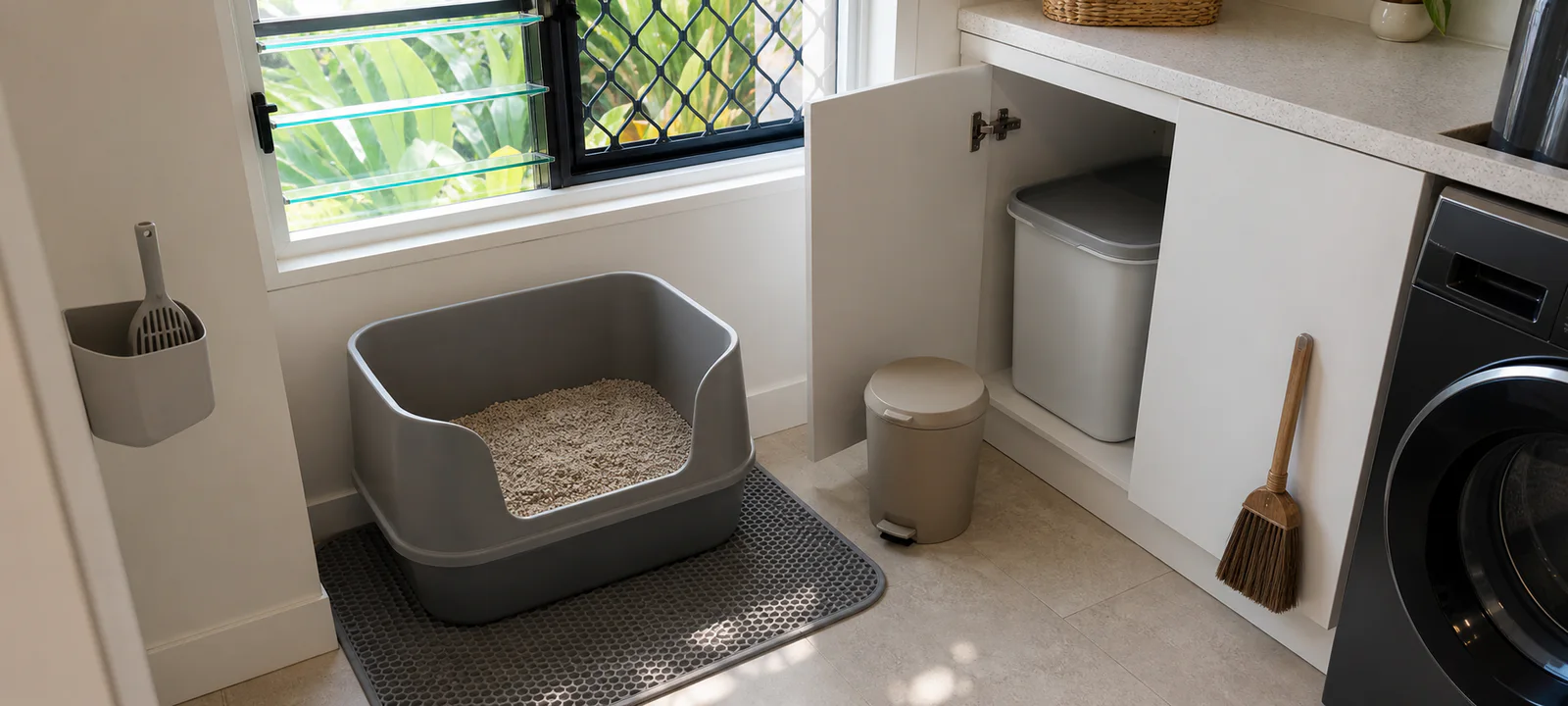
A litter tray has to work for the cat before it works for the room. A hidden position may look tidier but fail if the route is noisy, blocked or difficult to reach. A compact tray may fit the laundry yet leave too little room for the cat to turn and dig.
Plan the number and location first, then compare tray size, entry height, litter and cleaning access. The best setup is one the cat can use comfortably and the household can keep clean without constantly moving it.
For the wider feeding, resting and cleaning plan, start with pet essentials for Australian homes. This guide focuses on the tray decision and keeps the cat's access ahead of how discreet a product looks in the room.
Choose Quiet, Accessible Locations
Look for a position that offers some privacy without trapping the cat in a dead end. Avoid placing the tray beside food and water, in a route frequently blocked by a door, or next to a loud appliance that may start unexpectedly.
Check the route at different times of day. A laundry may be calm in the morning and crowded during washing. A bathroom door may be closed when guests visit. A balcony position may become inaccessible in bad weather or when the home is locked up.
Plan More Than One Tray Location
The RSPCA Knowledgebase litter tray guidance recommends at least two trays for one cat and, for multiple cats, one tray per cat plus one. Those trays should be in physically separate locations so one access problem does not affect them all.
Several trays lined up in one room do not provide the same choice as separate positions. In a multi-cat home, also consider whether one animal can watch or block the route used by another.
Measure the Cat as Well as the Room
The RSPCA guidance suggests starting with a large open tray around one-and-a-half times the cat’s length. The cat needs room to enter, turn and dig without pressing against every side.
Before buying, compare:
- internal tray dimensions rather than the outer footprint alone
- entry height for kittens, older cats or cats with reduced mobility
- space to turn and position comfortably
- whether a cover reduces usable room or traps odour
- how easily the tray can be lifted, emptied and washed
- clearance around doors, cupboards and appliances
Start Simply and Observe Preferences
Cats can have individual preferences for tray shape and litter. A large open tray with unscented litter is a practical starting point in the RSPCA advice, but the individual cat’s behaviour matters. Change one factor at a time so it is possible to tell what helped.
A covered tray may reduce visible scatter for the household, but some cats may find it cramped or less comfortable. A very high-sided tray may contain litter yet create an access problem for a kitten, older cat or an animal recovering from illness.
Make Daily Cleaning Realistic
Plan where the scoop, replacement litter and waste bags will live without placing them on food preparation surfaces. Keep the route to a bin practical, protect the nearby floor with a washable mat where useful and leave enough clearance to clean around the whole tray.
Remove urine and faeces daily and empty and clean the tray regularly, following the litter and tray instructions. Strong fragrances do not replace cleaning and may not suit the cat. Wash hands after handling the tray and seek health advice if someone in the household has particular infection-risk concerns.
Store Litter Without Creating Another Obstacle
Bulk litter can be heavy. Keep it dry, stable and close enough to refill the tray without awkward lifting, but do not narrow the cat’s route or the household walkway. Retain the product label and directions if litter is transferred into another container.
Check whether the container can be cleaned and lifted when full. A very large tub may look tidy but become impractical in a small laundry or apartment.
Plan for Apartments, Rentals and Shared Rooms
In a smaller home, physically separate locations may require using two different rooms rather than finding a single dedicated cat area. Prioritise the cat’s access, then use a simple mat, screen or furniture arrangement only if it does not turn the tray into a cramped enclosure.
Renters should protect floors with washable, non-slip solutions and avoid permanent cabinetry changes without approval. Ventilation matters, but an open window or balcony door should not be the only thing making the tray area usable.
Respond to Changes Instead of Blaming the Cat
If a cat begins toileting outside the tray, review access, cleanliness, tray number, litter and any recent household changes. Do not punish the cat. Persistent or sudden changes can have a medical cause, so seek veterinary advice rather than treating the problem only as cleaning or behaviour.
Review the setup when:
- a kitten grows and the tray becomes cramped
- an older cat finds the entry or route difficult
- another cat or pet joins the home
- doors, appliances or furniture change the access path
- the household cannot keep the current position clean
Litter-tray styles to compare after planning the locations
These are product types, not ranked recommendations. Retain the cat's existing acceptable options while comparing a new tray, and change one factor at a time.
Large open trays
- May help with
- A simple starting point with clear access, visibility and room to turn.
- Measure first
- The cat's length, the usable internal tray dimensions and the full floor area needed to enter and clean around it.
- Check before buying
- Entry height, base stability, corner shape, lifting points and whether the tray fits the cleaning and waste route.
- Avoid if
- The internal space is cramped or the household is relying on a small tray only because it fits a hidden position.
High-sided open trays
- May help with
- Cats that scatter litter or toilet near an edge while still needing an open route above the tray.
- Measure first
- Internal floor space and the lowest entry point, not only the outside height.
- Check before buying
- Whether the cat can enter comfortably, how the high sides affect lifting and where tracked litter will still land.
- Avoid if
- The entry is difficult for a kitten, older cat or cat with reduced mobility.
Low-entry trays
- May help with
- Cats that need an easier step into the tray while retaining enough internal turning space.
- Measure first
- Entry height, internal length and width, and the clear approach route.
- Check before buying
- Stability at the lowered edge, likely litter scatter and whether the tray remains practical to empty and wash.
- Avoid if
- The lower edge lets ordinary output or litter escape because the tray is otherwise too shallow or small.
Covered trays
- May help with
- Households considering a more visually contained tray when the individual cat accepts the enclosure.
- Measure first
- Internal length, width and height with the cover fitted, plus door and cleaning clearance.
- Check before buying
- Ventilation, entry size, ease of removing the cover and whether odour or waste becomes harder to inspect.
- Avoid if
- The cover reduces usable room, creates a difficult route or the cat shows a preference for an open tray.
Let the Cat’s Access Lead the Decision
A good litter setup is not defined by how thoroughly the tray disappears from view. It gives the cat a quiet choice of accessible locations, enough room to use the tray and a cleaning routine the household can maintain.
Plan those fundamentals before comparing covers, cabinets, automatic systems or decorative screens. If an enclosure makes access, inspection or cleaning harder, it has not improved the setup.
Common Questions
Where is the best place to put a cat litter tray?
Choose a quiet, accessible position that gives the cat some privacy without creating a blocked or dead-end route. Keep the tray away from food and water, loud appliances and doors that may be closed. Check the location at different times of day before making it permanent.
How many litter trays do cats need?
The RSPCA guidance cited in the article recommends at least two trays for one cat and, in a multi-cat home, one tray per cat plus one. Put them in physically separate locations so a closed door, noisy room or another animal cannot make every tray inaccessible at once.
How big should a cat litter tray be?
The cited RSPCA guidance suggests starting with a large open tray around one-and-a-half times the cat's length. Compare the usable internal space, entry height and room to turn rather than only the outer footprint. The tray must also be practical to lift, empty, wash and clean around.