
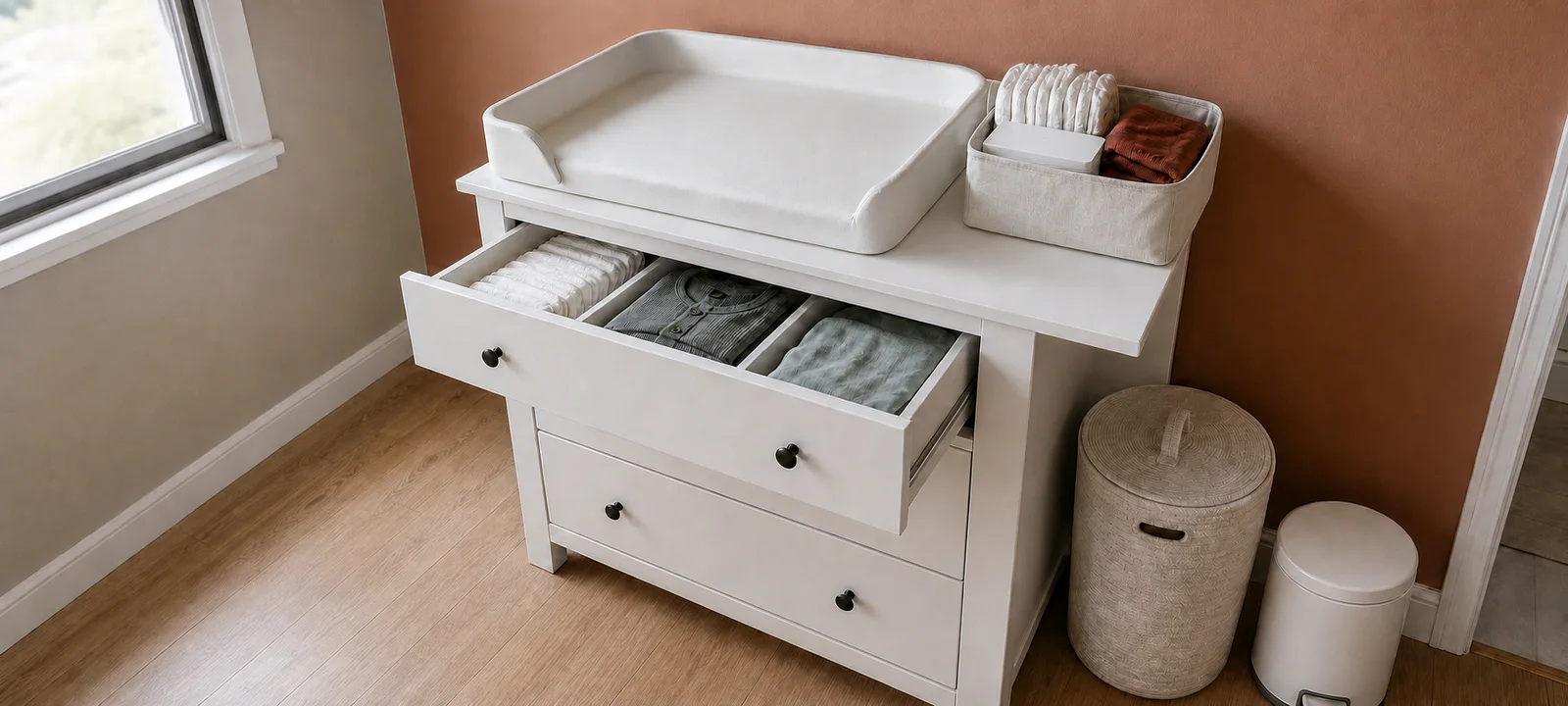
A change area earns its place at 2 am, after a bath and when the clean clothes are nearly gone. It does not need matching nursery furniture. It needs a stable changing surface, supplies within adult reach and somewhere obvious for used nappies and wet clothes.
That may be a dedicated change table, a mat used according to its instructions or a portable floor setup. Choose the arrangement that works where changes actually happen, then add storage only when the routine shows what is missing.
Keep the baby supported and the supplies close
The ACCC Product Safety guidance for bathing and changing says to keep at least one hand supporting the baby, never leave the baby alone or in the care of another child, and have supplies ready within arm's reach.
A strap or raised edge does not make it safe to step away. If something is missing, take the baby with you rather than leaving them on the changing surface.
Notice where changes happen
Some households use one fixed station. Others change the baby in the bedroom overnight and in a living area during the day. Track those locations for a few days before buying furniture.
- Is there enough light to see clearly?
- Can an adult reach nappies, wipes and a change of clothes without turning away?
- Does the surface remain stable when drawers or doors are opened?
- Can leaks and spills be cleaned without dismantling the setup?
- Where will used nappies, dirty clothes and washable covers go?
Test the room with drawers open and supplies in place. A table that blocks a wardrobe or leaves no room to stand beside it is not a useful addition.
Check the surface, height and stability
A change table, a mat used on suitable furniture and a floor setup create different trade-offs. Follow the instructions and limits for every table, mat or piece of furniture involved.
- Check that the setup does not rock, slide or interfere with drawers.
- Keep cords, blinds, heaters and unstable furniture away from the change area.
- Choose a surface or cover that can be cleaned after leaks and spills.
- Leave enough clear surface to change the baby without shifting bottles or baskets.
A portable mat on the floor avoids the fall risk of a raised surface, but it may be less comfortable for some adults. Choose the arrangement that can be used safely and consistently in the actual room.
Keep the daily kit small
The change area works best when the supplies used most often are easy to grab without searching through drawers.
- Nappies.
- Wipes.
- Barrier cream if used.
- Spare clothes.
- The household's chosen bin or bag system for dirty items.
- A small towel or cloth.
- A wipeable mat or washable cover.
- A nearby laundry basket or hamper.
Store bulk nappies, next-size clothes and spare wipes nearby but not necessarily on the changing surface. Keeping the immediate area clear makes the routine easier to repeat.
Give dirty items a short route out
Nappy changes create small mess often. The setup should make it obvious where dirty clothes, used wipes, empty packaging and washable covers go next.
Put a laundry basket or washable bag close enough to use immediately and empty the nappy bin or bag on a routine the household can maintain. Keep creams, plastic bags and other small items in a contained place that remains out of the child's reach.
Small rooms favour portable supplies
Small bedrooms, shared nurseries and rentals may not have room for a full change table. In those cases, focus on portable and compact storage.
A caddy can carry the daily supply between rooms while bulk nappies, next-size clothes and spare wipes stay in a wardrobe, laundry or nearby cupboard. One drawer or basket for spare clothes is often enough.
For compact room ideas, the nursery storage guide covers smaller rooms, rentals, wardrobes and supplies near the change area in more detail.
Night-time supplies need their own reset
Overnight changes need enough light to see clearly without turning the whole room into a storage zone. Keep a small supply of nappies, wipes and one change of clothes close to the night-time spot, then restock it during the day.
Restock the night supply during the day. In a shared bedroom or living area, use a contained caddy and return creams, bags and loose supplies to a place the child cannot reach.
A dedicated change table can wait
A dedicated change table can be helpful, but it is not the only way to create a practical change station.
- The nursery layout is still changing.
- The baby is mostly changed in another room.
- You already have a suitable dresser or surface.
- There is not enough room to move around extra furniture.
- A portable caddy would suit the household better.
If you do use a mat, dresser or furniture item for changing, follow the manufacturer's setup and use instructions.
The checklist before the first change
- Where most changes happen during the day and overnight.
- Whether nappies and wipes are easy for adults to reach.
- Whether spare clothes are close enough.
- Whether the changing surface is easy to wipe or cover.
- Whether dirty clothes and covers have a laundry spot.
- Whether bulk supplies can live somewhere else.
- Whether the room still has clear movement around furniture.
- Whether cords, heaters, unstable furniture and small items are out of reach.
- Whether the setup can be reset quickly.
Let the routine change the setup
Begin with nappies, wipes, one change of clothes and a clear route to cleaning and laundry. Move the caddy or restock point when the household routine changes. Furniture and organisers should follow that routine rather than decide it.
Common Questions
What do you need at a nappy change station?
Keep a small daily kit of nappies, wipes, cream if used, spare clothes, a cloth and the household's chosen system for dirty items. Use a stable, wipeable changing surface and place supplies within adult reach so the baby can remain supported throughout the change.
Do you need a dedicated change table?
Not necessarily. The article compares a dedicated table, a mat used on suitable furniture and a portable floor setup. Follow the instructions and limits for every item involved, then choose the arrangement that stays stable, fits the room and can be used consistently where changes really happen.
Where should spare nappies and change supplies be stored?
Keep only the working supply at the change point and store bulk packs elsewhere. The immediate area needs clear surface space, easy access to clean clothes and a short route for dirty nappies or wet laundry. Restock the small kit during the normal room reset rather than crowding it.