
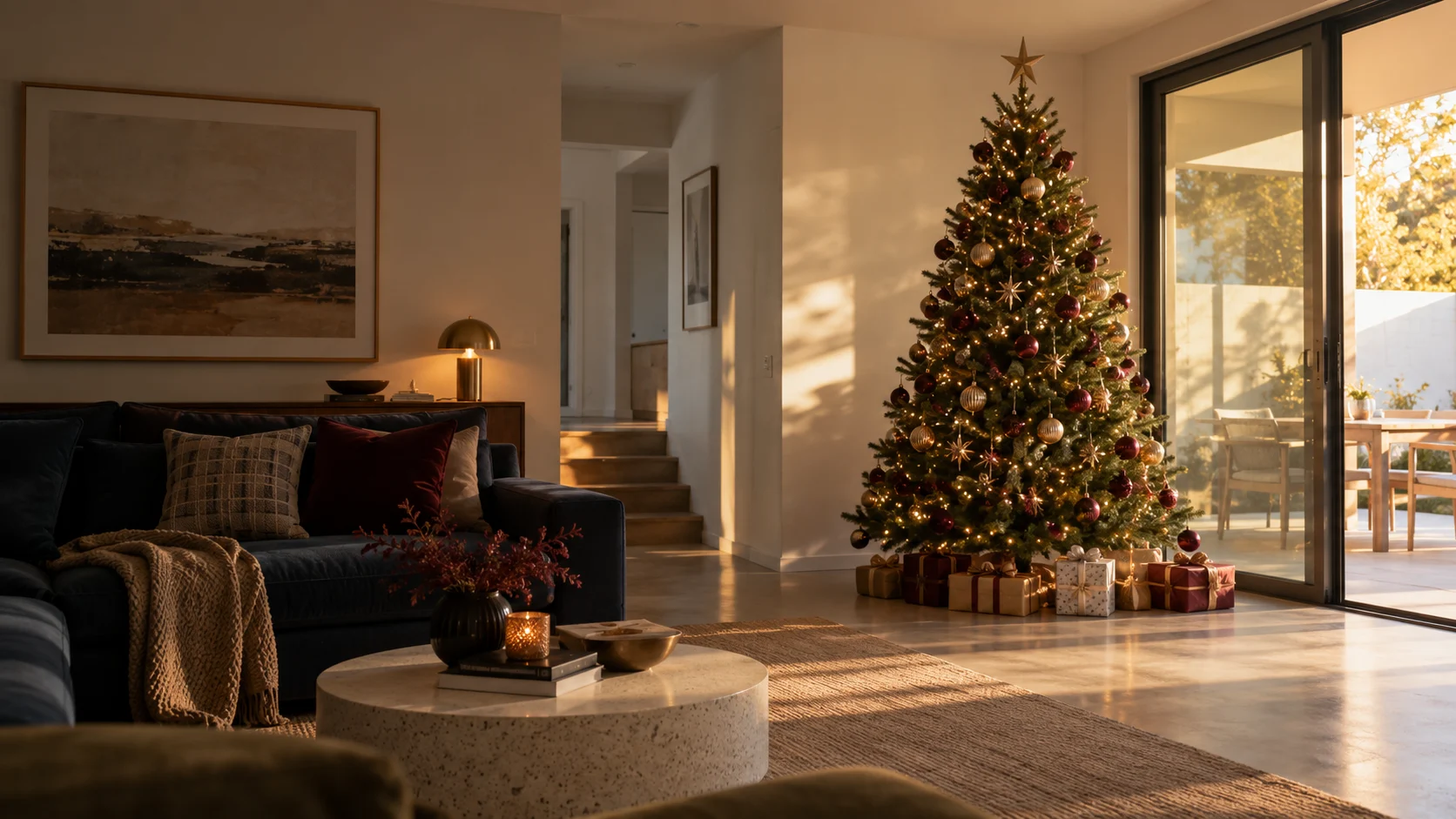
Image: Illustrative setting.
A Christmas tree has to share the room with everyday life: the sofa, the path to the back door and, eventually, a few more people around the table. Before choosing a taller tree or another box of decorations, work out what will fit, what you already have and where everything will go in January.
This Australian Christmas guide brings those decisions together, from tree measurements and lighting to a summer table and storage. It is planning guidance, rather than a review of trees or decorations we have tested.
Choose the position before the tree
Stand where the tree will go and look at the room as it will be used over Christmas. Open the nearby door, pull out a dining chair and walk between the lounge and kitchen. A corner that looks empty may be part of the route everyone uses.
Mark the proposed tree width on the floor with a suitable removable marker, such as low-tack tape tested on an inconspicuous area. Include the stand, a collar if you want one, and the presents. Leave the marking in place long enough to notice whether you keep stepping around it.
Keep exits clear. Position the tree away from heat sources and out of the sweep of curtains, doors and ceiling fans. Queensland's Christmas tree safety advice also recommends distributing heavy decorations evenly to reduce the risk of the tree falling over.
Measure height and width separately
Measure the ceiling at the actual display position; a bulkhead or sloping ceiling can reduce the available height. Then check how the manufacturer measures the assembled tree, including whether its stand is included.
As a starting point, Balsam Hill's tree buying guide suggests allowing at least 30 cm between the tree tip and ceiling, and says its tree heights include the stand. Treat this as a planning allowance, not a universal fit rule: your topper or a raised base may need more room.
A simple height example
A 240 cm ceiling minus a 30 cm allowance leaves 210 cm for the assembled tree, including its stand. A 230 cm tree would leave only 10 cm. Check the extra height the topper adds once fitted, rather than assuming its whole length sits above the tree.
Width needs its own measurement. Two trees of the same height can occupy very different amounts of floor space. Compare the widest assembled diameter, not the carton width or a photograph taken in a large showroom.
| Shape | Where it can work | What to check |
|---|---|---|
| Full | A generous living room or an open corner | The widest branches, stand and gifts still leave a usable walkway. |
| Narrow or slim | A smaller lounge or a position beside furniture | The actual diameter. “Slim” is a description, not a standard size. |
| Tabletop | A small room or a home with limited floor space | The combined height of the furniture, tree and topper, plus a stable base. |
Artificial or fresh: choose the routine you want
An artificial tree can be unpacked early and reused, but it needs storage throughout the year. Consider the weight of each section, how the branches attach, and the time needed to shape them. A tall tree that is easy to assemble in a showroom may be awkward to carry up your stairs.
A fresh cut tree offers natural variation and scent, but also needs water, needle clean-up and an end-of-season disposal plan. Ask the supplier about collection timing and care. Queensland fire guidance recommends adding water daily and removing a tree if it dries out. Check your council's current collection or green-waste rules before assuming it can go in the bin.
If you will be away for much of December, factor that into the choice. There is little value in a display that needs care nobody will be home to provide. There is also no need to replace an existing artificial tree simply to follow a new colour scheme.
Pre-lit or separate lights?
A pre-lit tree saves the job of winding separate light strings through the branches. Before buying, see the lights operating if possible: check the colour, brightness, available modes and whether the setting you like returns after the power is switched off.
The less visible decision is what happens if the lighting fails. Ask whether bulbs, light strings, the controller or transformer are replaceable, which parts the warranty covers, and how support works in Australia. Follow the supplied instructions; do not assume any spare transformer or connector will be compatible.
An unlit tree gives you more freedom to change the lights or replace a separate string. The trade-off is more work putting them on and taking them off. It may suit a household that changes between warm white and coloured lights, or already owns suitable lights in good condition.
Judge an artificial tree beyond the product photo
Look at photographs of the tree without decorations as well as the styled version. Dense ornaments and carefully positioned lights can hide gaps you would notice in daylight.
Check close-ups of the outer branches, colour variation and the trunk. Balsam Hill's buying guide distinguishes flat PVC needles from more dimensional moulded polyethylene (PE) needles. Materials can be mixed within one tree, so ask where each type is used rather than judging by a single percentage or tip count.
If viewing in person, ask to see how a branch supports a decoration similar in weight to your own. Also check the stand, branch hinges and assembly instructions. Realistic foliage does not answer whether the tree will be manageable to set up and store.
Refresh the decorations without replacing everything
Lay out the decorations you already enjoy. Pick one or two colours to repeat and let family ornaments remain part of the display. Burgundy with champagne, blue with silver, or red with natural textures can give the room a clear direction without making every ornament match.
Concentrate spending on what you will actually see: the tree, the entrance or the dining table. One finished area can feel more welcoming than small purchases scattered throughout the house.
Before buying a tree collar, check its internal opening against the stand and how it opens for assembly. For wreaths and garlands, check the finished weight and a hanging method suited to the surface. Renters should check their agreement before attaching fixtures.
Leave breakable decorations and small detachable pieces out of children's reach. Battery decorations deserve attention too: the ACCC recommends avoiding button battery products where possible if you have children, or choosing ones with child-resistant compartments and checking that the batteries remain secure.
Plan lights around the power supply and weather
Check the route to the power point before buying a longer light string. Indoor lights belong indoors, including when a veranda seems sheltered. For outdoor displays, check the suitability of every part: the lights, leads, connectors and transformer.
The Queensland Electrical Safety Office's Christmas lighting guidance explains that some outdoor lights still require their transformer to stay indoors. Follow the instructions for the exact set.
- Inspect old lights for damaged wiring, plugs and lamp holders before use. Do not use damaged equipment.
- Keep leads out of walking routes, doorways and windows where they could be damaged.
- Keep outdoor connections weatherproof and clear of pools or wet areas.
- Switch decorative lights off before bed or leaving home, and outdoor lights off in rain or storms.
Buy Australian-compliant equipment and check its intended use. A product photo showing lights outdoors does not establish that the set is suitable for your installation.
Make room for an Australian Christmas lunch
Style the table after deciding how food will be served. Put out the largest platter, water jug and serving bowls before adding a centrepiece. Keep decorations low enough for people to see across the table, and leave somewhere for hot dishes to land.
Cloth napkins, a runner and a few familiar ornaments can carry the same colours as the tree. Avoid buying a full set of Christmas tableware unless you have a place to store it and expect to use it.
For an outdoor meal, check where the shade falls at lunchtime, how people will move between the kitchen and table, and what can be brought inside quickly if the weather changes. Our outdoor entertaining area checklist covers the layout, shade and pack-down checks in more detail.
If using candles, keep them away from decorations and other combustible materials. Fire and Rescue NSW advises using a secure base and extinguishing candles when leaving the room and before bed. Flameless decorations avoid an open flame, but their batteries still need the checks above.
Buy for the whole season, including January
Compare the total delivered cost. A lower tree price may exclude the stand or storage bag, while a larger tree can also mean more lights and decorations. Check what is included instead of assuming a styled photograph shows the contents of the box.
Read dispatch estimates separately from delivery estimates, especially for regional addresses. Check return conditions and costs before ordering a bulky tree. Allow time to assemble and inspect it before the day you want the room ready.
Before packing away, photograph the arrangement you would like to repeat. Label the tree sections and keep the instructions, model details and compatible accessories together. Let decorations dry fully, protect fragile pieces and store everything according to its care instructions. Check whether the proposed garage, shed or roof space is suitable; being out of the way does not make it a good storage environment.
The storage bag or carton needs to fit through the doorway and onto the shelf when full. If that is awkward now, choose a smaller tree or a different storage position before committing to another annual lifting job.
Your Christmas planning checklist
Keep gift spending separate from the decorating budget. If you are choosing a practical home gift and local manufacture matters, the Australian-made gift guide explains how to check the origin claim, usefulness and delivered cost before ordering.
- Before shopping: measure the tree position and storage space, inspect what you own and set the complete budget.
- When comparing: check assembled dimensions, stand, lighting support, packed size and delivered price.
- When decorating: keep exits and walking routes clear, follow the lighting instructions and leave space for everyday use.
- Before guests arrive: test the table layout, check shade and prepare an indoor option if needed.
- At pack-down: dry, label and protect what you will reuse, and note any repairs or replacements for next year.
A good Christmas setup feels like part of your home. It leaves room for people, works with what you own and is manageable to put away when the season is over.